


Putin ordered campaign to influence prez election: US intel

January 7, 2017

Washington, Jan 7: The US intelligence community in a new declassified file today accused Russian President Vladimir Putin of ordering an "influence campaign" to help Donald Trump win the White House and denigrate his Democratic rival Hillary Clinton in a bid to undermine public faith in the American democratic process.
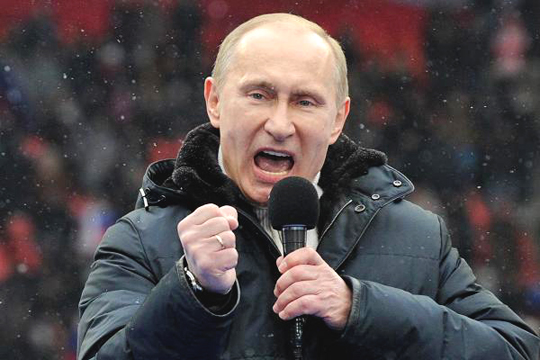
Putin

US President-elect Donald Trump was quick to refute the conclusion, saying hacking did not impact the November 8 presidential polls outcome.

"We assess Russian President Vladimir Putin ordered an influence campaign in 2016 aimed at the US presidential election," the Director of National Intelligence said in a report.

The 31-page report alleges that Russia's goals were to undermine public faith in the US democratic process, denigrate Democratic presidential candidate Hillary Clinton and harm her electability and potential presidency.

"We further assess Putin and the Russian government developed a clear preference for President-elect Trump. We have high confidence in these judgements," the US intelligence community said in the which was submitted to outgoing US President Barack Obama on Thursday.

Obama had ordered a comprehensive probe into allegations of Russian hacking the Democratic party's email system. A team of intelligence officials briefed Trump and Vice President-elect Mike Pence on the report in New York.

"While Russia, China, other countries, outside groups and people are consistently trying to break through the cyber infrastructure of our governmental institutions, businesses and organisations including the Democrat National Committee, there was absolutely no effect on the outcome of the election including the fact that there was no tampering whatsoever with voting machines," Trump said in a statement after the meeting.

"There were attempts to hack the Republican National Committee (RNC), but the RNC had strong hacking defences and the hackers were unsuccessful.

"I will appoint a team to give me a plan within 90 days of taking office. The methods, tools and tactics we use to keep America safe should not be a public discussion that will benefit those who seek to do us harm. Two weeks from today I will take the oath of office and America's safety and security will be my number one priority," Trump said, adding that there is a need to aggressively combat and stop cyberattacks.

Pence said Trump has made it very clear that the US is going to take aggressive action in the early days of the new administration to combat cyberattacks and protect the security of its citizens from this type of intrusion in the future.

The report alleged that Russian efforts to influence the 2016 US presidential poll represent the most recent expression of Moscow's longstanding desire to undermine the US-led liberal democratic order, but these activities demonstrated a significant escalation in directness, level of activity and scope of effort compared to previous operations.

"We also assess Putin and the Russian government aspired to help President-elect Trump's election chances when possible by discrediting secretary Clinton and publicly contrasting her unfavourably to him. All three agencies agree with this judgement. CIA and FBI have high confidence in this judgement; NSA has moderate confidence," the report said.

It said Moscow's approach evolved over the course of the campaign based on Russia's understanding of the electoral prospects of the two main candidates.

"When it appeared to Moscow that secretary Clinton was likely to win the election, the Russian influence campaign began to focus more on undermining her future presidency.

"Further information has come to light since election day that, when combined with Russian behaviour since early November 2016, increases our confidence in our assessments of Russian motivations and goals," it alleged.

Moscow's influence campaign followed a Russian messaging strategy that blends covert intelligence operations such as cyber activity with overt efforts by Russian government agencies, state-funded media, third-party intermediaries and paid social media users or "trolls", the report said.

"Russia, like its Soviet predecessor, has a history of conducting covert influence campaigns focused on US presidential elections that have used intelligence officers and agents and press placements to disparage candidates perceived as hostile to the Kremlin.

"We assess Moscow will apply lessons learned from its Putin-ordered campaign aimed at the US presidential election to future influence efforts worldwide, including against US allies and their election processes," the report said.

House Foreign Affairs Chairman Ed Royce said this report confirms what is already know, Putin's acts of aggression pose serious threats to vital US interests.

"The Obama administration's response to Putin's propaganda machine was weak and ineffective in Eastern Europe, and now we are paying the price here at home," Royce said.

Describing the intelligence community report on Russian hacking as stunning, House Minority Leader Nancy Pelosi wished that American people could have access to more details.

"The American people have a right to know what a foreign power did to disrupt our election, regardless of the election's outcome. Putin's assault on American democracy was political thuggery in support of Trump and there must be consequences," Pelosi said.

Comments

Add new comment

  • Coastaldigest.com reserves the right to delete or block any comments.
  • Coastaldigset.com is not responsible for its readers’ comments.
  • Comments that are abusive, incendiary or irrelevant are strictly prohibited.
  • Please use a genuine email ID and provide your name to avoid reject.
Agencies
August 7,2020

Russia boasts that it's about to become the first country to approve a Covid-19 vaccine, with mass vaccinations planned as early as October using shots that are yet to complete clinical trials -- and scientists worldwide are sounding the alarm that the headlong rush could backfire.

Moscow sees a Sputnik-like propaganda victory, recalling the Soviet Union's launch of the world's first satellite in 1957.

But the experimental Covid-19 shots began first-in-human testing on a few dozen people less than two months ago, and there's no published scientific evidence yet backing Russia's late entry to the global vaccine race, much less explaining why it should be considered a front-runner.

“I'm worried that Russia is cutting corners so that the vaccine that will come out may be not just ineffective, but also unsafe,” said Lawrence Gostin, a global public health law expert at Georgetown University. “It doesn't work that way... Trials come first. That's really important.”

According to Kirill Dmitriev, head of Russia's Direct Investment Fund that bankrolled the effort, a vaccine developed by the Gamaleya research institute in Moscow may be approved in days, before scientists complete what's called a Phase 3 study.

That final-stage study, usually involving tens of thousands of people, is the only way to prove if an experimental vaccine is safe and really works.

Health Minister Mikhail Murashko said members of “risk groups,” such as medical workers, may be offered the vaccine this month.

He didn't clarify whether they would be part of the Phase 3 study that is said to be completed after the vaccine receives “conditional approval.”

Deputy Prime Minister Tatyana Golikova promised to start “industrial production” in September, and Murashko said mass vaccination may begin as early as October.

Dr Anthony Fauci, the top US infectious disease specialist, questioned the fast-track approach last week.

“I do hope that the Chinese and the Russians are actually testing a vaccine before they are administering the vaccine to anyone, because claims of having a vaccine ready to distribute before you do testing I think is problematic at best," he said.

Questions about this vaccine candidate come after the US, Britain and Canada last month accused Russia of using hackers to steal vaccine research from Western labs.

Delivering a vaccine first is a matter of national prestige for the Kremlin as it tries to assert the image of Russia as a global power capable of competing with the US and China.

The notion of being “the first in the world” dominated state news coverage of the effort, with government officials praising reports of the first-step testing.

In April, President Vladimir Putin ordered state officials to shorten the time of clinical trials for a variety of drugs, including potential coronavirus vaccines.

According to Russia's Association of Clinical Trials Organizations, the order set “an unattainable bar” for scientists who, as a result, "joined in on the mad race, hoping to please those at power.”

The association first raised concern in late May, when professor Alexander Gintsburg, head of the Gamaleya institute, said he and other researchers tried the vaccine on themselves.

The move was a “crude violation of the very foundations of clinical research, Russian law and universally accepted international regulations" the group said in an open letter to the government, urging scientists and health officials to adhere to clinical research standards.

But a month later, the Health Ministry authorized clinical trials of the Gamaleya product, with what appeared to be another ethical issue.

Human studies started June 17 among 76 volunteers. Half were injected with a vaccine in liquid form and the other half with a vaccine that came as soluble powder.

Some in the first half were recruited from the military, which raised concerns that servicemen may have been pressured to participate.

Some experts said their desire to perform well would affect the findings. “It's no coincidence media reports we see about the trials among the military said no one had any side effects, while the (other group) reported some," said Vasily Vlassov, a public health expert with Moscow's Higher School of Economics.

As the trials were declared completed and looming regulatory approval was announced last week, questions arose about the vaccine's safety and effectiveness.

Government assurances the drug produced the desired immune response and caused no significant side effects were hardly convincing without published scientific data describing the findings.

The World Health Organization said all vaccine candidates should go through full stages of testing before being rolled out.

“There are established practices and there are guidelines out,” WHO spokesman Christian Lindmeier said Tuesday.

“Between finding or having a clue of maybe having a vaccine that works, and having gone through all the stages, is a big difference.”

Offering an unsafe compound to medical workers on the front lines of the outbreak could make things worse, Georgetown's Gostin said, adding: “What if the vaccine started killing them or making them very ill?”

Vaccines that are not properly tested can cause harm in many ways — from a negative impact on health to creating a false sense of security or undermining trust in vaccinations, said Thomas Bollyky, director of the global health program at the Council on Foreign Relations. 

Comments

Add new comment

  • Coastaldigest.com reserves the right to delete or block any comments.
  • Coastaldigset.com is not responsible for its readers’ comments.
  • Comments that are abusive, incendiary or irrelevant are strictly prohibited.
  • Please use a genuine email ID and provide your name to avoid reject.
News Network
June 11,2020

Jun 11: The total death toll in the US from the novel coronavirus pandemic could hit the grim figure of 200,000 by September and expecting a dramatic decrease in COVID-19 cases in the country will be a "wishful thinking , an eminent Indian-American professor has warned.

Ashish Jha, the head of Harvard's Global Health Institute, told CNN on Wednesday that he is not trying to scare people to stay at home rather urged everyone to wear masks, adhere to the social distancing rules and called for ramping up testing and tracing infrastructure.

Anybody who's expecting a dramatic decrease in cases is almost surely engaging in wishful thinking. And if it (COVID numbers) stays just flat for the next three months, we're going to hit 200,000 deaths sometime in September and that is just awful, Jha said.

Jha said the 200,000 death toll is not just a guess . Currently 800-1000 people are dying daily in America from the virus and all data suggest that the situation is going to get worse.

We're gonna have increases, but even if we assume that it's going to be flat all summer, that nothing is going to get worse... even if we pick that low number of 800 a day, that is 25,000 (deaths) a month in three and a half months. We're going to add another 88,000 people and we will hit 200,000 sometime in September, Jha said.

The United States is by far the hardest-hit country in the global pandemic, in terms of both confirmed infections and deaths.

According to data by the Johns Hopkins University, the number of coronavirus cases in the US currently is nearly two million and about 112,900 people have died in the country, the most in the world.

When asked about an improvement in states like New York, which had been the epicenter of the COVID19 pandemic in the US, Jha said while coronavirus cases are declining in New York, New Jersey, Connecticut and Massachusetts, the numbers are increasing in states such as Arizona, Florida, Texas, North and South Carolina while the country as a whole is pretty flat.

He said, people should take measures as that will help suppress the virus and ensure people could get back outside safely but he voiced concern that this was not the situation in reality.

We're not doing that and so we're going to unfortunately have another 25,000 deaths a month until September, and then it'll keep going. It's not going to magically disappear. We've got a turn around. This is not the future I want, he said.

Jha said he had expected the situation to improve in the summer months but on the contrary the numbers have continued to rise even in the warm weather.

Summer was supposed to be our better months - warmer weather, people outside, a little less transmission. This is not the time (summer) I was expecting a lot more cases. We're seeing a lot more cases, especially in states like Arizona where the numbers look really scary, he said.

Jha added that he was hopeful that maybe the summer months would give us more of a break. I think I may have been too optimistic on that.

Comments

Add new comment

  • Coastaldigest.com reserves the right to delete or block any comments.
  • Coastaldigset.com is not responsible for its readers’ comments.
  • Comments that are abusive, incendiary or irrelevant are strictly prohibited.
  • Please use a genuine email ID and provide your name to avoid reject.
News Network
March 4,2020

Tokyo, Mar 4: Takeda Pharmaceutical Co said on Wednesday it was developing a drug to treat COVID-19, the flu-like illness that has struck more than 90,000 people worldwide and killed over 3,000.

The Japanese drugmaker is working on a plasma-derived therapy to treat high-risk individuals infected with the new coronavirus and will share its plans with members of the U.S. Congress on Wednesday, it said in a statement.

Takeda is also studying whether its currently marketed and pipeline products may be effective treatments for infected patients.

"We will do all that we can to address the novel coronavirus threat...(and) are hopeful that we can expand the treatment options," Rajeev Venkayya, president of Takeda's vaccine business, said in the statement.

Takeda said it was in talks with various health and regulatory agencies and healthcare partners in the United States, Asia and Europe to move forward its research into the drug.

Its research requires access to the blood of people who have recovered from the respiratory disease or who have been vaccinated, once a vaccine is developed, Takeda said.

Comments

Add new comment

  • Coastaldigest.com reserves the right to delete or block any comments.
  • Coastaldigset.com is not responsible for its readers’ comments.
  • Comments that are abusive, incendiary or irrelevant are strictly prohibited.
  • Please use a genuine email ID and provide your name to avoid reject.