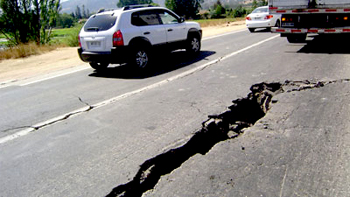
Quake sows panic in Papua New Guinea, tsunami threat passes

May 5, 2015

Sydney, May 5: A 7.4 magnitude earthquake struck off Papua New Guinea today, sending frightened residents fleeing from their homes, but a threatened tsunami passed without incident, seismologists said.

magnitude quake

The quake struck 133 kilometres (83 miles) south-southwest of the town of Kokopo in the New Britain region at a depth of 63 kilometres, the US Geological Survey said, and was followed by a 5.9 magnitude aftershock.

The Pacific Tsunami Warning Center initially warned that "hazardous tsunami waves" were possible but in a later update said "the tsunami threat has now mostly passed".

Mathew Moihoi, a seismologist at the PNG Geophysical Observatory, said the latest quake followed a series of seismic activity in the region in recent weeks but there had been no reports of major damage to buildings or infrastructure.

"Some things fell off the shelves," he told AFP.

Annette Sete, who lives in Kokopo, said there had been powerful tremors recently "but this latest one was big".

"Schools shut and kids sent home, many homes had the interiors turned upside down. A number of power lines down and trees fallen but no reports of casualties yet," she said.

Zenia Lopez, a worker at the Kokopo Village Resort, said she and her colleagues ran outside when the quake struck, but there was no damage to their resort.

"It was frightening, we all ran outside, but the place is okay, there is no damage," she said.

A receptionist at the Seaview Beach Resort in Kokopo added to AFP before the phone line cut off that "we felt the earth shaking" but that "everything was okay".

The quake hit in the remote New Britain area near Rabaul, but Moihoi said he did not think it was related to an active volcano some 110 kilometres away.

"Right now, we think it's tectonic in origin," he said. "Whether it develops a flow-on effect... we just don't know right now."

Kokopo, the capital of East New Britain, has a population of around 20,000. It started to grow after Rabaul was flattened by volcanic eruptions in 1994.

Last week, a 6.8 earthquake hit off Kokopo after a 6.7 tremor struck off the same area on Thursday. There was no reported damage.

Geoscience Australia senior seismologist Jonathan Bathgate told AFP the region had been very active recently and noted that a 7.7 magnitude earthquake occurred on March 30, generating a local tsunami. Again, there was no major damage reported.

"We can't predict earthquakes but this area is in a very active sequence. This could be the biggest earthquake that's been building up over the last few months, but there could be another larger earthquake," Bathgate added.

Comments

Add new comment

  • Coastaldigest.com reserves the right to delete or block any comments.
  • Coastaldigset.com is not responsible for its readers’ comments.
  • Comments that are abusive, incendiary or irrelevant are strictly prohibited.
  • Please use a genuine email ID and provide your name to avoid reject.
Agencies
February 11,2020

The head of the World Health Organisation on Tuesday warned the novel coronavirus was a "very grave threat" for the world as he opened a conference to combat the epidemic.

"With 99% of cases in China, this remains very much an emergency for that country, but one that holds a very grave threat for the rest of the world," Tedros Adhanom Ghebreyesus said in Geneva.

Some 400 scientists will review how the virus is transmitted and possible vaccines at the two-day forum.

"What matters most is stopping the outbreak and saving lives. With your support, that's what we can do together," Tedros said.

The virus, first identified in China on December 31, has killed more than 1,000 people, infected over 42,000 and reached some 25 countries.

Participants will also discuss the source of the virus, which is thought to have originated in bats and reached humans via another animal such as snakes or pangolins.

There is no specific treatment or vaccine against the virus, which can cause respiratory failure.

Tedros, who has repeatedly urged countries affected to share their data, called for global "solidarity".

"That is especially true in relation to the sharing of samples and sequences. To defeat this outbreak, we need open and equitable sharing, according to the principles of fairness and equity," he said.

"We hope that one of the outcomes of this meeting will be an agreed roadmap for research around which researchers and donors will align," Tedros said.

Several companies and institutes in Australia, China, France, Germany and the United States are racing to develop a vaccine -- a process that normally takes years.

Asked whether scientists from Taiwan would be allowed to take part in this week's Geneva conference, WHO officials said that they would do so but only online -- along with colleagues from other parts of China.

While the WHO does not deal with Taiwan directly and only recognises Beijing, Taiwan was often allowed to attend annual assemblies and sideline meetings as an observer.

But in recent years it has been frozen out as Beijing takes an increasingly combative stance towards democratic Taiwan, which it considers its own territory.

Comments

Add new comment

  • Coastaldigest.com reserves the right to delete or block any comments.
  • Coastaldigset.com is not responsible for its readers’ comments.
  • Comments that are abusive, incendiary or irrelevant are strictly prohibited.
  • Please use a genuine email ID and provide your name to avoid reject.
News Network
March 28,2020

Berlin, Mar 28: The number of confirmed coronavirus infections worldwide topped 600,000 on Saturday as new cases stacked up quickly in Europe and the United States and officials dug in for a long fight against the pandemic.

The latest landmark came only two days after the world passed half a million infections, according to a tally by John Hopkins University, showing that much work remains to be done to slow the spread of the virus. It showed more than 602,000 cases and a total of over 27,000 deaths.

While the U.S. now leads the world in reported infections — with more than 104,000 cases — five countries exceed its roughly 1,700 deaths: Italy, Spain, China, Iran and France.

“We cannot completely prevent infections at this stage, but we can and must in the immediate future achieve fewer new infections per day, a slower spread,” German Chancellor Angela Merkel, who is in quarantine at home after her doctor tested positive for the virus, told her compatriots in an audio message. “That will decide whether our health system can stand up to the virus.”

The virus already has put health systems in Italy, Spain and France under extreme strain. Lockdowns of varying severity have been introduced across Europe. Merkel's chief of staff, Helge Braun, said that Germany — where authorities closed nonessential shops and banned gatherings of more than two in public — won't relax its restrictions before April 20.

As the epicenter has shifted westward, the situation has calmed in China, where some restrictions on people's lives have now been lifted. Six subway lines restored limited service in Wuhan, where the virus first emerged in December, after the city had its official coronavirus risk evaluation downgraded from high to medium on Friday. Five districts of the city of 11 million people had other restrictions on travel loosened after their risk factor was downgraded to low.

For most people, the coronavirus causes mild or moderate symptoms, such as fever and cough that clear up in two to three weeks. But for others, especially older adults and people with existing health problems, the virus can cause more severe illness, including pneumonia, and lead to death.

More than 130,000 people have recovered, according to Johns Hopkins' tally.

In one way or another, the effects of the COVID-19 outbreak have been felt by the powerful and the poor alike.

On Friday, British Prime Minister Boris Johnson became the first leader of a major country to test positive for the virus. He said he would continue to work from self-quarantine.

Countries are still scrambling bring home some citizens stranded abroad by border closures and a near-shutdown of flights. On Saturday, 174 foreign tourists and four Nepali nationals on the foothills of Mount Everest were flown out days after being stranded on the only airstrip serving the world's highest mountain.

In neighboring India, authorities sent a fleet of buses to the outskirts of the capital to meet an exodus of migrant workers desperately trying to reach their home villages during the world's largest lockdown.

Thousands of people, mostly young male day laborers but also families, had fled their New Delhi homes after Prime Minister Narendra Modi announced a 21-day lockdown that began on Wednesday and effectively put millions of Indians who live off daily earnings out of work.

In a possibly hopeful sign, the U.S. Food and Drug Administration cleared a new rapid test from Abbott Laboratories, which the company says can detect the coronavirus in about 5 minutes. Medical device maker Abbott announced the emergency clearance of its cartridge-based test Friday night, saying the test delivers a negative result in 13 minutes when the virus is not detected.

While New York remained the worst-hit city in the U.S., Americans braced for worsening conditions elsewhere, with worrisome infection numbers being reported in New Orleans, Chicago and Detroit.

New Orleans’ sprawling Ernest N. Morial Convention Center, along the Mississippi River, was being converted into a massive hospital as officials prepared for thousands more patients than they could accommodate.

In New York, where there are more than 44,000 cases statewide, the number of people hospitalized with COVID-19 passed 6,000 on Friday, double what it had been three days earlier.

Gov. Andrew Cuomo called for 4,000 more temporary beds across New York City, where the Jacob K. Javits Convention Center has already been converted into a hospital.

The struggle to defeat the virus will take “weeks and weeks and weeks,” Cuomo told members of the National Guard working at the Javits Center.

President Donald Trump invoked the Defense Production Act on Friday, ordering General Motors to begin manufacturing ventilators. Trump had previously rejected Cuomo's pleas for tens of thousands more of the machines and the governor's calls to implement the Korean War-era production law.

Trump signed a $2.2 trillion stimulus package, after the House approved the sweeping measure by voice vote. Lawmakers in both parties lined up behind the law to send checks to millions of Americans, boost unemployment benefits, help businesses and toss a life preserver to an overwhelmed health care system.

Dr. John Brooks of the U.S. Centers for Disease Control and Prevention warned Americans remained “in the acceleration phase” of the pandemic and that all corners of the country were at risk.

"There is no geographic part of the United States that is spared from this," he said.

Comments

Add new comment

  • Coastaldigest.com reserves the right to delete or block any comments.
  • Coastaldigset.com is not responsible for its readers’ comments.
  • Comments that are abusive, incendiary or irrelevant are strictly prohibited.
  • Please use a genuine email ID and provide your name to avoid reject.
News Network
June 19,2020

United Nations, Jun 19: Half of the world's children -- one billion every year -- are affected by physical, sexual or psychological violence, suffering injuries and death because countries have failed to follow established strategies to protect them, the first report of its kind from the UN has said, with experts noting that the coronavirus-related lockdowns have left far too many youngsters stuck with their abusers.

While nearly all countries (88 per cent) have laws in place to protect minors, less than half (47 per cent) say they strongly enforce them, said the Global Status Report on Preventing Violence Against Children 2020 launched on Thursday.

Because countries have failed to follow established strategies to protect children, about one billion are affected each year by physical, sexual or psychological violence, it said.

"There is never any excuse for violence against children," WHO Director-General Tedros Adhanom Ghebreyesus said.

"We have evidence-based tools to prevent it, which we urge all countries to implement. Protecting the health and well-being of children is central to protecting our collective health and well-being, now and for the future," he said.

The report -- launched by the World Health Organisation, the UNICEF, the UNESCO, the Special Representative of the UN Secretary-General on Violence against Children and the End Violence Partnership -- charted progress in 155 countries against the "INSPIRE" framework, a set of seven strategies for preventing and responding to violence against children.

The report signaled a clear need in all countries to scale up efforts to implement them. It included the first ever global homicide estimates specifically for children under 18 years of age -- previous estimates were based on data that included 18 to 19-year olds.

According to the findings, in 2017, around 40,000 children were victims of homicide.

"Violence against children has always been pervasive, and now things could be getting much worse," UNICEF Executive Director Henrietta Fore said.

"Lockdowns, school closures and movement restrictions have left far too many children stuck with their abusers, without the safe space that school would normally offer. It is urgent to scale up efforts to protect children during these times and beyond, including by designating social service workers as essential and strengthening child helplines," she said.

UNESCO Director-General Audrey Azoulay said during the COVID-19 pandemic, and the related school closures, "we have seen a rise in violence and hate online – and this includes bullying".

"Now, as schools begin to re-open, children are expressing their fears about going back to school. It is our collective responsibility to ensure that schools are safe environments for all children. We need to think and act collectively to stop violence at school and in our societies at large," Azoulay said.

Stay-at-home measures including school closures have limited the usual sources of support for families and individuals such as friends, extended family or professionals.

This further erodes victims’ ability to successfully cope with crises and the new routines of daily life. Spikes in calls to helplines for child abuse and intimate partner violence have been observed, the report said.

While online communities have become central to maintain many children's learning, support and play, an increase in harmful online behaviors including cyberbullying, risky online behavior and sexual exploitation have been identified.

“Whilst this report was being finalised, confinement measures and the disrupted provision of already limited child protection services exacerbated the vulnerability of children to various forms of violence," said Najat Maalla M’jid, Special Representative of the UN Secretary-General on Violence against Children.

Of the INSPIRE strategies, only access to schools through enrolment showed the most progress with 54 per cent of the countries reporting that a sufficient number of children in need were being reached in this way.

Between 32 per cent and 37 per cent of the countries considered that victims of violence could access support services, while 26 per cent of the countries provided programmes on parent and caregiver support; 21 per cent of the countries had programmes to change harmful norms; and 15 per cent of the countries had modifications to provide safe physical environments for children, the report said.

Although a majority of countries (83 per cent) have national data on violence against children, only 21 per cent used these to set baselines and national targets to prevent and respond to violence against children, it added.

The report said about 80 per cent of countries have national plans of action and policies but only one-fifth have plans that are fully funded or have measurable targets. A lack of funding combined with inadequate professional capacity are likely contributing factors and a reason why implementation has been slow.

"Ending violence against children is the right thing to do, a smart investment to make - and it's possible. We can and must create a world where every child can thrive," Howard Taylor of the End Violence Partnership said.

Comments

Add new comment

  • Coastaldigest.com reserves the right to delete or block any comments.
  • Coastaldigset.com is not responsible for its readers’ comments.
  • Comments that are abusive, incendiary or irrelevant are strictly prohibited.
  • Please use a genuine email ID and provide your name to avoid reject.