



From ragpicker to speaker in Geneva conference

June 17, 2015

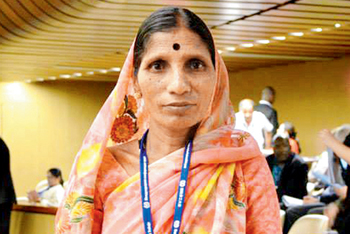
Suman More's life has been a rags-to-recognition journey. As an illiterate, impoverished ragpicker from Pune, the 50-year-old could never have imagined that she would one day be the centre of attention at a conference held all the way in Geneva by the International Labour Organisation. Just the past fortnight, over 2,000 experts from all over the world listened enthralled, as she spoke about her work and the challenges she, and many like her, faced in finding acceptance and a voice in society.

“I thought it was just us ragpickers who were not treated properly, but during the conference, I learnt about many other people – like hairstylists and weavers – who were also struggling to find their voice,” said Suman, who has spent the past 37 years collecting and sorting waste.
ragpicker1

“There were more than 2,000 people from across the world and I was the only one in a sari. The most difficult issue was sitting in the air conditioned room, as I am not used to it. But I managed. Everyone appreciated me and the Indian culture, and the next day, they even tried on my saris,” she added.

At the 104th session of the International Labour Conference held from June 1 to 13, Suman was one of the esteemed speakers, invited to speak about her work to an elite gathering of experts and leaders from around the world. This is starkly different from the past, when she could not even find a job as a cleaner or labourer because of her caste and was harassed for being a ragpicker.

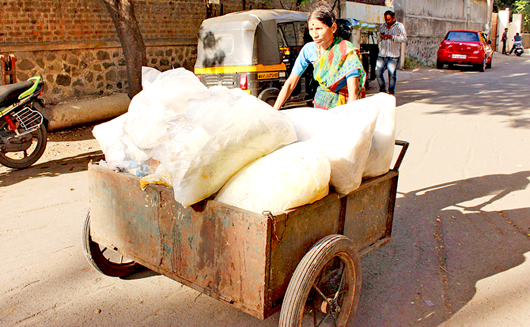
Suman hails from Kalamb village in Usmanabad district, where her parents would work in farms for daily wages. When a drought hit the village, however, jobs began drying up and Suman and her family moved to Pune in search of work. Her husband was from the potraj community (a tribe of nomads) and would barely gather enough alms to provide one meal a day. Suman was refused jobs on account of her caste and eventually began picking up waste like iron rods and other scrap material to eke out a living. After collecting scrap for nine hours, she would make barely R30-40 a day, far short of what was needed to keep a family of six afloat.
ragpicker2

“I came to Pune so we could beat the hunger we had experienced in our village. But it was hard; we couldn't find jobs because of out caste, so I started collecting waste. Later, I realised that if the scrap is segregated properly, it can fetch a better price,” Suman recalled.

Years later, this same lesson would come into play when ragpickers joined hands with the local municipality to manage the city's waste. Instead of the corporation collecting and moving the garbage to waste management centres, ragpickers from across the city do the task both faster and more economically. Since this tie-up, life has become smoother for waste collectors who faced great harassment from citizens and the police in the early days.

“While picking up the waste, many a time people use to complain or call us thieves and we were dragged to the police station for no reason. Many a time, the police used to humiliate us as well,” said Suman, adding that things began to improve after activists set up the organisation Kagad, Kach, Patra, Kashtakari Panchayat (KKPKP) to fight for ragpickers' rights. Where wastepickers would earn about R20-40 a day in the past, they now earn R5,000 a month, are accorded more respect and are even provided with identity cards to help them do their jobs with dignity.

Suman wanted to ensure her children never had to meet the same fate, and scrimped and saved to put her kids through school.

“I was illiterate but I did not want my children to have a similar life, so I worked day and night and we skipped one meal a day to make sure they went to school,” she said, proudly adding that of her four kids, one is a journalist with a double Masters degree, another is a graduate preparing for the civil services exams, a third son is a Bcom student, while her daughter is married.

Although her children are now doing well and the family even owns an apartment in Pune, they continue to live in Suman's old home in Gultekdi, a shanty that has now been converted to a brick-and-mortar two-room house.

'Proud of her'

Suman's daughter-in-law Shweta, who teaches at a Pune college, said, “We all tell Aai (Suman) not to work as we are earning well, but she tells us her work gives her joy. All her salary is used to support the education for underprivileged kids in the slum areas, and she personally visits them to ensure they go to school. I am proud of her.”

Comments

Add new comment

  • Coastaldigest.com reserves the right to delete or block any comments.
  • Coastaldigset.com is not responsible for its readers’ comments.
  • Comments that are abusive, incendiary or irrelevant are strictly prohibited.
  • Please use a genuine email ID and provide your name to avoid reject.
Agencies
February 23,2020

Google has indexed invite links to private WhatsApp group chats, meaning anyone can join various private chat groups (including several porn-sharing groups) with a simple search.

According to a report in Motherboard, invitations to WhatsApp group chats were being indexed by Google.

The team found private groups using specific Google searches and even joined a group intended for NGOs accredited by the UN and had access to all the participants and their phone numbers.

Journalist Jordan Wildon said on Twitter that he discovered that WhatsApp's "Invite to Group Link" feature lets Google index groups, making them available across the internet since the links are being shared outside of WhatsApp's secure private messaging service.

"Your WhatsApp groups may not be as secure as you think they are," Wildon tweeted on Friday, adding that using particular Google searches, people can discover links to the chats.

According to app reverse-engineer Jane Wong, Google has around 470,000 results for a simple search of "chat.whatsapp.com", part of the URL that makes up invites to WhatsApp groups.

WhatsApp spokesperson Alison Bonny said: "Like all content that is shared in searchable public channels, invite links that are posted publicly on the internet can be found by other WhatsApp users."

"The links that users wish to share privately with people they know and trust should not be posted on a publicly accessible website," Bonny told The Verge.

Danny Sullivan, Google's public search liaison, tweeted: "Search engines like Google & others list pages from the open web. That's what's happening here. It's no different than any case where a site allows URLs to be publicly listed. We do offer tools allowing sites to block content being listed in our results."

Comments

Add new comment

  • Coastaldigest.com reserves the right to delete or block any comments.
  • Coastaldigset.com is not responsible for its readers’ comments.
  • Comments that are abusive, incendiary or irrelevant are strictly prohibited.
  • Please use a genuine email ID and provide your name to avoid reject.
Agencies
January 25,2020

New Delhi, Jan 25: The Patiala House court on Saturday started hearing a plea filed by the Nirbhaya convicts that alleged that the Tihar Jail administration have "not presented the papers on time".

The Public Prosecutor informed the court that Tihar Jail authorities have already supplied the relevant documents. He further informed that these are mere delaying tactics adopted by the convicts.

Advocate A.P. Singh, lawyer for three of the four death row convicts in the Nirbhaya gang-rape case had moved an application before the court seeking directions to the Tihar Jail authorities to supply him the relevant documents in order to exercise the remaining legal remedies available with the death row convicts -- Vinay Pawan and Akshay.

The Public Prosecutor also told the court that he spoke to the jail authorities over the phone and a report in this regard will be filed shortly as the jail officials were on their way to the court.

The judge demanded from the convicts lawyer to show what he has filed.

The convicts lawyer, A.P. Singh, said that he received some documents, but has still not been supplied with the personal diary of one of the convict -- Vinay Kumar Sharma and also the medical documents.

Judge then asked the lawyer to wait for until the report arrives form the Tihar Jail.

On this, the convicts lawyer said he was not questioning the intention of the jail. "I know the jail has been changed. It isn't there fault, too," he said.

The Public Prosecutor refuted the allegation saying that the defence counsel was trying to defeat the speed of law.

"We have supplied all the documents to the counsel. We have supplied all the documents except the painting and some other documents. We have nothing apart from that," public prosecutor said.

Singh, in his plea filed before the Patiala House Court sought urgent orders of the court in order to file a mercy petition of Vinay Sharma and in relation to requests for documents for convicts Vinay Sharma, Pawan Kumar Gupta and Akshay Kumar Singh.

He further said that the convicts undertook several steps to obtain relevant information necessary for filing the mercy petitions. In regular interval, the convicts requested the concerned authority to supply documents pertaining to their medical records from 2012 to 2015 and 2019-2020, records of cellular confinement, records of the amount earned in prison through labour, records of educational and reformative activities like Tihar Olympics and Painting, etc.

The Supreme court had recently dismissed the curative petition for the other two convicts -- Vinay Kumar Sharma (26) and Mukesh Singh (32).

The court had recently issued death warrant against the convicts and fixed 6 a.m. on February 1 as the date and time of execution of the death penalty.

The 23-year-old victim in the case was brutally gang raped and tortured on December 16, 2012, which later led to her death. All the six accused were arrested and charged with sexual assault and murder. One of the accused was a minor and appeared before a juvenile justice court, while another accused committed suicide in Tihar Jail.

Four of the convicts were sentenced to death by a trial court in September 2013, and the verdict was confirmed by the Delhi High Court in March 2014 and subsequently upheld by the Supreme Court in May 2017, which also dismissed their review petitions.

A Juvenile involved in the crime was convicted by a juvenile justice board and released from a reformation home after serving a three-year term.

Hearing in a different case, Chief Justice of India S.A. Bobde on Thursday said a condemned person cannot fight the death penalty endlessly and it was important for the capital punishment to reach its finality.

The death penalty, he noted, cannot be questioned at every turn by the convict.

Comments

Add new comment

  • Coastaldigest.com reserves the right to delete or block any comments.
  • Coastaldigset.com is not responsible for its readers’ comments.
  • Comments that are abusive, incendiary or irrelevant are strictly prohibited.
  • Please use a genuine email ID and provide your name to avoid reject.
Agencies
July 2,2020

Paris, Jul 2: Several interacting exoplanets have already been spotted by satellites. But a new breakthrough has been achieved with, for the first time, the detection directly from the ground of an extrasolar system of this type.

An international collaboration including CNRS researchers has discovered an unusual planetary system, dubbed WASP-148, using the French instrument SOPHIE at the Observatoire de Haute-Provence (CNRS/Aix-Marseille Universite).

The scientists analysed the star's motion and concluded that it hosted two planets, WASP-148b and WASP-148c. The observations showed that the two planets were strongly interacting, which was confirmed from other data.

Whereas the first planet, WASP-148b, orbits its star in nearly nine days, the second one, WASP-148c, takes four times longer. This ratio between the orbital periods implies that the WASP-148 system is close to resonance, meaning that there is enhanced gravitational interaction between the two planets. And it turns out that the astronomers did indeed detect variations in the orbital periods of the planets.

While a single planet, uninfluenced by a second one, would move with a constant period, WASP-148b and WASP-148c undergo acceleration and deceleration that provides evidence of their interaction.

The study will shortly be published in the journal Astronomy & Astrophysics.

Comments

Add new comment

  • Coastaldigest.com reserves the right to delete or block any comments.
  • Coastaldigset.com is not responsible for its readers’ comments.
  • Comments that are abusive, incendiary or irrelevant are strictly prohibited.
  • Please use a genuine email ID and provide your name to avoid reject.