



Rahul may get another chance to prove himself

January 5, 2015

Sydney, Jan 5: If K L Rahul was looking for an assurance after essaying perhaps three of the worst shots by a debutant Test batsman, he would have found them in the words of the now-retired Test captain MS Dhoni shortly after the drawn Melbourne Test.
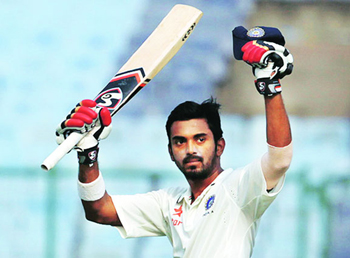
Rahul chance

“We are not deciding on him depending on just this one match, we will have to give him more matches and he is definitely someone who looks good,” he said when asked about what he made of Rahul’s debut.

You would have forgiven the right-hander when he first swept Nathan Lyon in the first innings and the resultant top-edge was floored by Peter Siddle.

You may blame it on nervous energy – it was a Boxing Day Test, the venue was the fabled Melbourne Cricket Ground where even empty seats intimidate you more than a full-house stadium in England or New Zealand, he was batting at No 6 instead of his usual opening slot and he had been handed a Test cap ahead of the experienced Suresh Raina.

When he repeated the same shot off the very next ball, this time to only get out, you may have thought he had suffered brain-freeze. If you were frustrated with the manner of his batting, you would have been seething in anger when he miscued a pull off Mitchell Johnson in the second innings. Rahul had been sent ahead of Cheteshwar Pujara at No 3 and he had thrown away a golden opportunity just like that.

It’s of course easy, and even justified to some extent, to get infuriated with his approach to batting but the team management may well give him another go for he is too good a player to be cast aside after just one bad show.

During India’s first practice session after the third Test here at the Sydney Cricket Ground on Sunday, Rahul got another extended run in the ‘nets’ after starting with the first batch. After finishing with his batting stint, the 22-year-old had a long discussion with team director Ravi Shastri whose suggestions obviously carry a lot of weight in the dressing room. Often, what you see during India’s practice sessions is not what you get, but still it was an encouraging sign from the batsman’s point of view.

For those who have seen Rahul play for various age-group sides of Karnataka, his home State, it was bizarre to see him bat the way he did. It didn’t make any sense because it was just not him.

When he raked in over 1000 runs during Karnataka’s victorious Ranji Trophy campaign in the last season he hardly played a stroke in anger; even when he had gone past the three-figure mark on three occasions. He is a level-headed person and has an unflappable temperament. That’s why he has had so much success as an opener. Yes, he does like to keep himself busy but not necessarily by playing extravagant shots. Maybe, as Dhoni pointed out, he just wanted to play the release shot and get going.

“We shouldn’t really judge him on just one performance,” Dhoni had stressed. “He is someone who really looks very compact and good. And this is the era of cricketers where they want to play the shots to get out of pressure situations. It can be taken as a positive and also he is someone who loves playing his strokes, so overall I was quite happy with his approach. It didn’t pay him in this game but he is definitely someone for us to look ahead in the future,” he had reasoned.

Fair point. If those shots had come off well, people would have been appreciating his positive attitude for a debutant but the problem is when they don’t you look awful and you really have no excuse to offer. Rahul should back his ability and play his natural game which is to play the ball on its merit and not fall for the bait.

In the first innings, Steven Smith had brought the field up and asked Lyon to toss up the ball to lure the batsman into clearing the field and in the second innings Johnson perhaps played on his ego and did him in with a bouncer. Hopefully he would have learnt his lessons and bat more with some responsibility, if he gets another opportunity to play.

Comments

Add new comment

  • Coastaldigest.com reserves the right to delete or block any comments.
  • Coastaldigset.com is not responsible for its readers’ comments.
  • Comments that are abusive, incendiary or irrelevant are strictly prohibited.
  • Please use a genuine email ID and provide your name to avoid reject.
News Network
June 18,2020

Jun 18: Sri Lanka "sold" the 2011 World Cup final to India, the country's former sports minister said on Thursday, reviving one of cricket's most explosive match-fixing controversies. Mahindananda Aluthgamage, who was sports minister at the time, is the second senior figure to allege the final was fixed, after 1996 World Cup-winning skipper Arjuna Ranatunga. "I tell you today that we sold the 2011 World Cup finals," Aluthgamage told Sirasa TV. "Even when I was sports minister I believed this."

Aluthgamage, sports minister from 2010 to 2015 and now state minister for renewable energy and power, said he "did not want to disclose" the plot at the time.

"In 2011, we were to win, but we sold the match. I feel I can talk about it now. I am not connecting players, but some sections were involved," he said.

Sri Lanka lost the match at Mumbai's Wankhede stadium by six wickets. Indian players have strongly denied any wrongdoing.

Ranatunga, who was at the stadium as a commentator, has previously called for an investigation into the defeat.

"When we lost, I was distressed and I had a doubt," he said in July 2017. "We must investigate what happened to Sri Lanka at the 2011 World Cup final."

"I cannot reveal everything now, but one day I will. There must be an inquiry," added Ranatunga, who said players could not hide the "dirt".

Sri Lanka batted first and scored 274-6 off 50 overs. They appeared in a commanding position when Indian superstar Sachin Tendulkar was out for 18.

But India turned the game dramatically, thanks partly to poor fielding and bowling by Sri Lanka, who were led by Kumar Sangakkara.

Sri Lankan cricket has regularly been involved in corruption controversies, including claims of match-fixing ahead of a 2018 Test against England.

Earlier this month, the Sri Lankan cricket board said the International Cricket Council was investigating three unnamed former players over alleged corruption.

Sri Lanka introduced tough penalties for match-fixing and tightened sports betting restrictions in November in a bid to stamp out graft.

Another former sports minister, Harin Fernando, has said Sri Lankan cricket was riddled with graft "from top to bottom", and that the ICC considered Sri Lanka one of the world's most corrupt nations.

Former Sri Lankan fast bowler Dilhara Lokuhettige was suspended in 2018 for corruption relating to a limited-overs league.

He was the third Sri Lankan charged under the ICC anti-corruption code, following former captain and ex-chief selector Sanath Jayasuriya, and former paceman Nuwan Zoysa.

Jayasuriya was found guilty of failing to cooperate with a match-fixing probe and banned for two years. Zoysa was suspended for match-fixing.

Comments

Add new comment

  • Coastaldigest.com reserves the right to delete or block any comments.
  • Coastaldigset.com is not responsible for its readers’ comments.
  • Comments that are abusive, incendiary or irrelevant are strictly prohibited.
  • Please use a genuine email ID and provide your name to avoid reject.
Agencies
April 2,2020

Lausanne, Apr 2: The postponement of the Tokyo Olympics and the shutdown of the sporting calendar because of the coronavirus pandemic are going to hit international sports federations hard financially.

Many sports that are part of the Games depend heavily on the payouts every four years from the International Olympic Committee (IOC).

"The situation is tense and very gloomy. An assessment will be made, but clearly some posts are under threat," said an official of a major international federation.

The 28 international federations (IF) of the sports that were due to be present at the Tokyo Olympics, would have received substantial sums from the IOC.

However, the postponement of the Games until 2021 could lead to a freeze of their payment.

"We have a lot of IF with substantial reserves, but others work on a different business model, they have income from major events which are suspended, which can be a problem for the cashflow if they don't have enough reserves," said Andrew Ryan, director general of the Association of International Olympic Summer Sports Federations (ASOIF), which is responsible for distributing this money.

The five additions to the Tokyo Games programme - karate, surfing, skateboarding, climbing and baseball/softball - are not eligible.

The Olympic payout totalled 520 million after the Rio Games, four years ago.

"The Olympic money could be less than for Rio 2016," Ryan warned before adding: "My advice is to budget the same as in Rio".

The federations receive money on a sliding scale determined by their audience and size.

The three largest (athletics, swimming and gymnastics) can expect approximately 40 million.

For the second tier, made up of cycling, basketball, volleyball, football and tennis, the sum is 25 million.

For group three, which contains eight sports, including boxing, rowing, judo and table tennis, it is 17 million.

The nine sports in the next level (including sailing, canoing and fencing) receive 12 million.

For the three in the last category (rugby, golf, modern pentathlon) the payout is 7 million.

For the largest associations, such as football's FIFA which has a 1.5 billion nest egg, or basketball body FIBA which has CHF 44.4 million (42 million euros) in reserves, IOC aid represents a small proportion of their income.

For others, it is vital.

"Some IF probably don't have the cashflow to survive one year," said Ryan.

For most federations, the postponement of the Olympic Games has a domino effect, forcing them to reschedule their own money-earning competitions.

"The revenues from these events will eventually come in," said Ryan. "But this impacts the cashflow." World Athletics has already postponed the 2021 World Championships in Eugene, Oregon to 2022.

The International Swimming Federation (FINA) will have to do the same for its World Championships scheduled for next summer in Fukuoka, Japan, when they would probably clash with the Tokyo Games.

"One edition of the World Championships means for us 10 million in revenues," said one sports federation official, speaking on condition of anonymity.

"If this income is postponed, totally or partially, for a year, we will face major problems, especially if the IOC money, originally expected in September, is not paid out."

The Singapore-based International Table Tennis Federation has already taken steps, with "the Executive Committee agreeing to reduce their expenses and senior staff offering to take a salary reduction," said marketing director Matt Pound, but, he added,"further cuts will take place if needed."

- 'Significant loss of revenue' -

The ITTF has suspended all its competitions until June and that is costly.

Kim Andersen, the Danish president of London-based World Sailing, said commercial revenues are not immune.

"The IOC will eventually pay out its aid, but what weighs most heavily is the uncertainty about whether our competitions will be held and whether our sponsors will be maintained," he said.

The IOC is not prepared to go into details of what it plans.

"It is not possible at this stage to assess the overall impact" of the postponement of the Tokyo Olympics, an official told AFP.

"It depends on a number of variables that are currently being studied." According to an official of one federation: "the IOC will discuss on a case-by-case basis, sport by sport".

Another option is for the federations to ask for a share of the public aid set up to deal with the coronavirus crisis, in Switzerland, where 22 ASOIF members are based and also in the United Kingdom, home of World Sailing.

"Can sports federations benefit from federal aid? The answer is yes, in principle," Philippe Leuba, State Councillor of the canton of Vaud, in charge of the economy and sport, told.

Comments

Add new comment

  • Coastaldigest.com reserves the right to delete or block any comments.
  • Coastaldigset.com is not responsible for its readers’ comments.
  • Comments that are abusive, incendiary or irrelevant are strictly prohibited.
  • Please use a genuine email ID and provide your name to avoid reject.
News Network
February 27,2020

Melbourne, Feb 27: Shafali Verma's 34-ball 46 followed by a superlative performance from the bowlers helped India notch up a narrow four-run win over New Zealand in a crucial group A match of the ICC Women's T20 World Cup on Thursday.

Invited to bat, India posted a below-par 133 for eight against New Zealand in the crucial group A match with Shafali top-scoring with a 34-ball 46 and Taniya Bhatia chipping in with a 25-ball 23.

India, however, produced a disciplined performance with the ball to restrict New Zealand to 129 for six and register their third successive win in the tournament.

With this win, India topped Group A, having beaten Australia and Bangladesh in their last two outing.

Defending the total, India introduced spin straight away but Deepti Sharma bled 12 runs with opener Rachel Priest (12) hitting her for two boundaries.

But experienced pacer Shikha Pandey removed Priest in the next over when she had her caught at mid wicket.

With Shikha and left-arm spinner Rajeshwari Gayakwad bowling in tandem, New Zealand played with caution to reach 28 for one.

Back into the attack, Deepti then cleaned up Bates with a beauty of a delivery as New Zealand slipped to 30 for two.

Poonam Yadav and Radha Yadav then mounted the pressure on the Kiwis and soon the Black Caps were 34 for 3 when the former dismissed skipper Sophie Devine (14).

Maddy Green (24) and Katey Martin (25) then tried to resurrect the innings with a 36-ball 43-run stand.

However, Gayakwad returned to remove Green, who danced down the pitch only to end up with an outside edge as Bhatia did the rest.

Radha then dismissed Martin to leave New Zealand at 90 for 5 in 16.3 overs.

Needing 44 off 21 balls, Kerr (34) blasted four boundaries to accumulate 18 runs in the penultimate over bowled by Poonam to bring the equation down to 16 off six balls.

In the final over, Heyley Jensen (11) and Kerr cracked a four each but Shikha held her nerves in the end to complete the win.

Earlier, 16-year-old Shafali provided the fireworks as India scored 49 for one in the powerplay overs. But they lost six wickets for 43 runs to squander the good start.

Smriti Mandhana (11), who returned to the playing XI after missing the last match due to illness, departed early but Shafali and Taniya (23) kept the scoreboard ticking, adding 51 runs for the second wicket.

In the 10th over, Taniya was caught by Amelia Kerr at backward point, while Jemimah Rodrigues (10) was caught by Kerr in the 12th over as India slipped to 80 for 3.

Skipper Harmanpreet Kaur's (1) poor form also continued as she was soon back to the hut after being caught and bowled by Leigh Kasperek.

Shafali, who was dropped at long-on in the 8th over and at mid-wicket in the 10th over, then holed out to Jensen at deep extra cover. She had four hits to the fence and three maximum shots in her innings.

Left-handed batter Deepti Sharma (8) and Veda Krishnamurthy (6) brought up the 100 in the 15th over but both departed soon as India slumped to 104 for 6.

Radha Yadav then blasted 14 off nine balls, which included a six in the final over, to give some respectability to the total.

Comments

Add new comment

  • Coastaldigest.com reserves the right to delete or block any comments.
  • Coastaldigset.com is not responsible for its readers’ comments.
  • Comments that are abusive, incendiary or irrelevant are strictly prohibited.
  • Please use a genuine email ID and provide your name to avoid reject.