


Rail Budget to spell out strategy to shore up revenue

July 7, 2014

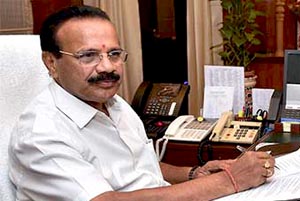
New Delhi, Jul 7: Having done a pre-budget hike of 14.2 per cent in passenger fares and raised freight rates, Railway Minister Sadananda Gowda's maiden budget is likely to adopt a realistic approach in announcing new trains, lines and survey in view of the cash crunch of Rs 26,000 crore.Sadananda Gowda
With the growth in passenger earnings declining, railways is likley to spell out its strategy to earn additional revenue to reach the target in the current fiscal.

While many unviable projects may be scrapped, Gowda will also announce some new projects on priority basis in the rail budget 2014-2015 tomorrow.

Since the government is grappling with ever-increasing fuel cost, harnessing alternative energy like solar power and bio-diesel in a big way is likely to feature in the NDA government's first Rail Budget as it is believed to be the vision of Prime Minister Narendra Modi who wants use of non-renewable energy in rail sector so that the dependence on fuel is less.

Gowda is likely to announce pilot project for introduction of automatic closing of doors in Shatabdi coaches and EMU coaches in Mumbai suburban train as safety measures for passengers to prevent accidental fall from running train.

There will be provision for a few new trains including premium and services connecting various pilgrim centres in the Rail Budget 2014-15.

Managing passenger service through cross-subsidy from freight earnings, railways may spell out its policy on FDI to attract foreign capital in expansion of rail infrastructure including modernisation of station and high speed train.

The Rail Budget will spell out details of future course of action plan for having a 'Diamond Quadrilateral' to run high speed trains.

The budget will also reflect the views of NDA government on Rail Tariff Authority and High Speed Rail Authority.

Though involvement of private players in big ticket projects is becoming a necessity now, the state-run transporter has to come out with win-win formula for investors in a hassle-free environment.

Hinting at the possibility of private investment in rail sector, the Prime Minister had recently said that private parties would be ready to invest in rail sector like development of stations.

"This would be a win-win situation project and we want to move ahead in this direction in the coming days," Modi had said.

Former Railway Minister Mallikarjun Kharge had set a revenue target of Rs 1.65 lakh crore in the interim budget which includes Rs 1.06 lakh crore from goods and Rs 45,255 crore from passenger and balance from coaching and other sources.

Railways, which have sought about Rs 40,000 cr as Gross Budgetary Support is likely to keep the annual plan at about Rs 64,000 crore.

In its bid to increase carrying capacity of wagons, Gowda will propose development of higher capacity milk van for National Dairy Development Board, parcel van and light weight wagon for carrying salt.

With the focus on alternative fuel, the budget will have proposals for bio-diesel plant and LNG locomotives in view of increased fuel prices.

The budget will emphasise on switching over to solar power for rail workshops, colonies, hospitals and stations. Besides the proposal of setting up of power plants at vacant land and installing solar panels on rooftop of trains, the commissioning of solar power plant at Raebareli coach factory are likely to be announced.

Gowda is likely to encourage use of innovative measures to perk up revenue and for use of latest technology to prevent mishaps while proposing installation of track side equipment to find fault such as overheating bearings, wheels and brake system and other damaged parts of rolling stock.

Introduction of on board integrated coach monitoring and communication system in trains to display GIS-based information on real-time to the passenger about the next upcoming station, arrival and departure timings, platform and coach position among others is also likely to find mention in the Rail Budget on July 8.

Gowda has made it clear after assuming charge that his focus will be on safety, security and speed. So, the budget is likely to focus on providing better amenities to passengers including improved catering service in rail premises.

Expansion of coach house keeping scheme on 90 additional trains, clean station scheme in five more stations and a comprehensive pest and rodent control treatment for all coaches are slated to be part of Gowda's budget speech.

Strengthening of fire safety mechanism and accident prevention measures will be specifically mentioned by the new Railway Minister to highlight government's concern for passenger safety.

The budget is likely to consider the demand of Delhi Division for additional funds for building separate parcel terminal to ease out load on busy platforms.

Comments

Add new comment

  • Coastaldigest.com reserves the right to delete or block any comments.
  • Coastaldigset.com is not responsible for its readers’ comments.
  • Comments that are abusive, incendiary or irrelevant are strictly prohibited.
  • Please use a genuine email ID and provide your name to avoid reject.
Agencies
April 23,2020

New Delhi, Apr 23: The nationwide lockdown in India which started about a month ago has impacted nearly 40 million internal migrants, the World Bank has said.

The lockdown in India has impacted the livelihoods of a large proportion of the country's nearly 40 million internal migrants. Around 50,000 60,000 moved from urban centers to rural areas of origin in the span of a few days, the bank said in a report released on Wednesday.

According to the report -- 'COVID-19 Crisis Through a Migration Lens' -- the magnitude of internal migration is about two-and-a-half times that of international migration.

Lockdowns, loss of employment, and social distancing prompted a chaotic and painful process of mass return for internal migrants in India and many countries in Latin America, it said.

Thus, the COVID-19 containment measures might have contributed to spreading the epidemic, the report said.

Governments need to address the challenges facing internal migrants by including them in health services and cash transfer and other social programmes, and protecting them from discrimination, it said.

World Bank said that coronavirus crisis has affected both international and internal migration in the South Asia region.

As the early phases of the crisis unfolded, many international migrants, especially from the Gulf countries, returned to countries such as India, Pakistan, and Bangladesh until travel restrictions halted these flows.

Some migrants had to be evacuated by governments, such as those of China and Iran, it said.

Before the coronavirus crisis, migrant outflows from the region were robust, the report said.

The number of recorded, primarily low-skilled emigrants from India and Pakistan rose in 2019 relative to the prior year but is expected to decline in 2020 due to the pandemic and oil price declines impacting the Gulf countries.

In India, the number of low-skilled emigrants seeking mandatory clearance for emigration rose slightly by eight percent to 368,048 in 2019.

In Pakistan, the number of emigrants jumped 63 per cent to 6,25,203 in 2019, largely due to a doubling of emigration to Saudi Arabia, it said.

According to the bank, migration flows are likely to fall, but the stock of international migrants may not decrease immediately, since migrants cannot return to their countries due to travel bans and disruption to transportation services.

In 2019, there were around 272 million international migrants.

The rate of voluntary return migration is likely to fall, except in the case of a few cross-border migration corridors in the South (such as Venezuela-Colombia, Nepal-India, Zimbabwe South Africa, Myanmar-Thailand), it said.

Migrant workers tend to be vulnerable to the loss of employment and wages during an economic crisis in their host country, more so than native-born workers.

Lockdowns in labour camps and dormitories can also increase the risk of contagion among migrant workers.

Many migrants have been stranded due to the suspension of transport services. Some host countries have granted visa extensions and temporary amnesty to migrant workers, and some have suspended the involuntary return of migrants, it said.

Observing that government policy responses to the COVID-19 crisis have largely excluded migrants and their families back home, the World Bank said there is a strong case for including migrants in the near-term health strategies of all countries, given the externalities associated with the health status of an entire population in the face of a highly contagious pandemic.

The Bank said governments would do well to consider short, medium and long-term interventions to support stranded migrants, remittance infrastructure, loss of subsistence income for families back home, and access to health, housing, education, and jobs for migrant workers in host/transit countries and their families back home.

The pandemic has also highlighted the global shortage of health professionals and an urgent need for global cooperation and long-term investments in medical training, it said.

Comments

Add new comment

  • Coastaldigest.com reserves the right to delete or block any comments.
  • Coastaldigset.com is not responsible for its readers’ comments.
  • Comments that are abusive, incendiary or irrelevant are strictly prohibited.
  • Please use a genuine email ID and provide your name to avoid reject.
Agencies
June 6,2020

United Nations, Jun 6: The coronavirus disease has not "exploded" in India, but the risk of that happening remains as the country moves towards unlocking its nationwide lockdown that was imposed in March to contain the Covid-19, according to a top WHO expert.

WHO Health Emergencies Programme Executive Director Michael Ryan on Friday said the doubling time of the coronavirus cases in India is about three weeks at this stage.

“So the direction of travel of the epidemic is not exponential but it is still growing,” he said, adding that the impact of the pandemic is different in different parts of India and varies between urban and rural settings.

“In South Asia, not just in India but in Bangladesh and...in Pakistan, other countries in South Asia, with large dense populations, the disease has not exploded. But there is always the risk of that happening,” Ryan said in Geneva.

He stressed that as the disease generates and creates a foothold in communities, it can accelerate at any time as has been seen in a number of settings.

Ryan noted that measures taken in India such as the nationwide lockdown have had an impact in slowing transmission but the risk of an increase in cases looms as the country opens up.

“The measures taken in India certainly had an impact in dampening transmission and as India, as in other large countries, open up and as people begin to move again, there's always a risk of the disease bouncing back up,” he said.

He added that there are specific issues in India regarding the large amount of migration, the dense populations in the urban environment and the fact that many workers have no choice but to go to work every day.

India went past Italy to become the sixth worst-hit nation by the COVID-19 pandemic.

India saw a record single-day jump of 9,887 coronavirus cases and 294 deaths on Saturday, pushing the nationwide infection tally to 2,36,657 and the death toll to 6,642, according to the health ministry.

The lockdown in India, was first clamped on March 25 and spanned for 21 days, while the second phase of the curbs began on April 15 and stretched for 19 days till May 3. The third phase of the lockdown was in effect for 14 days and ended on May 17. The fourth phase ended on May 31.

The country had registered 512 coronavirus infection cases till March 24.

The nation-wide lockdown in containment zones will continue till June 30 in India but extensive relaxations in a phased manner from June 8 are listed in the Union home ministry's fresh guidelines on tackling the Covid-19 pandemic issued last week.

WHO Chief Scientist Soumya Swaminathan said the over 200,000 current coronavirus cases in India, a country of over 1.3 billion people, "look big but for a country of this size, it's still modest.”

She stressed that it is important for India to keep track of the growth rate, the doubling time of the virus and to make sure that that number doesn't get worse.

She said that India is a “heterogeneous and huge country” with very densely populated cities and much lower density in some rural areas and varying health systems in different states and these offer challenges to the control of Covid-19.

Swaminathan added that as the lockdown and restrictions are lifted, it must be ensured that all precautions are taken by people.

“We've been making this point repeatedly that really if you want behaviour change at a large level, people need to understand the rationale for asking them to do certain things (such as) wearing masks,” she said.

In many urban areas in India, it's impossible to maintain physical distancing, she said adding that it then becomes very important for people to wear appropriate face coverings when they are out, in office settings, in public transport and educational institutions.

“As some states are thinking about opening, every institution, organisation, industry and sector needs to think about what are the measures that need to be put in place before you can allow a functioning and it may never be back to normal.”

She said that in many professions working from home can be encouraged but in several jobs, people have to go to work and in such cases measures must be put in place that allow people to protect themselves and others.

“I think communication and behaviour change is a very large part of this whole exercise,” she added.

Comments

Add new comment

  • Coastaldigest.com reserves the right to delete or block any comments.
  • Coastaldigset.com is not responsible for its readers’ comments.
  • Comments that are abusive, incendiary or irrelevant are strictly prohibited.
  • Please use a genuine email ID and provide your name to avoid reject.
News Network
March 26,2020

Srinagar, Mar 25: A 65-year-old man hailing from Hyderpora area of the city died on Thursday, becoming the first fatality in Jammu and Kashmir due to coronavirus.
"As we share the sad news of our first #Covid19 fatality, my heart goes out to the family of the deceased. We stand with you and share your grief," Mayor of Srinagar Junaid Azim Mattu tweeted.
Government spokesperson Rohit Kansal also confirmed the death via Twitter.
"First death due to Coronavirus- 65 years old Male from Hyderpora Srinagar. Four of his contacts also tested positive yesterday," Kansal said.
Four people had tested positive for coronavirus in J-K on Wednesday, taking the total number of cases to 11.
Authorities in Kashmir have expressed apprehensions that the cases could be more than reported in the Valley as a significant number of people appeared to have concealed their travel history.
As per a government bulletin on Wednesday in Jammu and Kashmir, as many as 5,124 travellers and people who came in contact with suspected and positive cases have been put under surveillance.

Among them 3,061 are in home quarantine (including facilities operated by the government), 80 in hospital quarantine and 1,477 in home surveillance.
Restrictions on movement imposed in Kashmir to prevent the spread of coronavirus were tightened on Wednesday.


Comments

Add new comment

  • Coastaldigest.com reserves the right to delete or block any comments.
  • Coastaldigset.com is not responsible for its readers’ comments.
  • Comments that are abusive, incendiary or irrelevant are strictly prohibited.
  • Please use a genuine email ID and provide your name to avoid reject.