


Rail Budget to spell out strategy to shore up revenue

July 7, 2014

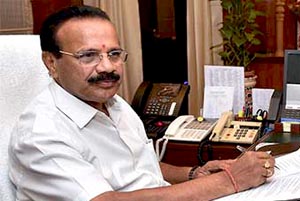
New Delhi, Jul 7: Having done a pre-budget hike of 14.2 per cent in passenger fares and raised freight rates, Railway Minister Sadananda Gowda's maiden budget is likely to adopt a realistic approach in announcing new trains, lines and survey in view of the cash crunch of Rs 26,000 crore.Sadananda Gowda
With the growth in passenger earnings declining, railways is likley to spell out its strategy to earn additional revenue to reach the target in the current fiscal.

While many unviable projects may be scrapped, Gowda will also announce some new projects on priority basis in the rail budget 2014-2015 tomorrow.

Since the government is grappling with ever-increasing fuel cost, harnessing alternative energy like solar power and bio-diesel in a big way is likely to feature in the NDA government's first Rail Budget as it is believed to be the vision of Prime Minister Narendra Modi who wants use of non-renewable energy in rail sector so that the dependence on fuel is less.

Gowda is likely to announce pilot project for introduction of automatic closing of doors in Shatabdi coaches and EMU coaches in Mumbai suburban train as safety measures for passengers to prevent accidental fall from running train.

There will be provision for a few new trains including premium and services connecting various pilgrim centres in the Rail Budget 2014-15.

Managing passenger service through cross-subsidy from freight earnings, railways may spell out its policy on FDI to attract foreign capital in expansion of rail infrastructure including modernisation of station and high speed train.

The Rail Budget will spell out details of future course of action plan for having a 'Diamond Quadrilateral' to run high speed trains.

The budget will also reflect the views of NDA government on Rail Tariff Authority and High Speed Rail Authority.

Though involvement of private players in big ticket projects is becoming a necessity now, the state-run transporter has to come out with win-win formula for investors in a hassle-free environment.

Hinting at the possibility of private investment in rail sector, the Prime Minister had recently said that private parties would be ready to invest in rail sector like development of stations.

"This would be a win-win situation project and we want to move ahead in this direction in the coming days," Modi had said.

Former Railway Minister Mallikarjun Kharge had set a revenue target of Rs 1.65 lakh crore in the interim budget which includes Rs 1.06 lakh crore from goods and Rs 45,255 crore from passenger and balance from coaching and other sources.

Railways, which have sought about Rs 40,000 cr as Gross Budgetary Support is likely to keep the annual plan at about Rs 64,000 crore.

In its bid to increase carrying capacity of wagons, Gowda will propose development of higher capacity milk van for National Dairy Development Board, parcel van and light weight wagon for carrying salt.

With the focus on alternative fuel, the budget will have proposals for bio-diesel plant and LNG locomotives in view of increased fuel prices.

The budget will emphasise on switching over to solar power for rail workshops, colonies, hospitals and stations. Besides the proposal of setting up of power plants at vacant land and installing solar panels on rooftop of trains, the commissioning of solar power plant at Raebareli coach factory are likely to be announced.

Gowda is likely to encourage use of innovative measures to perk up revenue and for use of latest technology to prevent mishaps while proposing installation of track side equipment to find fault such as overheating bearings, wheels and brake system and other damaged parts of rolling stock.

Introduction of on board integrated coach monitoring and communication system in trains to display GIS-based information on real-time to the passenger about the next upcoming station, arrival and departure timings, platform and coach position among others is also likely to find mention in the Rail Budget on July 8.

Gowda has made it clear after assuming charge that his focus will be on safety, security and speed. So, the budget is likely to focus on providing better amenities to passengers including improved catering service in rail premises.

Expansion of coach house keeping scheme on 90 additional trains, clean station scheme in five more stations and a comprehensive pest and rodent control treatment for all coaches are slated to be part of Gowda's budget speech.

Strengthening of fire safety mechanism and accident prevention measures will be specifically mentioned by the new Railway Minister to highlight government's concern for passenger safety.

The budget is likely to consider the demand of Delhi Division for additional funds for building separate parcel terminal to ease out load on busy platforms.

Comments

Add new comment

  • Coastaldigest.com reserves the right to delete or block any comments.
  • Coastaldigset.com is not responsible for its readers’ comments.
  • Comments that are abusive, incendiary or irrelevant are strictly prohibited.
  • Please use a genuine email ID and provide your name to avoid reject.
News Network
June 10,2020

New Delhi, Jun 10: India on Wednesday reported a spike of 9,985 more COVID-19 cases in the last 24 hours, taking the country's COVID-19 count to 2,76,583, according to the Union Ministry of Health and Family Welfare.

279 deaths were reported in the last 24 hours taking the total death toll to 7,745.

The total number of active cases has reached 1,33,632 while 1,35,205 patients have recovered. While one person has migrated.

With 90,787 cases, Maharashtra reported the highest number of coronavirus cases in the country followed by Tamil Nadu with 34,914 cases.

According to the Indian Council of Medical Research (ICMR), 1,45,216 samples were tested in the last 24 hours while overall 50,61,332 samples have been tested so far.

Comments

Add new comment

  • Coastaldigest.com reserves the right to delete or block any comments.
  • Coastaldigset.com is not responsible for its readers’ comments.
  • Comments that are abusive, incendiary or irrelevant are strictly prohibited.
  • Please use a genuine email ID and provide your name to avoid reject.
News Network
March 31,2020

Srinagar, Mar 31: In order to prevent the spread of coronavirus, the Jammu and Kashmir administration on Tuesday declared 20 villages of Kashmir division as 'red zone'.
"20 villages including Parray Mohala Hajin, Chandergeer Hajin, Batagund Hajin in Bandipora district, Gudoora, Chandgam, Pinglena, Parigam, Abhama, Sangerwani and Khaigam in Pulwama district, Waskura in Ganderbal, Sedew, and Ramnagri in Shopian district have been declared as red zones," said Department of Information and Public Relations, J-K, in a tweet.

In Srinagar district, Mehjoor Nagar, Natipora, Lal Bazar, Eidgah and Shalteng villages have been declared as red zones.

"Chadoora in Budgam district of Kashmir division has also been declared as red zone," another tweet said.

The total number of COVID-19 cases in Jammu and Kashmir climbed to 49 after 11 more people tested positive in the Union Territory on Monday. While three of these cases were reported from Jammu region, eight were from the Kashmir division.

Comments

Add new comment

  • Coastaldigest.com reserves the right to delete or block any comments.
  • Coastaldigset.com is not responsible for its readers’ comments.
  • Comments that are abusive, incendiary or irrelevant are strictly prohibited.
  • Please use a genuine email ID and provide your name to avoid reject.
News Network
June 9,2020

Jun 9: Prime Minister Narendra Modi wants all 1.3 billion Indians to be “vocal for local” — meaning, to not just use domestically made products but also to promote them. As an overseas citizen living in Hong Kong, I’m doing my bit by very vocally demanding Indian mangoes on every trip to the grocery. But half the summer is gone, and not a single slice so far.

My loss is due to India’s COVID-19 lockdown, which has severely pinched logistics, a perennial challenge in the huge, infrastructure-starved country. But more worrying than the disruption is the fruity political response to it. Rather than being a wake-up call for fixing supply chains, the pandemic seems to be putting India on an isolationist course. Why?

Granted that the liberal view that trade is good and autarky bad isn’t exactly fashionable anywhere right now. What makes India’s lurch troublesome is that the pace and direction of economic nationalism may be set by domestic business interests. The Indian liberals, many of whom are Western-trained academics, authors and — at least until a few years ago — policy makers, want a more competitive economy. They will be powerless to prevent the slide.

Modi’s call for a self-reliant India has been echoed by Home Minister Amit Shah, the cabinet’s unofficial No. 2, in a television interview. If Indians don’t buy foreign-made goods, the economy will see a jump, he said. The strategy — although it’s too nebulous yet to call it that — has a geopolitical element. A military standoff with China is under way, apparently triggered by India’s completion of a road and bridge near the common border in the tense Himalayan region of Ladakh. It’s very expensive to fight even a limited war there. With India’s economy flattened by COVID, New Delhi may be looking for ways to restore the status quo and send Beijing a signal.

Economic boycotts, such as Chinese consumers’ rejection of Japanese goods over territorial disputes in the East China Sea, are well understood as statecraft. In these times, it’s not even necessary to name an enemy. An undercurrent of popular anger against China, the source of both the virus and India’s biggest bilateral trade deficit, is supposed to do the job. But is it ever that easy?

A hastily introduced policy to stock only local goods in police and paramilitary canteens became a farcical exercise after the list of banned items ended up including products by the local units of Colgate-Palmolive Co., Nestle SA, and Unilever NV, which have had significant Indian operations for between 60 and 90 years, as well as Dabur India Ltd., a New Delhi-based maker of Ayurveda brands. The since-withdrawn list demonstrates the practical difficulty of bureaucrats trying to find things in a globalized world that are 100% indigenous.

Free-trade champions fret that the prime minister, whom they saw as being on their side six years ago, is acting against their advice to dismantle statist controls on land, labor and capital to help make the country more competitive. Engage with the world more, not less, they caution. But Modi also has to satisfy the Rashtriya Swayamsevak Sangh, the umbrella Hindu organisation that gets him votes. Its backbone of small traders, builders and businessmen — the RSS admits only men — was losing patience with the anemic economy even before the pandemic. Now, they’re in deep trouble, because India’s broken financial system won’t deliver even state-guaranteed loans to them.

The U.S.-China tensions — over trade, intellectual property, COVID responsibility and Hong Kong’s autonomy — offer a perfect backdrop. A dire domestic economy and trouble at the border provide the foreground. Big business will dial economic nationalism up and down to hit a trifecta of goals: Block competition from the People's Republic; make Western rivals fall in line and do joint ventures; and tap deep overseas capital markets. The first goal is being achieved with newly placed restrictions on investment from any country that shares a land border with India. The second aim is to be realized by corporate lobbying to influence India's whimsical economic policies. As for the third objective, with the regulatory environment becoming tougher for U.S.-listed Chinese companies like Alibaba Group Holding Ltd., an opportunity may open up for Indian firms.

All this may bring India Shenzhen-style enclaves of manufacturing and trade, but it will concentrate economic power in fewer hands, something that worries liberals. They’re moved by the suffering of India’s low-wage workers, who have borne the brunt of the COVID shutdown. But when their vision of a more just society and fairer income distribution prompts them to make common cause with the ideological Left, they’re quickly repelled by the Marxist voodoo that all cash, property, bonds and real estate held by citizens or within the nation “must be treated as national resources available during this crisis.” Who will invest in a country that does that instead of just printing money?

At the same time, when liberals look to the business class, they see a sudden swelling of support for ideas like a universal basic income. They wonder if this isn’t a ploy by industry to outsource part of the cost of labor to the taxpayer. Slogans like Modi’s vocal-for-local stir the pot and thicken the confusion. The value-conscious Indian consumer couldn’t give two hoots for calls to buy Indian, but large firms will know how to exploit economic nationalism. One day soon, I’ll get my mangoes — from them.

Comments

Add new comment

  • Coastaldigest.com reserves the right to delete or block any comments.
  • Coastaldigset.com is not responsible for its readers’ comments.
  • Comments that are abusive, incendiary or irrelevant are strictly prohibited.
  • Please use a genuine email ID and provide your name to avoid reject.