



Rail Budget to spell out strategy to shore up revenue

July 7, 2014

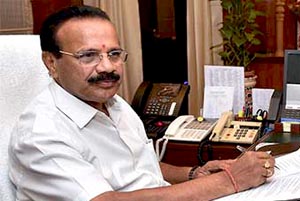
New Delhi, Jul 7: Having done a pre-budget hike of 14.2 per cent in passenger fares and raised freight rates, Railway Minister Sadananda Gowda's maiden budget is likely to adopt a realistic approach in announcing new trains, lines and survey in view of the cash crunch of Rs 26,000 crore.Sadananda Gowda
With the growth in passenger earnings declining, railways is likley to spell out its strategy to earn additional revenue to reach the target in the current fiscal.

While many unviable projects may be scrapped, Gowda will also announce some new projects on priority basis in the rail budget 2014-2015 tomorrow.

Since the government is grappling with ever-increasing fuel cost, harnessing alternative energy like solar power and bio-diesel in a big way is likely to feature in the NDA government's first Rail Budget as it is believed to be the vision of Prime Minister Narendra Modi who wants use of non-renewable energy in rail sector so that the dependence on fuel is less.

Gowda is likely to announce pilot project for introduction of automatic closing of doors in Shatabdi coaches and EMU coaches in Mumbai suburban train as safety measures for passengers to prevent accidental fall from running train.

There will be provision for a few new trains including premium and services connecting various pilgrim centres in the Rail Budget 2014-15.

Managing passenger service through cross-subsidy from freight earnings, railways may spell out its policy on FDI to attract foreign capital in expansion of rail infrastructure including modernisation of station and high speed train.

The Rail Budget will spell out details of future course of action plan for having a 'Diamond Quadrilateral' to run high speed trains.

The budget will also reflect the views of NDA government on Rail Tariff Authority and High Speed Rail Authority.

Though involvement of private players in big ticket projects is becoming a necessity now, the state-run transporter has to come out with win-win formula for investors in a hassle-free environment.

Hinting at the possibility of private investment in rail sector, the Prime Minister had recently said that private parties would be ready to invest in rail sector like development of stations.

"This would be a win-win situation project and we want to move ahead in this direction in the coming days," Modi had said.

Former Railway Minister Mallikarjun Kharge had set a revenue target of Rs 1.65 lakh crore in the interim budget which includes Rs 1.06 lakh crore from goods and Rs 45,255 crore from passenger and balance from coaching and other sources.

Railways, which have sought about Rs 40,000 cr as Gross Budgetary Support is likely to keep the annual plan at about Rs 64,000 crore.

In its bid to increase carrying capacity of wagons, Gowda will propose development of higher capacity milk van for National Dairy Development Board, parcel van and light weight wagon for carrying salt.

With the focus on alternative fuel, the budget will have proposals for bio-diesel plant and LNG locomotives in view of increased fuel prices.

The budget will emphasise on switching over to solar power for rail workshops, colonies, hospitals and stations. Besides the proposal of setting up of power plants at vacant land and installing solar panels on rooftop of trains, the commissioning of solar power plant at Raebareli coach factory are likely to be announced.

Gowda is likely to encourage use of innovative measures to perk up revenue and for use of latest technology to prevent mishaps while proposing installation of track side equipment to find fault such as overheating bearings, wheels and brake system and other damaged parts of rolling stock.

Introduction of on board integrated coach monitoring and communication system in trains to display GIS-based information on real-time to the passenger about the next upcoming station, arrival and departure timings, platform and coach position among others is also likely to find mention in the Rail Budget on July 8.

Gowda has made it clear after assuming charge that his focus will be on safety, security and speed. So, the budget is likely to focus on providing better amenities to passengers including improved catering service in rail premises.

Expansion of coach house keeping scheme on 90 additional trains, clean station scheme in five more stations and a comprehensive pest and rodent control treatment for all coaches are slated to be part of Gowda's budget speech.

Strengthening of fire safety mechanism and accident prevention measures will be specifically mentioned by the new Railway Minister to highlight government's concern for passenger safety.

The budget is likely to consider the demand of Delhi Division for additional funds for building separate parcel terminal to ease out load on busy platforms.

Comments

Add new comment

  • Coastaldigest.com reserves the right to delete or block any comments.
  • Coastaldigset.com is not responsible for its readers’ comments.
  • Comments that are abusive, incendiary or irrelevant are strictly prohibited.
  • Please use a genuine email ID and provide your name to avoid reject.
March 27,2020

Mumbai, Mar 27: The RBI on Friday put on hold EMI payments on all term loans for three months and cut interest rate by steepest in more than 11 years as it joined the government effort to rescue a slowing economy that has now got caught in coronavirus whirlwind.

The Reserve Bank of India (RBI) cut repo to 4.4 per cent, the lowest in at least 15 years. Also, it reduced the cash reserve ratio maintained by the banks for the first time in over seven years. CRR for all banks was cut by 100 basis points to release Rs 1.37 lakh crore across banking system.

The reverse repo rate was cut by 90 bps to 4 per cent, creating an asymmetrical corridor.

RBI Governor Shaktikanta Das predicted a big global recession and said India will not be immune.

It all depends how India responds to the situation, he said.

Global slowdown could make things difficult for India too, despite some help from falling crude prices, Das said, adding food prices may soften even further on record crop production.

Aggregate demand may weaken and ease core inflation further, he noted.

The liquidity measures announced include auction of targeted long-term repo operation of 3 year tenor for total amount of Rs 1 lakh crore at floating rate and accommodation under Marginal Standing Facility to be increased from 2 per cent to 3 per cent of Statutory Liquidity Ratio (SLR) with immediate effect till June 30.

Combined, these three measures will make available a total Rs 3,74,000 crore to the country's financial system.

After cutting policy rates five times in 2019, the RBI had been on a pause since December in view of high inflation.

The measures announced come a day after the government unveiled a Rs 1.7 lakh crore package of free foodgrains and cash doles to the poor to deal with the economic impact of the unprecedented 21-day nationwide lockdown.

While the Monetary Policy Committee (MPC) of the RBI originally was slated to meet in the first week of April, it was advanced by a week to meet the challenge of coronavirus.

Comments

Add new comment

  • Coastaldigest.com reserves the right to delete or block any comments.
  • Coastaldigset.com is not responsible for its readers’ comments.
  • Comments that are abusive, incendiary or irrelevant are strictly prohibited.
  • Please use a genuine email ID and provide your name to avoid reject.
Agencies
January 15,2020

Mumbai, Jan 15: The Reserve Bank of India (RBI) on Wednesday redistributed portfolios of Deputy Governors following the appointment of Michael Debabrata Patra to the post.

An official release said that NS Vishwanathan will handle co-ordination, Department of Regulation (DOR), Department of Communication (DoC), Enforcement Department, Inspection Department (ID), Risk Monitoring Department (RMD), and Secretary's Department.

BP Kanungo will look after Department of Currency Management (DCM), Department of External Investments and Operations (DEIO), Department of Government and Bank Accounts (DGBA), Department of Information Technology (DIT), Department of Payment and Settlement Systems (DPSS), Deposit Insurance and Credit Guarantee Corporation (DICGC), Foreign Exchange Department (FED), Internal Debt Management Department (IDMD), Legal Department (LD) and Right to Information (RIA) Division.

The release said that MK Jain will handle the Department of Supervision (DOS), Consumer Education and Protection Department (CEPD), Financial Inclusion and Development Department (FIDD), Human Resource Management Department (HRMD), HR Operations Unit (HR-OU), Premises Department (PD), Central Security Cell (CSC), and Rajbhasha Department.

Patra will look after the Monetary Policy Department including Forecasting and Modelling Unit (MPD/MU), Financial Markets Operations Department (FMOD), Financial Markets Regulation Department including Market Intelligence (FMRD/MI), International Department (Intl. D), Department of Economic and Policy Research (DEPR), Department of Statistics & Information Management (including Data and Information Management Unit) (DSIM/DIMU), Corporate Strategy and Budget Department (CSBD) and Financial Stability Unit.

Comments

Add new comment

  • Coastaldigest.com reserves the right to delete or block any comments.
  • Coastaldigset.com is not responsible for its readers’ comments.
  • Comments that are abusive, incendiary or irrelevant are strictly prohibited.
  • Please use a genuine email ID and provide your name to avoid reject.
News Network
January 31,2020

New Delhi, Jan 31: Chief Economic Adviser K V Subramanian on Friday said India's GDP is expected to grow at 6-6.5 per cent next fiscal as the economic slowdown has bottomed out.

As per the first advance estimates released by the National Statistical Organisation (NSO), the country's economic growth is likely to hit an 11-year low of 5 per cent in the current fiscal ending March 2020.

The Economic Survey 2019-20, prepared by a team lead by Subramanian, has projected the GDP to expand in the range of 6-6.5 per cent during 2020-21.

The Indian economy has hit the bottom and it will see an uptick from here, he said in a media briefing post the Economic Survey.

Amidst a weak environment for global manufacturing, trade and demand, the Indian economy slowed down with GDP growth moderating to 4.8 per cent in the first half of 2019-20, lower than 6.2 per cent in H2 of 2018-19.

Based on NSO's first advance estimates of GDP growth for 2019-20 at 5 per cent, an uptick in GDP growth is expected in the second half of the fiscal, it said.

According to it, the uptick in second half of 2019-20 would be mainly due to ten positive factors like picking up of Nifty India Consumption Index for the first time this year, an upbeat secondary market, higher FDI flows, build-up of demand pressure, positive outlook for rural consumption, rebound of industrial activity, steady improvement in manufacturing, growth in merchandise exports, higher build-up of foreign exchange reserves and positive growth rate of GST revenue collection.

The survey also emphasised that merger of public sector banks may increase the financial strength of the merged entities, lower the risk aversion and result in lowering of lending rates.

Further, as the implementation of GST further settles down, the increased unification of the domestic market may reduce business costs and facilitate fresh investment.

Reforms in land and labour market may further reduce business costs, said the survey, presented a day before Sitharaman's Union Budget 2020-21.

Comments

Add new comment

  • Coastaldigest.com reserves the right to delete or block any comments.
  • Coastaldigset.com is not responsible for its readers’ comments.
  • Comments that are abusive, incendiary or irrelevant are strictly prohibited.
  • Please use a genuine email ID and provide your name to avoid reject.