Rail Budget to spell out strategy to shore up revenue

July 7, 2014

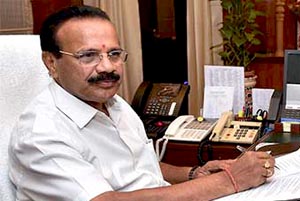
New Delhi, Jul 7: Having done a pre-budget hike of 14.2 per cent in passenger fares and raised freight rates, Railway Minister Sadananda Gowda's maiden budget is likely to adopt a realistic approach in announcing new trains, lines and survey in view of the cash crunch of Rs 26,000 crore.Sadananda Gowda
With the growth in passenger earnings declining, railways is likley to spell out its strategy to earn additional revenue to reach the target in the current fiscal.

While many unviable projects may be scrapped, Gowda will also announce some new projects on priority basis in the rail budget 2014-2015 tomorrow.

Since the government is grappling with ever-increasing fuel cost, harnessing alternative energy like solar power and bio-diesel in a big way is likely to feature in the NDA government's first Rail Budget as it is believed to be the vision of Prime Minister Narendra Modi who wants use of non-renewable energy in rail sector so that the dependence on fuel is less.

Gowda is likely to announce pilot project for introduction of automatic closing of doors in Shatabdi coaches and EMU coaches in Mumbai suburban train as safety measures for passengers to prevent accidental fall from running train.

There will be provision for a few new trains including premium and services connecting various pilgrim centres in the Rail Budget 2014-15.

Managing passenger service through cross-subsidy from freight earnings, railways may spell out its policy on FDI to attract foreign capital in expansion of rail infrastructure including modernisation of station and high speed train.

The Rail Budget will spell out details of future course of action plan for having a 'Diamond Quadrilateral' to run high speed trains.

The budget will also reflect the views of NDA government on Rail Tariff Authority and High Speed Rail Authority.

Though involvement of private players in big ticket projects is becoming a necessity now, the state-run transporter has to come out with win-win formula for investors in a hassle-free environment.

Hinting at the possibility of private investment in rail sector, the Prime Minister had recently said that private parties would be ready to invest in rail sector like development of stations.

"This would be a win-win situation project and we want to move ahead in this direction in the coming days," Modi had said.

Former Railway Minister Mallikarjun Kharge had set a revenue target of Rs 1.65 lakh crore in the interim budget which includes Rs 1.06 lakh crore from goods and Rs 45,255 crore from passenger and balance from coaching and other sources.

Railways, which have sought about Rs 40,000 cr as Gross Budgetary Support is likely to keep the annual plan at about Rs 64,000 crore.

In its bid to increase carrying capacity of wagons, Gowda will propose development of higher capacity milk van for National Dairy Development Board, parcel van and light weight wagon for carrying salt.

With the focus on alternative fuel, the budget will have proposals for bio-diesel plant and LNG locomotives in view of increased fuel prices.

The budget will emphasise on switching over to solar power for rail workshops, colonies, hospitals and stations. Besides the proposal of setting up of power plants at vacant land and installing solar panels on rooftop of trains, the commissioning of solar power plant at Raebareli coach factory are likely to be announced.

Gowda is likely to encourage use of innovative measures to perk up revenue and for use of latest technology to prevent mishaps while proposing installation of track side equipment to find fault such as overheating bearings, wheels and brake system and other damaged parts of rolling stock.

Introduction of on board integrated coach monitoring and communication system in trains to display GIS-based information on real-time to the passenger about the next upcoming station, arrival and departure timings, platform and coach position among others is also likely to find mention in the Rail Budget on July 8.

Gowda has made it clear after assuming charge that his focus will be on safety, security and speed. So, the budget is likely to focus on providing better amenities to passengers including improved catering service in rail premises.

Expansion of coach house keeping scheme on 90 additional trains, clean station scheme in five more stations and a comprehensive pest and rodent control treatment for all coaches are slated to be part of Gowda's budget speech.

Strengthening of fire safety mechanism and accident prevention measures will be specifically mentioned by the new Railway Minister to highlight government's concern for passenger safety.

The budget is likely to consider the demand of Delhi Division for additional funds for building separate parcel terminal to ease out load on busy platforms.

Comments

Add new comment

  • Coastaldigest.com reserves the right to delete or block any comments.
  • Coastaldigset.com is not responsible for its readers’ comments.
  • Comments that are abusive, incendiary or irrelevant are strictly prohibited.
  • Please use a genuine email ID and provide your name to avoid reject.
News Network
January 9,2020

Srinagar, Jan 9: Envoys from 15 countries including the United States were shown around Srinagar on Thursday, the first visit by New Delhi-based diplomats since the government stripped Kashmir of its semi-autonomous status and began a harsh crackdown five months ago.

The diplomats were driven by Indian authorities in a motorcade amid tight security from the airport to the military headquarters in Srinagar, where they were briefed on the security situation, an army officer said. He spoke on condition of anonymity as he was not authorized to speak to reporters.

They also held discussions with civil society members and some Kashmiri politicians, said Raveesh Kumar, spokesman for the Ministry of External Affairs (MEA).

The objective of the visit, organized by the Union government, was for the envoys to see first-hand “how things have progressed and how normalcy has been restored to a large extent'' in Kashmir since August, Kumar told reporters in New Delhi.

In October, a group of European Parliament members had visited the region, which is claimed by both India and Pakistan.

The delegation that visited Kashmir on Thursday included US ambassador to India Kenneth Juster and diplomats from Bangladesh, Vietnam, Norway, the Maldives, South Korea, Morocco, Niger, Nigeria, Argentina, the Philippines, Fiji, Uzbekistan, Peru and Togo.

Offices, shops and businesses were open in Srinagar on the cold winter day, but the diplomats did not stop to talk to people as they moved to different venues of their meetings.

They were to fly to Jammu, the winter capital of Kashmir, later Thursday and return to New Delhi on Friday.

Congress leader Jairam Ramesh pointed out the oddity of taking foreign diplomats to the troubled state but not allowing allowing Indian political leaders to freely visit it.

The National Conference said it was "disappointed" with the way the government brought envoys from various countries to "endorse" its "claims of normalcy" in the union territory. The party alleged that it was no more than a "guided tour" with access limited to "handpicked individuals who toe the government line".

“The NC wishes to ask these envoys that if the situation in Jammu & Kashmir is "normal", then why are scores of people, including three former chief ministers, under detention for almost 160 days and why have the people been denied access to the internet for over 5 months?" a statement issued by the party said.

Kumar dismissed as unfounded criticism of the visit, and said more such visits to Kashmir by New Delhi-based diplomats are likely in the near future.

Comments

Add new comment

  • Coastaldigest.com reserves the right to delete or block any comments.
  • Coastaldigset.com is not responsible for its readers’ comments.
  • Comments that are abusive, incendiary or irrelevant are strictly prohibited.
  • Please use a genuine email ID and provide your name to avoid reject.
News Network
January 6,2020

Jan 6: India’s Finance Ministry has delivered a challenge to its revenue collectors: meet tax targets despite $20 billion of corporate tax cuts.

Through a video conference on Dec. 16, officials were exhorted to meet the direct tax mop-up target of 13.4 trillion rupees ($187 billion), a government official told reporters. Collection in the eight months to November grew at 5% from a year earlier, against the desired 17%.

The missive shows Prime Minister Narendra Modi’s urgent need to buoy public finances in a slowing economy where April-November tax collections were half the amount budgeted. Authorities withheld some payments to states and have capped ministries’ expenditure as the fiscal deficit ballooned beyond the target.

The government’s efforts to maintain its deficit goal goes against advice from some quarters, including central bank Governor Shaktikanta Das, who urged more spending to spur economic growth.

It’s uncertain though how much room Modi’s administration has to boost expenditure, given that it may already be borrowing as much as 540 billion rupees through state-run companies, a figure that isn’t reflected on the federal balance sheet. Uncertainty about public finances pushed up sovereign yields in November and December, compelling Das to announce unconventional policies to keep costs in check.

“This is not a time to conceal the fiscal deficit by off-budget borrowing or deferring payments,” said Indira Rajaraman, an economist and a former member of the Reserve Bank of India’s board. “If they were to stick to the target, that would be catastrophic because there is so much pump-priming that is needed right now.”

GDP grew 4.5% in the quarter ended September, the slowest pace in more than six years as both consumption and investments cooled in Asia’s third-largest economy. Only government spending supported the expansion, piling pressure on Modi to keep stimulating.

S&P Global Ratings warned in December it may downgrade India’s sovereign ratings if economic growth doesn’t recover. Government support seems to be waning now, with ministries asked to cap spending in the final quarter of the financial year at 25% of the amount budgeted rather than 33% allowed earlier. This new rule will hamstring sectors including agriculture, aviation and coal, where not even half of annual targets have been disbursed.

As the federal government runs short of money, it’s been delaying payouts to state administrations.

Private hospitals have threatened to suspend cash-less services to government employees over non-payment of dues, while a builder informed the stock exchange about delayed rental payments from no less than the tax office itself.

India is considering a litigation-settlement plan that will allow companies to exit lingering tax disputes by paying a portion of the money demanded by the government, the Economic Times newspaper reported Saturday.

The move will help improve the ease of doing business besides unlocking a part of the almost 8 trillion rupees ($111 billion) caught up in these disputes. The step, which is being considered as part of the annual budget, could also bridge India’s fiscal gap.

Finance Minister Nirmala Sitharaman has refused to comment on the deficit goal before the official budget presentation due Feb. 1.

A deviation from target, if any, “will need to be balanced with a credible consolidation plan further-out,” said Radhika Rao, an economist at DBS Group Holdings Ltd. in Singapore.

Comments

Add new comment

  • Coastaldigest.com reserves the right to delete or block any comments.
  • Coastaldigset.com is not responsible for its readers’ comments.
  • Comments that are abusive, incendiary or irrelevant are strictly prohibited.
  • Please use a genuine email ID and provide your name to avoid reject.
Agencies
July 29,2020

New Delhi, Jul 29: Calling touchdown of Rafale fighter aircraft at Ambala airbase as "historic day" for Indian Air Force and proud moment for India, Union Home Minister Amit Shah on Wednesday said that "world-class fighter jets will prove to be a game-changer".

In a series of tweets, Shah congratulated Prime Minister Narendra Modi, Defence Minister Rajnath Singh, Indian Air Force and the entire country on this "momentous day".

"Rafale touchdown is a historic day for our vigorous @IAF_MCC and a proud moment for India! These are the world's most powerful machines capable to thwart any challenge in the sky. I am sure Rafale will help our Air warriors to safeguard our skies with its mighty superiority," Shah said in a tweet.

"From speed to weapon capabilities, Rafale is way ahead! I am sure these world class fighter jets will prove to be a game changer. Congratulations to PM @narendramodi ji, DM @rajnathsingh ji, Indian Air Force and the entire country on this momentous day. #RafaleInIndia," he added.

Shah said that Modi government is committed to build India's defence capabilities.

"Induction of these next generation aircrafts is a true testimony of PM @narendramodi's resolve to make India a powerful and secure nation. Modi govt is committed to build on India's defence capabilities. I thank honourable PM for providing this unprecedented strength to our IAF," he tweeted.

Earlier today, the five French Rafale fighter jets touched down at Haryana's Ambala after covering a distance of nearly 7,000 km to join the Indian Air Force.

The jets were given a customary water salute upon their arrival at the airbase, some 220-km from the India-Pakistan border.

The formal induction ceremony of the aircraft would be held later. The aircraft would move out soon to another operational base for operational sorties.

The five Rafale fighter aircraft took off on Monday for India from an airbase in France.
Rafale has multi-directional radar system which can detect 40 targets at the same time in a range of over 100 Kms. It has advance radar warning receiver to identify hostile tracking system a towed decoy system to thwart incoming missile attacks.

Rafale will ensure that our pilots will not have to cross the border to strike the target, that is about 600 Km in enemy territory.

It will get French industrial support for 50 years. India had signed a deal worth over Rs 60,000 crore with France in September 2016 for 36 Rafales to meet the emergency requirements of the IAF.

Comments

Add new comment

  • Coastaldigest.com reserves the right to delete or block any comments.
  • Coastaldigset.com is not responsible for its readers’ comments.
  • Comments that are abusive, incendiary or irrelevant are strictly prohibited.
  • Please use a genuine email ID and provide your name to avoid reject.