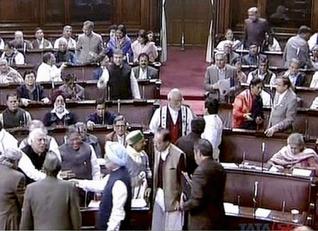
Rajya Sabha passes Lokpal Bill, to be debated in Lok Sabha tomorrow; Anna celebrates

December 17, 2013

lokpa

New Delhi, Dec 17: The Rajya Sabha on Tuesday passed the Lokpal and Lokayukta Bill, which provides for creation of an anti-corruption ombudsman.

The most prominent of the group of anti-graft bills on the anvil, the Lokpal Bill establishes a lokpal at the central level and asks states to establish lokayuktas in a year's time from the date of notification of the law. The format of the lokayukta will be left to the state assemblies to decide.

The bill was passed by the Lok Sabha at the fag end of the winter session of 2011, but not by the Rajya Sabha, where it was debated but the house was adjourned before voting on it.

A select committee of the Rajya Sabha suggested changes in the bill which were incorporated and approved by the union cabinet.

Concluding the debate on the bill, law minister Kapil Sibal called it a historic moment, but stressed that corruption could not be removed by the lokpal alone.

"Law alone will not lead to elimination of corruption. Law will help deal with those who are corrupt, but it will not deal with the impetus to be corrupt. It will just be a deterrent," he said.

He also said government will also deal with the "supply side" of corruption, as pointed out by Communist Party of India-Marxist (CPM), saying a bill amending Prevention of Corruption Act, pending with Lok Sabha, provides to deal with the source of bribe.

Rajya Sabha chairman Hamid Ansari had earlier moved the motion on amendments suggested by political parties on the Lokpal Bill.

Now the bill will have to be sent to the Lok Sabha for approval of the changes. The Lower House will debate the bill in Parliament on Wednesday.

Anna Hazare, cheering the move, thanked the MPs for passing the bill adding that he will break his fast after the Lokpal Bill gets passed in the Lok Sabha tomorrow. Sabha chairman Hamid Ansari had earlier moved motion on amendments suggested by political parties on the Lokpal Bill.

Comments

Add new comment

  • Coastaldigest.com reserves the right to delete or block any comments.
  • Coastaldigset.com is not responsible for its readers’ comments.
  • Comments that are abusive, incendiary or irrelevant are strictly prohibited.
  • Please use a genuine email ID and provide your name to avoid reject.
News Network
February 1,2020

New Delhi, Feb 1: India has uplifted 271 million people out of poverty, Finance Minister Nirmala Sitharaman said on Saturday.

In her second Budget presentation, the finance minister said the Budget for 2020-21, is woven around aspirational India, economic development and caring society.

The government aims to achieve seamless delivery of services through digital governance, she added.

"We shall strive to bring ease of living for every citizen," Sitharaman said.

Comments

Add new comment

  • Coastaldigest.com reserves the right to delete or block any comments.
  • Coastaldigset.com is not responsible for its readers’ comments.
  • Comments that are abusive, incendiary or irrelevant are strictly prohibited.
  • Please use a genuine email ID and provide your name to avoid reject.
News Network
March 7,2020

Srinagar, Mar 7: Two more accused, including a man who allegedly bought chemicals online for making improvised explosive device (IED) to be used in an attack on a convoy of the Central Reserve Police Force (CRPF) in Jammu and Kashmir's Pulwama last year, were arrested by the National Investigation Agency (NIA) on Friday, an official said.

The terror attack left 40 CRPF personnel dead in south Kashmir's Pulwama last year.

Waiz-ul-Islam, 19, from Srinagar and Mohammad Abbass Rather, 32, from Pulwama were arrested by the NIA, taking the number of those arrested in the case in the past week to five.

"During initial interrogation, Islam disclosed that he used his Amazon online shopping account to procure chemicals for making IEDs, batteries and other accessories on the directions of Pakistani Jaish-e-Mohammed (JeM) terrorists," the official said.

He said Islam personally delivered the items to the JeM terrorists after buying them online as a part of the conspiracy to carry out the attack.

"Rather is an old overground worker of the JeM. He has disclosed that he gave shelter at his home to Jaish terrorist and IED expert Mohd Umar after he came to Kashmir in April-May 2018," the official said.

Rather also sheltered other JeM terrorists - suicide bomber Adil Ahmad Dar, Sameer Ahmed Dar and Kamran, a Pakistani -- at his house before the Pulwama attack, the official said.

"He also facilitated safe shelter for the JeM terrorists, including Adil, at the house of accused Tariq Ahmed Shah and his daughter Insha Jan of Hakripora, who were arrested on March 3," the official said.

He said Islam and Rather will be produced before the NIA special court in Jammu on Saturday, while further investigation in the case continues. The NIA took over the case to probe the conspiracy behind the February 14, 2019, attack in Pulwama.

The last video of Adil, which was released by the JeM from Pakistan after the terror attack, was filmed at the home of Tariq Ahmed Shah. On February 28, the NIA achieved a major breakthrough in the case when it arrested 22-year-old Shakir Bashir Magrey, a furniture shop owner and resident of Pulwama.

Magrey had given shelter and other logistical assistance to suicide bomber Adil. He was introduced to Adil in mid-2018 by Pakistani terrorist Mohammad Umar Farooq and he became a full-time OGW of the JeM.

The explosives used in the attack were determined through forensic probe to be ammonium nitrate, nitro-glycerin and RDX. During investigation into the attack, the identity of the suicide bomber to be Adil Ahmad Dar was confirmed through DNA matching with that of his father.

The other key terrorists involved in the attack have been found to be JeM's south Kashmir divisional head Muddasir Ahmad Khan, killed in an operation by the security forces on March 11 last year; Pakistani terrorists Muhammad Umar Farooq and IED expert Kamran, both killed on March 29 last year; the owner of the car Sajjad Ahmad Bhat, a resident of Anantnag who was killed on June 16 last year, and Qari Yassir, JeM's commander for Kashmir who was killed on January 25 this year.

Comments

Add new comment

  • Coastaldigest.com reserves the right to delete or block any comments.
  • Coastaldigset.com is not responsible for its readers’ comments.
  • Comments that are abusive, incendiary or irrelevant are strictly prohibited.
  • Please use a genuine email ID and provide your name to avoid reject.
News Network
January 1,2020

Jan 1: The ban on the practice of instant triple talaq, making it a penal offence and the increase in the strength of Supreme Court judges were two of the major achievements of the law ministry in 2019.

In July, Parliament gave its nod to The Muslim Women (Protection of Rights on Marriage) Bill, 2019. The new law makes talaq-e-biddat or any other similar form of talaq having the effect of instantaneous and irrevocable divorce pronounced by a Muslim husband void and illegal.

It makes it illegal to pronounce talaq three times in spoken, written or through SMS or WhatsApp or any other electronic chat in one sitting.

According to the new law, any Muslim who pronounces the illegal form of talaq upon his wife shall be punished with imprisonment for a term which may extend to three years, and shall also be liable to fine.

During the year, four new judges were appointed to the Supreme Court in September, taking its strength to 34, the highest-ever.

However, vacancies in high courts and lower courts are on the rise and convincing state governments and the 25 high courts to come on board to create an all-India judicial service to recruit judges for the subordinate courts tops the agenda of the Law Ministry in 2020.

Besides creating a consensus on setting up the All-India Judicial Services, the ministry will also have to focus on filling up vacancies in the high court. On an average, the vacancies stood at 400 throughout this year.

With more than 5,000 positions of judicial officers in district and subordinate courts lying vacant, the Law Ministry has pitched for setting up all-India judicial services.

The sanctioned strength of the judicial officers in district and subordinate courts was 22,644. The number of judicial officers in position and vacant posts is 17,509 and 5,135, respectively.

The government has proposed that while states and high courts can recruit judicial officers, the Union Public Service Commission (UPSC) can hold pan-India entrance tests.

The ministry has made it clear that such services would not encroach on the powers of the states.

As of now, the selection and appointment of judges in subordinate courts is the responsibility of the high courts and state governments concerned.

The Narendra Modi government has given a fresh push to the long-pending proposal to set up the new service to have a separate cadre for the lower judiciary in the country.

But there is a divergence of opinion among state governments and respective high courts on the constitution of the All India Judicial Service (AIJS).

One of the problems cited is that since several states have used powers under Code of Criminal Procedure (CrPC) and Code of Civil Procedure (CPC) to declare that the local language would be used in lower courts even for writing orders, a person say selected from Tamil Nadu may find it difficult to hold proceedings in states like Uttar Pradesh and Bihar.

The other point of opposition is that an all India service may hamper the career progression of state judicial services officers.

Another key issue the ministry has to handle in 2020 is vacancies in the 25 high courts.

Throughout 2019, on an average, the high courts faced a shortage of 400 judges.

According to Law Ministry data, as on September 1, the high courts had 414 vacant positions as compared to the sanctioned strength of 1,079 judges. The figure was 409 in August and 403 in July, as per the data.

A three-member Supreme Court collegium recommends the names of candidates for appointment as high court judges. In case of appointments to the Supreme Court, the collegium consists of five top judges of the top court.

High court collegiums shortlist candidates for their respective high courts and send the names to the law ministry.

The ministry, along with background check reports by the Intelligence Bureau, forwards it to the Supreme Court collegium for a final call.

The government has maintained that appointment of judges in the high courts is a "continuous collaborative process" between the Executive and the Judiciary, as it requires consultation and approval from various Constitutional authorities.

Vacancies keep arising on account of retirement, resignation or elevation of judges and increase in judges' strength. In June last year, the vacancy position stood at 399, while it was 396 in May.

In April, 399 posts of judges were vacant, while the figure was 394 in March. The vacancy position in February stood at 400 and in January, it was 392, according to the data collated by the Department of Justice.

Over 43 lakh cases are pending in the 25 high courts.

Another priority would be the finalisation of the memorandum of the procedure to guide the appointment and transfer of the Supreme Court and high court judges. The issue had now been pending for over two years now with the SC collegium and the government failing to reach a consensus.

Successive governments have also been working on making India a hub of international arbitration. It has taken several steps to change laws dealing with commercial disputes.


Comments

Add new comment

  • Coastaldigest.com reserves the right to delete or block any comments.
  • Coastaldigset.com is not responsible for its readers’ comments.
  • Comments that are abusive, incendiary or irrelevant are strictly prohibited.
  • Please use a genuine email ID and provide your name to avoid reject.