



Reducing oxygen levels may cure jet lag: study

October 21, 2016

Jerusalem, Oct 21: Reducing oxygen levels in an aeroplane cabin may help combat jet lag in travellers, suggests a new study which found that variation in oxygen levels can reset circadian clocks of mice and help them adapt eating, sleeping and running habits to the new time faster.
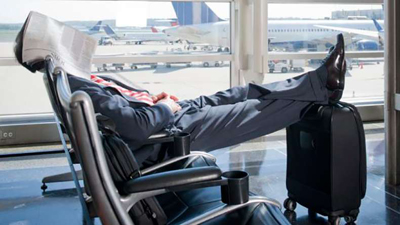
jetlagPresently, light, food and temperature are the best known cues that can influence circadian rhythms.

Lead author Gad Asher, scientist at the Weizmann Institute of Science in Israel, and his colleagues studied that changing the concentration of oxygen in cells by just 3 per cent, twice a day, will synchronise mouse cells to a circadian rhythm.

They suspected protein HIF1a was the link between oxygen and the circadian clock because HIF1a plays both a role in oxygen homeostasis in cells.

They found that cells with low HIF1a levels will not synchronise in response to oxygen variations.

"It was extremely exciting to see that even small changes in oxygen levels were sufficient to efficiently reset the circadian clock," said Asher.

Researchers further explored oxygen's effect on circadian rhythms with jetlag experiments. Just like humans, mice are prone to jetlag after a sudden shift in daylight hours.

Mice were first left to eat, sleep and run on their wheels in air-controlled environments.

Altering oxygen levels alone did not change their circadian rhythms but once mice experienced a six-hour jump ahead in daylight hours, varying oxygen levels could help them adapt their eating, sleeping and running habits to the new time faster.

They also saw that a small drop in oxygen levels 12 hours before the six-hour daylight shift, or two hours afterwards, put the mice back on their circadian schedules faster and this too was dependent on HIF1a levels.

Presently, commercial airliners pressurise cabins to the same air density of a city 6,000-8,000 feet above sea level.

This low-pressure saves wear and tear on the airplane, but enough passengers suffer from airsickness in response to this drop in oxygen levels that some airlines are considering ways to increase the pressure on flights.

Researchers noted that passengers may feel better with higher pressurised cabins during flights, but may also lose a potential advantage of recovering from jetlag.

Understanding how oxygen influences the circadian clock goes beyond jetlag. Cardiovascular disease, COPD, shift work sleep disorder, and other common health problems can result in tissues with low oxygen levels.

"We show that oxygen works in mammals, specifically rodents, but it will be interesting to test whether oxygen can reset the clock of bacteria, plants, flies and additional organisms," said Asher.

Comments

Add new comment

  • Coastaldigest.com reserves the right to delete or block any comments.
  • Coastaldigset.com is not responsible for its readers’ comments.
  • Comments that are abusive, incendiary or irrelevant are strictly prohibited.
  • Please use a genuine email ID and provide your name to avoid reject.
Agencies
July 25,2020

The COVID-19 pandemic and the subsequent lockdown saw many people turning chefs overnight, but those who could not turned to online delivery of food. And not just any food, as per a new report, Indians "craved the most for Biryani" during the lockdown.

The "StatEATistics report: The Quarantine Edition" from food delivery platform Swiggy found that Indians ordered biryani over "5.5 lakh times" from their favourite restaurants.

The new normal might have opened a pandora's box of behavioral changes, but some old habits die hard like the love for Biryani, which took the top spot for overall orders. It was followed by butter naan and masala dosa at 3,35,185 and 3,31,423, respectively.

Biryani has topped the list of most ordered dishes for the fourth year in a row, the food delivery platform noted.

Indians didn't forget to indulge their sweet tooth in the uncertain months of lockdown. Their favourite comfort food during the lockdown period was the moist and decadent Choco Lava cake, ordered around 1,29,000 times.

"The humble Gulab Jamun (84,558) and chic Butterscotch Mousse cake (27,317) followed suit," said the report derived from Swiggy's order analysis in the past few months across cities that it is present in.

Also, as birthday parties moved to video calls, and virtual cake cutting sessions, according to the food delivery platform, it delivered nearly "1,20,000 cakes" to complete these celebrations.

According to the report, on average, "65,000 meal orders" were placed by 8 pm each day to make sure food arrived in time for dinner.

"It was the busiest hour for Swiggy delivery partners and restaurants. On average, they (customers) chose to tip Rs.23.65, with one particularly generous customer tipping Rs. 2500!," it added.

For those who only relied on home-made food during the quarantine, Swiggy delivered a whooping 323 million kgs of onions and 56 million kgs of bananas through its grocery section and hence ensured that its consumers were all stocked up.

That said, it also took care of the 'quick-fix meal' tribe -- consumers who resort to the evergreen college hacks of living on instant noodles.

"Around 3,50,000 packets of this ideal easy to cook meal were ordered during the lockdown," it said.

In all, Swiggy delivered 40 million orders across food, groceries, medicines and other household items during India's lockdowns. It also delivered over 73,000 bottles of sanitizers and hand wash along with 47,000 face masks as the definition of essentials' changed during these uncertain times.

Comments

Add new comment

  • Coastaldigest.com reserves the right to delete or block any comments.
  • Coastaldigset.com is not responsible for its readers’ comments.
  • Comments that are abusive, incendiary or irrelevant are strictly prohibited.
  • Please use a genuine email ID and provide your name to avoid reject.
Agencies
May 19,2020

New York, May 19: Cigarette smoke spurs the lungs to make more of the receptor protein which the novel coronavirus uses to enter human cells, according to a study which suggests that quitting smoking might reduce the risk of a severe coronavirus infection.

The findings, published in the journal Developmental Cell, may explain why smokers appear to be particularly vulnerable to severe COVID-19 disease.

"Our results provide a clue as to why smokers who develop COVID-19 tend to have poor clinical outcomes," said study senior author Jason Sheltzer, a cancer geneticist at Cold Spring Harbor Laboratory in the US.

"We found that smoking caused a significant increase in the expression of ACE2, the protein that SARS-CoV-2 uses to enter human cells," Sheltzer said.

According to the scientists, quitting smoking might reduce the risk of a severe coronavirus infection.

They said most individuals infected with the virus suffer only mild illness, if they experience any at all.

However, some require intensive care when the sometimes-fatal virus attacks, the researchers said.

In particular, they said three groups have been significantly more likely than others to develop severe illness -- men, the elderly, and smokers.

Turning to previously published data for possible explanations for these disparities, the scientists assessed if vulnerable groups share some key features related to the human proteins that the coronavirus relies on for infection.

First, they said, they focused on comparing gene activity in the lungs across different ages, between the sexes, and between smokers and nonsmokers.

The scientists said both mice that had been exposed to smoke in a laboratory, and humans who were current smokers had significant upregulation of ACE2.

According to Sheltzer, smokers produced 30-55 per cent more ACE2 than their non-smoking counterparts.

While the researchers found no evidence that age or sex impacts ACE2 levels in the lungs, they said the influence of smoke exposure was surprisingly strong.

However, they said, the change seemed to be temporary.

According to the data, the level of the receptors ACE2 in the lungs of people who had quit smoking was similar to that of non-smokers.

The study noted that the most prolific producers of ACE2 in the airways are mucus-producing cells called goblet cells.

Smoking is known to increase the prevalence of such cells, the scientists said.

"Goblet cells produce mucous to protect the respiratory tract from inhaled irritants. Thus, the increased expression of ACE2 in smokers' lungs could be a byproduct of smoking-induced secretory cell hyperplasia," Sheltzer explained.

However, Sheltzer said other studies on the effects of cigarette smoke have shown mixed results.

"Cigarette smoke contains hundreds of different chemicals. It's possible that certain ingredients like nicotine have a different effect than whole smoke does," he said.

The researchers cautioned that the actual ACE2 protein may be regulated in ways not addressed in the current study.

"One could imagine that having more cells that express ACE2 could make it easier for SARS-CoV-2 to spread in someone's lungs, but there is still a lot more we need to explore," Sheltzer said.

Comments

Add new comment

  • Coastaldigest.com reserves the right to delete or block any comments.
  • Coastaldigset.com is not responsible for its readers’ comments.
  • Comments that are abusive, incendiary or irrelevant are strictly prohibited.
  • Please use a genuine email ID and provide your name to avoid reject.
Agencies
April 28,2020

As the world grapples with the impact of the novel coronavirus, daily interaction with the outside world --- public and retail spaces, restaurants, educational institutions, and even with each other has been and will continue to be reoriented prioritising personal hygiene and public health.

The sensibilities are building towards and leading to major changes in how the country's food service industry is expected to operate.

Based on a recent consumer survey by restaurant tech platform, Dineout, Indian diners are now ranking safety assurances and premier hygiene as top factors when it comes to choosing a restaurant to dine in.

The survey by Dineout conducted across 20 cities revealed that in a post-COVID-19 era, 81 per cent diners will prefer digital menus at restaurants, while 77 per cent of people will continue to want to dine out.

The survey found that 23 per cent people would prefer continuing with delivery/takeaway and online payment becomes the most preferred option with 60 per cent votes.
 
Diner's response to Contactless Dining:


Over 96 per cent demand better waitlist management
 
81 per cent consumers would rather scan a QR on their phone to place an order instead of handling physical menus or tablet-based digital menus.
 
After a dining experience, 60 per cent prefer seamless wallet-based digital payments over cash/cards 85 per cent would choose a digital valet over waiting in possibly contaminated public spaces and 84 per cent would prefer offering digital feedback over physical feedback collection.


What do people want to eat?
 
The report also revealed that most of India has been craving Pizza since the lockdown, except in Chennai, Hyderabad and Kolkata where their popular and indigenous Biryani recipes reign supreme. 
 
Which restaurants are diners waiting to go to?
 
77 per cent respondents claimed that they are waiting to dine out with friends and family once the lockdown is lifted.
 
Big Chill, Barbeque Nation and Social emerged as favourites in Delhi, while Mumbaikars picked Global Fusion, Poptates and Asia Kitchen. Bangaloreans miss going to pubs like Toit, Vapour and Barbeque Nation.
 
Aminia, Arsalan and Momo I Am emerge as the top picks in Kolkata.
 
Contrary to popular belief, Delhitties picked vegetarian over non-vegetarian food.
 
Bangaloreans and Lucknowis would rather have their drinks over food.
 
Besides the new parameters for restaurant selection, the factors deciding consumer delight have also seen a major overhaul as hygiene takes precedence. Consumers would prefer that the total number of reservations in a certain period be limited with the option to pre-select the seating, ample amounts of sanitisers at tables along with UV sanitised utensils whenever possible.
 
Hygiene ratings with detailed hygiene information, regular hygiene checks & usage of mask and disposable gloves by waiters are likely to be the new standard, with diners expecting service personnel to sanitise tables & chairs after every use.
 
Dineout recently unveiled the �contactless dining suite' to help restaurants survive and thrive in a post-COVID-19 world. The brand will also provide PPE Safety Kits to Restaurants to help ensure hygiene measures and is facilitating COVID free certification for restaurants through a licensed lab to ensure all microbiological tests are in place before restaurants restart post the lockdown.

Comments

Add new comment

  • Coastaldigest.com reserves the right to delete or block any comments.
  • Coastaldigset.com is not responsible for its readers’ comments.
  • Comments that are abusive, incendiary or irrelevant are strictly prohibited.
  • Please use a genuine email ID and provide your name to avoid reject.