



Reserve may submerge in Ken-Betwa project

September 25, 2016

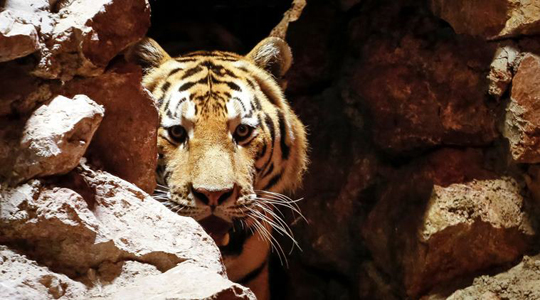
New Delhi, Sep 25: About 7.2 lakh trees and a huge 90 square kilometres area of Panna Tiger Reserve (PTR) may be submerged in water due to the Ken-Betwa river linking project, according to an official report.
tiger

There will be also be an "irreversible" loss of breeding sites for wild animals after submergence of critical and specialised habitats under the proposed project which is likely to cost over Rs 9,000 crore.

The Ken-Betwa project is expected to provide drinking water supply for 13.42 lakh people and help irrigate 6.75 lakh hectares of land in the poverty-ridden Bundelkhand region covering parts of Madhya Pradesh and Uttar Pradesh.

The project is founded on construction of a dam at Dhaudan village inside the PTR's core area in Chhatarpur district of Madhya Pradesh.

"The entire forest area under the proposed submergence both within and outside PTR is tiger habitat, while the non-forest area is potential tiger habitat. Thus, about 90 sq km area of tiger habitat, including potential habitat, will have to be considered as submergence zone," National Board of Wildlife (NBWL) Standing Committee report on Ken-Betwa link project said.

At present, there are around 35 tigers in the reserve, which had in 2009 reported extinction of the big cats.

The report, which has been submitted to Union Environment Ministry, said the total counting of trees in the proposed submergence area has not been done, but a sample survey by the forest department has estimated that "about 7.2 lakh trees above 20 cm girth at breast height would submerge in the national park area and this number may go up to about 12 lakh stems when young poles and established sapling are accounted".

It said an equally high number of trees will be cut or lost in the forest areas outside the national park. "Thus considerable quantity of carbon stored as biomass would be released once the dam is constructed, in addition to loss of vegetation diversity," said the report, a copy of which was received by wildlife activist Ajay Dubey in response to an RTI query filed by him.

He said the National Green Tribunal and appropriate court will be approached to challenge the proposed project on the basis of the report's findings. The report said Panna Tiger Reserve has largely been valued with respect to the requirement of the tiger.

"The importance of other key wildlife such as sloth bear, leopard, rusty spotted cat, hyena, sambhar, chital, four-horned antelope and chinkara are largely ignored under the shadow of tiger, although tiger conservation may support the conservation of its associated fauna. Ken river along with its tributary is a lifeline of the park. Ken river basin is full of gorges, caves, rock crevices which are normally occupied by wild mammals for breeding and resting.

"During hot days in summer, these gorges, caves, rock crevices are major shelters for some of the animals listed above. Loss of breeding sites will be irreversible after submergence of these critical and specialised habitats, specifically in the major submergence zone," it said.

The blasting of stone quarries, use of heavy machinery, movement of heavy vehicles and presence of over 500 workers (at a time) for construction are some of the "major concerns", the report said.

"Given that the region (Bundelkhand) is poverty-ridden, the realised benefit of the project cannot be ignored and that there would certainly be a need to strike a balance between wildlife conservation and people's livelihood considerations," it said. The estimated cost of Ken-Betwa project is Rs 9,393 crore.

Comments

Add new comment

  • Coastaldigest.com reserves the right to delete or block any comments.
  • Coastaldigset.com is not responsible for its readers’ comments.
  • Comments that are abusive, incendiary or irrelevant are strictly prohibited.
  • Please use a genuine email ID and provide your name to avoid reject.
Agencies
May 15,2020

Kolkata, May 15: Veteran Bengali author Debesh Roy, who was conferred the Sahitya Akademi award for his novel 'Teesta Parer Brittanto', died at a private hospital in Kolkata on Thursday, his family members said.

Roy was 84 and he is survived by his son. His wife had died earlier.

He was admitted to the hospital near his residence at Baguihati, in the eastern fringes of the city, on Wednesday after having symptoms like sodium potasium imbalance, sugar problem and breathing problem, his family members said.

He suffered a massive cardiac arrest and died at 10.50 PM.

A regular contributor to a number of Bengali dailies, he was a staunch critic of the attacks on liberals by in the country in recent times and attended protest meetings despite his failing health.

He was born in Pabna in present-day Bangladesh on December 17, 1936. He had five decades of career as a writer.

Besides Teesta Parer Britanta', he will be remembered for books like Borisaler Jogen Mondal , Manush Khun Kore Keno and Samay Asamayer Brittanto . His first book was Jajati.

His last rites will be performed tomorrow.

Comments

Add new comment

  • Coastaldigest.com reserves the right to delete or block any comments.
  • Coastaldigset.com is not responsible for its readers’ comments.
  • Comments that are abusive, incendiary or irrelevant are strictly prohibited.
  • Please use a genuine email ID and provide your name to avoid reject.
Agencies
February 27,2020

Feb 27: With the window to submit comments on India's proposed personal data protection law closing on Tuesday, a period of anxious wait for final version of the Bill started for social media firms.

This comes even as global Internet companies have called on the government for improved transparency related to intermediary Guidelines (Amendment) Rules and allay fears about the prospect of increased surveillance and prompting a fragmentation of the Internet in India that would harm users.

As per the proposed amendments, an intermediary having over 50 lakh users in the country will have to be incorporated in India with a permanent registered office and address.

When required by lawful order, the intermediary shall, within 72 hours of communication, provide such information or assistance as asked for by any government agency or assistance concerning security of the state or cybersecurity.

This means that the government could pull down information provided by platforms such as Wikipedia, potentially hampering its functioning in India.

In the open letter to IT Minister Ravi Shankar Prasad, leading browser and software development platform like Mozilla, Microsoft-owned GitHub and Cloudflare earlier called for improved transparency by allowing the public an opportunity to see a final version of these amendments prior to their enactment.

According to a Business Insider report, Indian users may lose access to Wikipedia if the new intermediary rules for internet and social media companies are approved.

Since the rules would require the website to take down content deemed illegal by the government, it would require Wikipedia to show different content for different countries.

Anusha Alikhan, senior communications director for Wikimedia told Business Insider that the platform is built though languages and not geographies. Therefore, removing content from one country, while it is still visible to other country users may not work for the company’s model.

India is one of Wikipedia’s largest markets. Over 771 million Indian users accessed the site in just November 2019.

Also read: Explained: What is the Personal Data Protection Bill and why you should care

The Personal Data Protection Bill, 2019, which was introduced in Lok Sabha in the winter session last year, was referred to a Joint Parliamentary Committee (JPC) of both the Houses.

The government last month decided to seek views and suggestions on the Bill from individuals and associations and bodies concerned and the last date for submitting the comments was on Tuesday.

Prasad, while introducing the Personal Data Protection Bill, 2019, in the Lok Sabha on December 11, announced that the draft Bill empowers the government to ask companies including Facebook, Google and others for anonymised personal data and non-personal data.

There was a buzz when the Bill's latest version was introduced in the Lok Sabha, especially the provision seeking to allow the use of personal and non-personal data of users in some cases, especially when national security is involved.

Several legal experts red-flagged the issue and said the provision will give the government unaccounted access to personal data of users in the country.

In their submission to the JPC, several organisations also flagged that the power to collect non-personal and anonymised data by the government without notice and consent should not form part of the Bill because of issues regarding effective anonymisation and potential abuse.

"Clauses 35 and 36 of the Bill provide unbridled access to personal data to the Central Government by giving it powers to exempt its agencies from the application of the Bill on the basis of various broad worded grounds," SFLC.in, a New Delhi-based not-for-profit legal services organisation, commented.

The Software Alliance, also known as BSA, a trade group which includes tech giants such as Microsoft, IBM and Adobe, among others said that the current version of the privacy bill pose substantial challenges, including the sweeping new powers for the government to acquire non-personal data, restrictions on data transfers, and local storage requirements.

"We urge the Joint Parliamentary Committee, as it considers revisions to the Bill, to eliminate provisions concerning non-personal data from the Personal Data Protection Bill and to remove the data localisation requirements and restrictions on international data flows," said Venkatesh Krishnamoorthy, Country Manager-India, BSA.

The Personal Data Protection (PDP) Bill, 2019 draws its origins from the Justice B.N. Srikrishna Committee on data privacy, which produced a draft of legislation that was made public in 2018 ("the Srikrishna Bill").

The mandatory requirement for storing a mirror copy of all personal data in India as per Section 40 of the Srikrishna Bill has been done away with in the PDP Bill, 2019, meaning that companies like Facebook and Twitter would be able to store data of Indian users abroad if they so wish.

But the bill prohibits processing of sensitive personal data and critical personal data outside India.

What is more, what constitutes critical data has not been clearly defined.

As per the proposals, social media companies will have to modify their application as they are required to have a system in place by which a user can verify themselves.

So legal experts believe that some system to upload identification documents should be there and something like the Twitter blue tick mark should be there to identify verified accounts.

"The 2019 Bill introduces a new category of data fiduciaries called social media intermediaries ('SMIs'). SMIs are a subcategory of significant data fiduciaries ('SDFs') and will be notified by the Central government after due consultation with the DPA, or the Data Protection Authority. Clause 26(4) of the Bill defines SMIs as intermediaries who primarily or solely enable online interaction between two or more users," SFLC.in said.

"On a plain reading of the definition, online platforms like Facebook, Twitter, YouTube, TikTok, ShareChat and WhatsApp are likely to be notified as SMIs under the Bill," it added.

Comments

Add new comment

  • Coastaldigest.com reserves the right to delete or block any comments.
  • Coastaldigset.com is not responsible for its readers’ comments.
  • Comments that are abusive, incendiary or irrelevant are strictly prohibited.
  • Please use a genuine email ID and provide your name to avoid reject.
Agencies
June 22,2020

New delhi, Jun 22: As consumer sentiment runs high amid growing chorus for boycotting Chinese goods in the country, the fluid market situation offers new opportunities for various smartphone makers, especially the non-Chinese ones like Samsung, Apple, Nokia, Asus and others, to realign their strategies and regain the lost market share in the face of fierce Chinese competition.

The challenge here would be not to look "opportunistic" and leverage the current explosive situation on just riding on the anti-Chinese sentiment but to offer real challenges in the form of top-end devices with solid internals at affordable price points, feel industry experts.

"The current market conditions in India are fluid and open up new opportunities for smartphone original equipment manufacturers (OEMs) to focus and leverage," Prabhu Ram, Head-Industry Intelligence Group, CyberMedia Research (CMR), told IANS.

In the first quarter (January-March) this year, Samsung's shipments were driven by its upgraded A and M series (A51, A20s, A30s, and M30s).

According to Counterpoint Research, Samsung managed to hold third position in Q1 2020 due to launches across several price tiers, especially in the affordable premium segment (S10 Lite, Note 10 Lite).

The South Korean smartphone maker last week announced a Rs 4,000 price drop on its popular Galaxy Note10 Lite smartphone that will now cost Rs 37,999 (6GB variant).

Earlier this month, Samsung launched two new smartphones, Galaxy M11 and Galaxy M01, with powerful batteries under Rs 15,000 in India.

Galaxy M11 comes in two variants. The 3GB+32GB will be priced at Rs 10,999 while the higher 4GB+64GB variant will be available for Rs 12,999.

Samsung has also launched an affordable Galaxy A21s smartphone with quad-camera system and 5,000mAh battery at a starting price of Rs 16,499.

Also read: Boycott China? OnePlus 8 Pro sold out within minutes of going on sale

On the other hand, Apple grew a strong 78 per cent YoY driven by strong shipments of iPhone 11 and multiple discounts on platforms like Flipkart and Amazon in Q1, according to Counterpoint.

Apple has also brought its cheapest yet powerful new iPhone SE that costs Rs 38,900 (64GB) in India with a special offer from HDFC Bank. The new iPhone SE is powered by the Apple-designed A13 Bionic, the fastest chip in a smartphone and features the best single-camera system ever in an iPhone.

According to Tarun Pathak, Associate Director, Counterpoint Research, consumer sentiments are running high and a section of users will look for alternatives, benefitting global and Indian brands.

"However, we do not think non-Chinese brands will run aggressive campaigns based on the situation as it might look like being opportunistic," Pathak told media.

It may actually let brands of Chinese origin try to run aggressive campaigns on their presence and scale.

"Some of these Chinese brands have been active in scaling up local value addition, creating jobs and investing in research and development," Pathak noted.

On Saturday, market leader Xiaomi said that it is "more Indian" than any other smartphone brand.

The company's India head Manu Kumar Jain said that the company's mobile phone R&D centre and product team is in India, it employs 50,000 people in the country, the entire leadership team is Indian and that the company pays its taxes in India.

Earlier, Realme India CEO Madhav Sheth who is also very active on social media said that Realme is an Indian startup.

In his latest episode of Ask Madhav' series on YouTube, Sheth said: "I can proudly say Realme is an Indian startup, which is now a global MNC (multinational corporation)".

Comments

Add new comment

  • Coastaldigest.com reserves the right to delete or block any comments.
  • Coastaldigset.com is not responsible for its readers’ comments.
  • Comments that are abusive, incendiary or irrelevant are strictly prohibited.
  • Please use a genuine email ID and provide your name to avoid reject.