



Reserve may submerge in Ken-Betwa project

September 25, 2016

New Delhi, Sep 25: About 7.2 lakh trees and a huge 90 square kilometres area of Panna Tiger Reserve (PTR) may be submerged in water due to the Ken-Betwa river linking project, according to an official report.
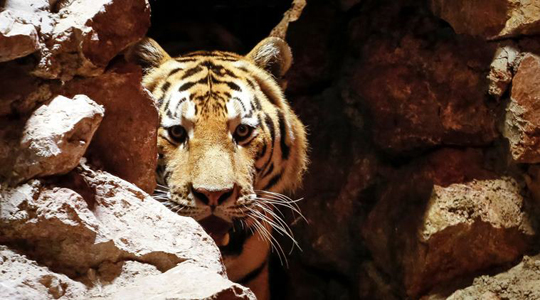
tiger

There will be also be an "irreversible" loss of breeding sites for wild animals after submergence of critical and specialised habitats under the proposed project which is likely to cost over Rs 9,000 crore.

The Ken-Betwa project is expected to provide drinking water supply for 13.42 lakh people and help irrigate 6.75 lakh hectares of land in the poverty-ridden Bundelkhand region covering parts of Madhya Pradesh and Uttar Pradesh.

The project is founded on construction of a dam at Dhaudan village inside the PTR's core area in Chhatarpur district of Madhya Pradesh.

"The entire forest area under the proposed submergence both within and outside PTR is tiger habitat, while the non-forest area is potential tiger habitat. Thus, about 90 sq km area of tiger habitat, including potential habitat, will have to be considered as submergence zone," National Board of Wildlife (NBWL) Standing Committee report on Ken-Betwa link project said.

At present, there are around 35 tigers in the reserve, which had in 2009 reported extinction of the big cats.

The report, which has been submitted to Union Environment Ministry, said the total counting of trees in the proposed submergence area has not been done, but a sample survey by the forest department has estimated that "about 7.2 lakh trees above 20 cm girth at breast height would submerge in the national park area and this number may go up to about 12 lakh stems when young poles and established sapling are accounted".

It said an equally high number of trees will be cut or lost in the forest areas outside the national park. "Thus considerable quantity of carbon stored as biomass would be released once the dam is constructed, in addition to loss of vegetation diversity," said the report, a copy of which was received by wildlife activist Ajay Dubey in response to an RTI query filed by him.

He said the National Green Tribunal and appropriate court will be approached to challenge the proposed project on the basis of the report's findings. The report said Panna Tiger Reserve has largely been valued with respect to the requirement of the tiger.

"The importance of other key wildlife such as sloth bear, leopard, rusty spotted cat, hyena, sambhar, chital, four-horned antelope and chinkara are largely ignored under the shadow of tiger, although tiger conservation may support the conservation of its associated fauna. Ken river along with its tributary is a lifeline of the park. Ken river basin is full of gorges, caves, rock crevices which are normally occupied by wild mammals for breeding and resting.

"During hot days in summer, these gorges, caves, rock crevices are major shelters for some of the animals listed above. Loss of breeding sites will be irreversible after submergence of these critical and specialised habitats, specifically in the major submergence zone," it said.

The blasting of stone quarries, use of heavy machinery, movement of heavy vehicles and presence of over 500 workers (at a time) for construction are some of the "major concerns", the report said.

"Given that the region (Bundelkhand) is poverty-ridden, the realised benefit of the project cannot be ignored and that there would certainly be a need to strike a balance between wildlife conservation and people's livelihood considerations," it said. The estimated cost of Ken-Betwa project is Rs 9,393 crore.

Comments

Add new comment

  • Coastaldigest.com reserves the right to delete or block any comments.
  • Coastaldigset.com is not responsible for its readers’ comments.
  • Comments that are abusive, incendiary or irrelevant are strictly prohibited.
  • Please use a genuine email ID and provide your name to avoid reject.
Agencies
June 29,2020

New Delhi, Jun 29: Witnessing azure skies and breathable air for the last three months, Delhi on Monday recorded deterioration in its air quality, with particulate matter with diameter of 2.5 and 10 microns -- too small to be filtered out of the human body -- standing at 52 and 297 micrograms per cubic respectively.

Gufran Beig, Project Director of System of Air Quality Weather Forecasting and Research (SAFAR), said that the sudden spike in air pollution is due to a mild dust storm blowing from Rajasthan.

"Since the wind direction is changing and moist air is coming in, the air quality in Delhi will become better by tomorrow," Beig told IANS.

Central Pollution Control Board (CPCB) data showed that the overall air quality near Delhi Technical University (DTU) area stood at 326 micrograms per cubic, followed by 308 at Narela and 307 at Mundka.

Out of 36 stations, the AQI in as many as 30 stations was above 200 micrograms per cubic till 1 pm on Monday.

The System of Air Quality Weather Forecasting and Research categorises air quality in the 0-50 range as good, 51-100 as satisfactory, 101-200 as moderate, 201-300 as poor, 301-400 as very poor, and above 400 as severe.

According to SAFAR's website, "PM 10 (coarser dust particle) is the lead pollutant. AQI is likely to improve to moderate category by tomorrow, and further improvement is expected by July 1."

Researchers indicated that PM 10 and PM 2.5 will be 170 and 47 micrograms per cubic on Tuesday.

With no vehicles plying on the roads or industries shut due to the lockdown since March 25, Delhi's air quality had improved drastically.

According to a study conducted by the Indian Institute of Technology (IIT), Delhi, if the low levels of air pollution reached during the lockdown period are maintained, India's annual death toll could reduce by 6.5 lakh.

Comments

Add new comment

  • Coastaldigest.com reserves the right to delete or block any comments.
  • Coastaldigset.com is not responsible for its readers’ comments.
  • Comments that are abusive, incendiary or irrelevant are strictly prohibited.
  • Please use a genuine email ID and provide your name to avoid reject.
Agencies
January 10,2020

Indian enterprises were flooded with a whopping 14.6 crore malware threats in 2019 - a growth of 48 per cent (year-on-year) compared to 2018, a new report said on Friday.

Manufacturing, BFSI (banking, financial services and insurance), education, healthcare, IT/ITES, and the government were the most at-risk industries in the country, said the report from Seqrite, the enterprise arm of Pune-based IT security firm Quick Heal Technologies.

Interestingly, almost a quarter (23 per cent) of the threats were identified through 'Signatureless behaviour-based' detection by Seqrite, indicating how a growing number of cybercriminals were deploying new or previously unknown threat vectors to compromise enterprise security.

"With the latest Seqrite annual threat report, we want to empower CIOs, CISOs, business leaders and all key public stakeholders with the insights they need to combat the growing complexity of the threat landscape," said Sanjay Katkar, Joint Managing Director and CTO, Quick Heal Technologies.

The most prominent trend was the drastic increase in the volume, intensity, and sophistication of cyber-attack campaigns targeting Indian enterprises in 2019.

The rapid integration of IoT devices, BYOD (bring your own device), and third-party APIs into enterprise networks has created newer security vulnerabilities that might go unnoticed until a major breach occurs.

Threat researchers at Seqrite observed several large-scale advanced persistent threats (APT) attacks deployed against organisations in the government sector.

"The entry of nation-states and organised cybercrime cells into the fray is expected to add more complication to this situation and will require Indian government bodies and corporate enterprises to shore up their cyber defence strategies in 2020 and beyond," the report noted.

More alarming, however, was the continued lack of security awareness amongst enterprises and government organisations.

"Unsecured Remote Desktop Protocol (RDP) and Server Message Block (SMB) protocols continued to be targeted through brute-force attacks," said the report.

Spear phishing attack campaigns leveraging Office exploits and infected macros were also used extensively by cybercriminals to gain access to enterprise networks and steal critical data.

"India's digital journey depends on ensuring robust cybersecurity for all stakeholders within the enterprise ecosystem," said Katkar.

The sharp spike should be a cause of concern for CIOs and CISOs in the country, especially given the growing digital penetration within their enterprise networks.

"With network vulnerabilities and potential entry points increasing at a rapid pace, threat actors are expected to leverage artificial intelligence (AI) capabilities to power their malware campaigns in the future to capitalise on newer attack vectors," the report added.

Comments

Add new comment

  • Coastaldigest.com reserves the right to delete or block any comments.
  • Coastaldigset.com is not responsible for its readers’ comments.
  • Comments that are abusive, incendiary or irrelevant are strictly prohibited.
  • Please use a genuine email ID and provide your name to avoid reject.
Agencies
February 29,2020

Ahmedabad, Feb 29: The presence of two feral pigeons onboard a GoAir flight at the airport in Ahmedabad in Gujarat created a flutter among the amused passengers, even though the avian surprise did not lead to any untoward incident or delay in the flight.

The incident took place on Friday when the passengers were boarding the Ahmedabad-Jaipur flight.

"Two pigeons had found their way inside the flight G8 702 while the passengers were boarding," an airline statement said on Saturday.

"The crew immediately shooed away the birds. The flight took off at its scheduled time at 5 p.m.," it added.

Comments

Add new comment

  • Coastaldigest.com reserves the right to delete or block any comments.
  • Coastaldigset.com is not responsible for its readers’ comments.
  • Comments that are abusive, incendiary or irrelevant are strictly prohibited.
  • Please use a genuine email ID and provide your name to avoid reject.