



Reserve may submerge in Ken-Betwa project

September 25, 2016

New Delhi, Sep 25: About 7.2 lakh trees and a huge 90 square kilometres area of Panna Tiger Reserve (PTR) may be submerged in water due to the Ken-Betwa river linking project, according to an official report.
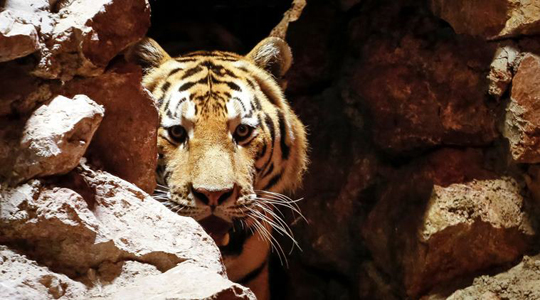
tiger

There will be also be an "irreversible" loss of breeding sites for wild animals after submergence of critical and specialised habitats under the proposed project which is likely to cost over Rs 9,000 crore.

The Ken-Betwa project is expected to provide drinking water supply for 13.42 lakh people and help irrigate 6.75 lakh hectares of land in the poverty-ridden Bundelkhand region covering parts of Madhya Pradesh and Uttar Pradesh.

The project is founded on construction of a dam at Dhaudan village inside the PTR's core area in Chhatarpur district of Madhya Pradesh.

"The entire forest area under the proposed submergence both within and outside PTR is tiger habitat, while the non-forest area is potential tiger habitat. Thus, about 90 sq km area of tiger habitat, including potential habitat, will have to be considered as submergence zone," National Board of Wildlife (NBWL) Standing Committee report on Ken-Betwa link project said.

At present, there are around 35 tigers in the reserve, which had in 2009 reported extinction of the big cats.

The report, which has been submitted to Union Environment Ministry, said the total counting of trees in the proposed submergence area has not been done, but a sample survey by the forest department has estimated that "about 7.2 lakh trees above 20 cm girth at breast height would submerge in the national park area and this number may go up to about 12 lakh stems when young poles and established sapling are accounted".

It said an equally high number of trees will be cut or lost in the forest areas outside the national park. "Thus considerable quantity of carbon stored as biomass would be released once the dam is constructed, in addition to loss of vegetation diversity," said the report, a copy of which was received by wildlife activist Ajay Dubey in response to an RTI query filed by him.

He said the National Green Tribunal and appropriate court will be approached to challenge the proposed project on the basis of the report's findings. The report said Panna Tiger Reserve has largely been valued with respect to the requirement of the tiger.

"The importance of other key wildlife such as sloth bear, leopard, rusty spotted cat, hyena, sambhar, chital, four-horned antelope and chinkara are largely ignored under the shadow of tiger, although tiger conservation may support the conservation of its associated fauna. Ken river along with its tributary is a lifeline of the park. Ken river basin is full of gorges, caves, rock crevices which are normally occupied by wild mammals for breeding and resting.

"During hot days in summer, these gorges, caves, rock crevices are major shelters for some of the animals listed above. Loss of breeding sites will be irreversible after submergence of these critical and specialised habitats, specifically in the major submergence zone," it said.

The blasting of stone quarries, use of heavy machinery, movement of heavy vehicles and presence of over 500 workers (at a time) for construction are some of the "major concerns", the report said.

"Given that the region (Bundelkhand) is poverty-ridden, the realised benefit of the project cannot be ignored and that there would certainly be a need to strike a balance between wildlife conservation and people's livelihood considerations," it said. The estimated cost of Ken-Betwa project is Rs 9,393 crore.

Comments

Add new comment

  • Coastaldigest.com reserves the right to delete or block any comments.
  • Coastaldigset.com is not responsible for its readers’ comments.
  • Comments that are abusive, incendiary or irrelevant are strictly prohibited.
  • Please use a genuine email ID and provide your name to avoid reject.
Agencies
July 6,2020

The Covid-19 pandemic has made an unprecedented impact on the Indian businesses, particularly small and medium enterprises (SMEs) and startups. According to a joint survey by FICCI and Indian Angel Network (IAN), the pandemic has hit the businesses of around 70% startups.

With uncertainty in the business environment and an unexpected shift in priorities of the government as well as corporates, many startups are struggling to survive, it says.

In a nationwide survey on the 'Impact of Covid-19 on Indian Startups' involving 250 startups, 70% participants said their businesses had been impacted by Covid-19 and around 12% had shut operations.

The survey shows only 22% startups have cash reserves to meet the fixed cost expenses over the next 3-6 months, and 68% are reducing operational and administrative expenses.

Around 30% of the companies said they would retrench employees if the lockdown was extended too long. The 43% startups have already started 20-40% salary cuts over April-June.

Over 33% startups said investors had put the investment decision on hold and 10% said the deals had been scrapped. Only 8% startups had received funds as per the deals signed before Covid-19 outbreak, the survey revealed.

The reduced funding has forced startups to put a hold on business development and manufacturing activities, which has resulted in loss of projected orders.

The survey highlights the need of an urgent relief package for startups, including possible purchase orders from the government, tax relief and swifter tax refunds, and immediate fiscal support measures, including grants, soft loans and payroll grants.

Besides 250 startups, 61 incubators and investors also participated in the survey.

While 96% of investors accepted that their investments in startups had been impacted by Covid-19, 92% said their investments in startups would continue to be low over the next six months.

Around 59% investors said they would prefer to work with the existing portfolio firms in the coming months. Only 41% said they would consider new deals.

"A comparison of priority investment sectors before and during Covid-19 shows 35% investors are now looking at investments in healthcare startups, followed by EdTech, AI/Deep Tech, FinTech and Agri," said the survey.

Around 44% incubators surveyed said their day-to-day operations had been considerably hit by Covid-19. Most incubators are now supporting their portfolio firms by providing them virtual platforms to interact with mentors, investors and industries.

Dilip Chenoy, FICCI Secretary General, said, "The startup sector is stressed for survival at the moment. The investment sentiment is also subdued and is expected to remain so in the coming months. Lack of working capital and cash flows may lead to major layoffs over the next 3-6 months."

Indian startups needed an enabling ecosystem and flow of funds to continue operations, the survey said.

Padmaja Ruparel, President, Indian Angel Network & Co-Chair of FICCI Startup Committee, said, "In these uncertain times, as investors, we must play an important role to provide the Indian startups funding, mentoring and hand-holding support to stay afloat and come out at the other end of this crisis."

To that end, IAN recently announced a debt fund to help IAN portfolio companies raise working capital and ensure business continuity by partnering with debt providers.

This must be replicated on a wider scale, so a larger number of startups are provided the capital support to make it during these tough times, Ruparel said.

Comments

Add new comment

  • Coastaldigest.com reserves the right to delete or block any comments.
  • Coastaldigset.com is not responsible for its readers’ comments.
  • Comments that are abusive, incendiary or irrelevant are strictly prohibited.
  • Please use a genuine email ID and provide your name to avoid reject.
Agencies
June 16,2020

Paris, Jun 16: Increasing numbers of readers are paying for online news around the world even if the level of trust in the media, in general, remains very low, according to a report published Tuesday.

Around 20 percent of Americans questioned said they subscribed to an online news provider (up to four points over the previous year) and 42 percent of Norwegians (up eight points), along with 13 percent of the Dutch (up to three points), compared with 10 percent in France and Germany.

But between a third and a half of all news subscriptions go to just a few major media organisations, such as the New York Times, according to the annual Digital News Report by the Reuters Institute.

Some readers, however, are also beginning to take out more than one subscription, paying for a local or specialist title in addition to a national news source, the study's authors said.

But a large proportion of internet users say nothing could convince them to pay for online news, around 40 percent in the United States and 50 percent in Britain.

YouGov conducted the online surveys of 40 countries for the Reuters Institute in January, with 2,000 respondents in each.

Further surveys were carried out in six countries in April to analyse the initial effects of COVID-19.

The health crisis brought a revival of interest in television news -- with the audience rising five percent on average -- establishing itself as the main source of information along with online media.

Conversely, newspaper circulation was hard-hit by coronavirus lockdown measures.

The survey found trust in the news had fallen to its lowest level since the first report in 2012, with just 38 percent saying they trusted most news most of the time.

However, confidence in the news media varied considerably by country, ranging from 56 percent in Finland and Portugal to 23 percent in France and 21 percent in South Korea.

In Hong Kong, which has been hit by months of sometimes violent street protests against an extradition law, trust in the news fell 16 points to 30 percent over the year.

Chile, which has had regular demonstrations against inequality, saw trust in the media fall 15 percent while in Britain, where society has been polarised by issues such as Brexit, it was down 12 points.

Comments

Add new comment

  • Coastaldigest.com reserves the right to delete or block any comments.
  • Coastaldigset.com is not responsible for its readers’ comments.
  • Comments that are abusive, incendiary or irrelevant are strictly prohibited.
  • Please use a genuine email ID and provide your name to avoid reject.
Agencies
March 3,2020

Facebook on Monday launched a new consumer marketing campaign in India titled 'More Together'. India is the first country in the Asia Pacific region where such a campaign is being rolled out.

It is also the first time that Facebook is rolling out a 'high decibel campaign of this stature in India', the company said in a statement.

It is also the first time that Facebook is rolling out a 'high decibel campaign of this stature in India', the company said in a statement.

"India is at the heart of Facebook and one of our focus areas this year is to tell the exciting story of a service that is deeply embedded in the fabric of India," said Ajit Mohan, Vice President and Managing Director, Facebook India.

The campaign would have multiple campaigns over the next few weeks in eight languages and the one will be set in the context of Holi.

Facebook in 2019 introduced a new company logo to further distinguish the company from the Facebook app.

The company recently announced the appointment of Avinash Pant as the Marketing Director for India operations, to drive the consumer marketing efforts across the family of apps.

Comments

Add new comment

  • Coastaldigest.com reserves the right to delete or block any comments.
  • Coastaldigset.com is not responsible for its readers’ comments.
  • Comments that are abusive, incendiary or irrelevant are strictly prohibited.
  • Please use a genuine email ID and provide your name to avoid reject.