



Reserve may submerge in Ken-Betwa project

September 25, 2016

New Delhi, Sep 25: About 7.2 lakh trees and a huge 90 square kilometres area of Panna Tiger Reserve (PTR) may be submerged in water due to the Ken-Betwa river linking project, according to an official report.
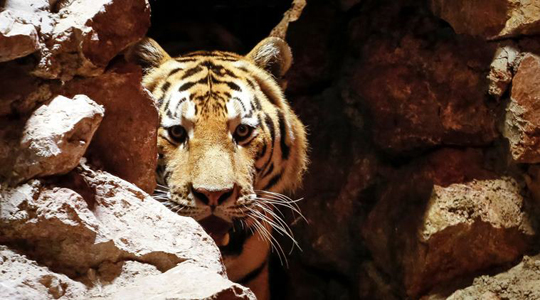
tiger

There will be also be an "irreversible" loss of breeding sites for wild animals after submergence of critical and specialised habitats under the proposed project which is likely to cost over Rs 9,000 crore.

The Ken-Betwa project is expected to provide drinking water supply for 13.42 lakh people and help irrigate 6.75 lakh hectares of land in the poverty-ridden Bundelkhand region covering parts of Madhya Pradesh and Uttar Pradesh.

The project is founded on construction of a dam at Dhaudan village inside the PTR's core area in Chhatarpur district of Madhya Pradesh.

"The entire forest area under the proposed submergence both within and outside PTR is tiger habitat, while the non-forest area is potential tiger habitat. Thus, about 90 sq km area of tiger habitat, including potential habitat, will have to be considered as submergence zone," National Board of Wildlife (NBWL) Standing Committee report on Ken-Betwa link project said.

At present, there are around 35 tigers in the reserve, which had in 2009 reported extinction of the big cats.

The report, which has been submitted to Union Environment Ministry, said the total counting of trees in the proposed submergence area has not been done, but a sample survey by the forest department has estimated that "about 7.2 lakh trees above 20 cm girth at breast height would submerge in the national park area and this number may go up to about 12 lakh stems when young poles and established sapling are accounted".

It said an equally high number of trees will be cut or lost in the forest areas outside the national park. "Thus considerable quantity of carbon stored as biomass would be released once the dam is constructed, in addition to loss of vegetation diversity," said the report, a copy of which was received by wildlife activist Ajay Dubey in response to an RTI query filed by him.

He said the National Green Tribunal and appropriate court will be approached to challenge the proposed project on the basis of the report's findings. The report said Panna Tiger Reserve has largely been valued with respect to the requirement of the tiger.

"The importance of other key wildlife such as sloth bear, leopard, rusty spotted cat, hyena, sambhar, chital, four-horned antelope and chinkara are largely ignored under the shadow of tiger, although tiger conservation may support the conservation of its associated fauna. Ken river along with its tributary is a lifeline of the park. Ken river basin is full of gorges, caves, rock crevices which are normally occupied by wild mammals for breeding and resting.

"During hot days in summer, these gorges, caves, rock crevices are major shelters for some of the animals listed above. Loss of breeding sites will be irreversible after submergence of these critical and specialised habitats, specifically in the major submergence zone," it said.

The blasting of stone quarries, use of heavy machinery, movement of heavy vehicles and presence of over 500 workers (at a time) for construction are some of the "major concerns", the report said.

"Given that the region (Bundelkhand) is poverty-ridden, the realised benefit of the project cannot be ignored and that there would certainly be a need to strike a balance between wildlife conservation and people's livelihood considerations," it said. The estimated cost of Ken-Betwa project is Rs 9,393 crore.

Comments

Add new comment

  • Coastaldigest.com reserves the right to delete or block any comments.
  • Coastaldigset.com is not responsible for its readers’ comments.
  • Comments that are abusive, incendiary or irrelevant are strictly prohibited.
  • Please use a genuine email ID and provide your name to avoid reject.
News Network
February 21,2020

London, Feb 21: Scientists have discovered a new species of land snail, and have named it Craspedotropis Greta Thunberg in honour of the Swedish activist Greta Thunberg for her efforts to raise awareness about climate change.

According to the study, published in the Biodiversity Data Journal, the newly discovered species belongs to the so-called caenogastropods -- a group of land snails known to be sensitive to drought, temperature extremes, and forest degradation.

The scientists, including evolutionary ecologist Menno Schilthuizen from Naturalis Biodiversity Center in the Netherlands, said the snails were found very close to the research field station at Kuala Belalong Field Studies Centre in Brunei.

They added that the snails were discovered at the foot of a steep hill-slope, next to a river bank, foraging at night on the green leaves of understorey plants.

The effort aided by amateur scientist J.P. Lim, who found the first individual of the snail said, "Naming this snail after Greta Thunberg is our way of acknowledging that her generation will be responsible for fixing problems that they did not create."

"And it's a promise that people from all generations will join her to help," Lim said.

The researchers said they approached Thunberg who said that she would be "delighted" to have this species named after her.

The study work including, fieldwork, morphological study, and classification of identified specimen was carried out in a field centre with basic equipment and no internet access, the scientists said.

According to the study, the work was done by untrained ‘citizen scientists’ guided by experts, on a 10-day taxon expedition.

"While we are aware that this way of working has its limitations in terms of the quality of the output (for example, we were unable to perform dissections or to do extensive literature searches), the benefits include rapid species discovery and on-site processing of materials," the researchers wrote in the study.

Comments

Add new comment

  • Coastaldigest.com reserves the right to delete or block any comments.
  • Coastaldigset.com is not responsible for its readers’ comments.
  • Comments that are abusive, incendiary or irrelevant are strictly prohibited.
  • Please use a genuine email ID and provide your name to avoid reject.
Agencies
January 26,2020

New Delhi, Jan 26: Google on Sunday marked India's 71st Republic Day by dedicating a doodle illustrating the country's rich cultural heritage that permeates and unites the diverse nation.

From its world-famous landmarks like the Taj Mahal and India Gate, to the wide array of fauna such as its national bird (the Indian peafowl), to classical arts, textiles, and dances, the doodle, designed by Singapore-based artist Meroo Seth, brings together the rich cultural heritage of the country.

Republic Day marks the completion of India's transition towards becoming an independent republic after its constitution came into effect. The governing document had taken nearly three years of careful deliberation to finalise, and its eventual enactment was joyfully celebrated across the country.

While the Constitution was adopted by the Indian Constituent Assembly on 26 November 1949, it came into effect on January 26 -- a day when Declaration of Indian Independence (Purna Swaraj) was proclaimed by the Indian National Congress back in 1929, as opposed to the Dominion status offered by the British Regime.

Festivities embody the essence of diversity found in one of the world's most populous nations, celebrated over a three-day period with cultural events displaying national pride.

Last year's doodle on Republic Day, designed by artist Reshidev RK, had featured Rashtrapati Bhavan in the background along with a display of the country's iconic monuments and heritage.

Comments

Add new comment

  • Coastaldigest.com reserves the right to delete or block any comments.
  • Coastaldigset.com is not responsible for its readers’ comments.
  • Comments that are abusive, incendiary or irrelevant are strictly prohibited.
  • Please use a genuine email ID and provide your name to avoid reject.
Agencies
June 18,2020

New Delhi, Jun 18: Vodafone Idea on Thursday told the Supreme Court that it has incurred Rs 1 lakh crore losses as it insisted it is not in a position to furnish bank guarantees.

A bench comprising Justices Arun Mishra, S. Abdul Nazeer, and M.R. Shah, taking up the adjusted gross revenue (AGR) matter through video conferencing, directed the telecom companies to submit their financial documents and books for the last 10 years.

Asking Vodafone if it was a foreign company, the bench said that how can the company say it would not furnish any bank guarantee.

"What if you fly away overnight in future without paying anything?" it asked.

Senior advocate Mukul Rohatgi, representing Vodafone Idea, denied his client is a completely foreign firm and cited before the bench its tie-ups and investments.

Vodafone owes over Rs 58,000 crore as AGR dues and so far, has paid close to Rs 7,000 crore.

Rohatgi contended before the court that the telecom company is in a tough situation, and cannot furnish any fresh bank guarantee, as profits have eluded the company in past many quarters. He submitted before the bench that Rs 15,000 crore bank guarantees are lying with the government, and his client's losses are over Rs 1 lakh crore.

"I cannot offer any more surety," he informed the bench.

Justice Mishra noted that this is public money and these dues should be recovered. "Do not tell us that you will pay if you were to make profits... the money must come," he noted.

Justice Shah observed that the telecom industry is the only industry which earned during the Covid-19 pandemic. "After all, this money will be used for public welfare", he said.

Rohatgi argued that his client would have to fold up if orders were issued to clear dues tomorrow. "11,000 employees will have to go without notice, as we cannot pay them," he added.

Senior advocate Abhishek Manu Singhvi, appearing for Bharti Airtel, contended before the court that out of Rs 21,000 crore AGR dues, the company has already deposited a sum of Rs 18,000 crore.

He argued that his client has given a bank guarantee, in excess of demand, to DoT, and supported the proposal for phased repayment of remaining AGR dues. He insisted that the company needs to sit down with the government and calculate the dues. Airtel owes Rs 25,976 crore after paying Rs 18,000 crore, as per the government.

Senior advocate Arvind Datar, representing Tata Telecom, informed the bench that his client has paid Rs 6,504 crore in AGR dues so far, and furnishing a bank guarantee may adversely impact investments in the sector.

The total AGR dues are close to Rs 1.5 lakh crore.

The top court will now take up the matter in the third week of July.

Comments

Add new comment

  • Coastaldigest.com reserves the right to delete or block any comments.
  • Coastaldigset.com is not responsible for its readers’ comments.
  • Comments that are abusive, incendiary or irrelevant are strictly prohibited.
  • Please use a genuine email ID and provide your name to avoid reject.