



Resurgence of Godse Worship

[email protected] (Ram Puniyani)
January 2, 2015

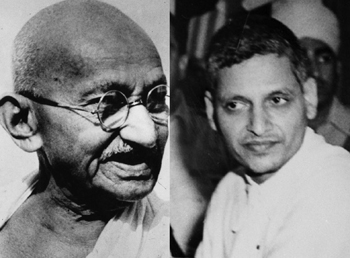
Times are a changing; and changing fast. During last many decades most Hindu nationalists have kept the appreciation of their hero, Nathuram Godse under wraps. The programs appreciating his politics did use to make small news here and there some time; but as such it was a muted act not much publicized and generally kept as a low key affair. During last few years Pradeep Dalvi’s play in Marathi, Mee Nathuram Boltoy (I, Nathuram speaking), attacking Gandhi and upholding Godse, drew packed houses in various places in Maharashtra. Many people had also protested against staging of this play off and on.
Resurgence of Godse

With the new dispensation coming to power (Modi Sarkar, May, 2014) many a communal assertions, acts and intimidations are up in the air. It seems these acts are being silently appreciated by those in power. This inference is logical as none in the positions of power have either reprimanded or opposed these Godse acolytes. The main reason is that due to the compulsions of power they do not openly support the Godse appreciation clubs. They also do not condemn these voices as they too belong to the Godse ideology of Hindu nationalism. This Hindu nationalism in popular parlance is projected as ‘Nationalism’, keeping the Hindu prefix in the silent mode.

The latest in the series of acts-statements by this Godse appreciation clubs is the bhumi pujan (earth prayer-a ritual before beginning of new construction) by Hindu Mahasabha for Godse temple in Meerut (Dec 25 2014). The activists of Akhil Bharatiya Hindu Mahasabha are all set to build the country's first temple for murderer of Mahatma Gandhi in Meerut. There are several demands from the Hindu Mahasabha offices to install his statues. The Hindu Mahasabha has requested land from the Centre to erect a statue of Godse in the national capital. The paperback issue of Godse’s book is already running into second reprint.

The BJP MP Sakhshi Maharaj recently called Godse as Nationalist; of course he retracted it soon; apparently to ensure that the ruling party, BJP, is not embarrassed on the issue. At the same time, BJP’s parent organization RSS has come out with two books meant for internal circulation. These books claim to ensure that RSS viewpoint is reached to its Pracharaks, swayamsevaks. These books are RSS-Ek Parichay (RSS-an introduction) and RSS-Ek Saral Parichay (RSS-a simple introduction), the second of which is written by veteran RSS member MG Vaidya. Mr. Vaidya claims that "a narrative of accusation was built around RSS" so the book to dispel that. Essentially these books aim to dissociate RSS from Godse. While the Prime Minister Mr. Modi is maintaining maun (silence) on the subject the opposition leaders are strongly criticizing Hindu Mahasabha's and others’ views on the murder of Mahatma Gandhi by Nathuram Godse.

What is the relationship between Godse and RSS? Was he part of RSS and later left it or was he part of it and also joined Hindu Mahasabha in mid 1930s? As for as official line is concerned RSS has tried to keep its slate clean by stating that it had nothing to do with Godse and he was not a member of RSS when he killed Mahatma Gandhi. Just to recall, in early 1998 Professor Rajendra Singh, the then RSS chief, had stated "Godse was motivated by akhand Bharat. His intention was good but he used the wrong method." (April 27 1998, Outlook)

How do we understand the whole issue? The major backdrop to understand the issue is to see the politics of Hindu nationalism as expressed through Hindu Mahasbah and RSS. These organizations remained aloof from freedom struggle. Hindu Mahasabha (HM), was more interested in the immediate participation in politics, as the flag bearers of Hindu communal politics, and the RSS wanted to concentrate on making a network of ‘cadres’ before forming organizations and infiltrating into different arena of education, culture, electoral politics and state apparatus. There was a lot of overlap in the agenda of these organizations as they were both working for the common goal of Hindu Nation. Nathuram Godse, ‘uniquely’ symbolized the fusion of both these two trends.

RSS could get away with dissociating with Godse or rather underplaying Godse’s association with RSS as there was no official record of members of RSS, and so they could disown Godse at legal level. In 1930 Godse joined RSS and very soon rose to be the bauddhik pracharak (intellectual propagator). Like both HM & RSS he was ardent Hindu Nationalist.

As a strong Hindutvawadi he was extremely critical of Gandhi’s ahimsa (non-violence) and the anti British movements led by him. Godse had very poor opinion of Gandhi’s role in freedom movement. RSS-Hindu Mahasbha kept criticizing Gandhi for his involving all religious communities in the freedom movement. Gandhi kept religion as personal matter and projected overarching Indian identity for all. This was what annoyed the HM-RSS combine, as they wanted only Hindus to be recognized as Indians. Godse’s assessment of nationalism of Gandhi is expressed in a way which identifies nationalism with Hindu kings. He used very peculiar parameters to assess Gandhi, “His (Gandhi’s, added) followers cannot see what is clear even to the blind viz. that Gandhi was a mere pigmy before Shivaji, Rana Pratap and Guru Govind (ibid Pg. 40, Why I assassinated Gandhi?) and finally about the winning of swaraj and freedom I maintain the Mahatma’s contribution was negligible.” (Ibid. pg. 87)

He held Mahatma responsible for appeasing Muslims, and thereby the formation of Pakistan. About his association with RSS and Hindu Mahasabha, he writes, “Having worked for the uplift of the Hindus I felt it necessary to take part in political activities of the country for the protection of just rights of Hindus. I therefore left the Sangh and joined Hindu Mahasabha (Godse, ‘Why I Assassinated Mahatma Gandhi’ 1993, Pg. 102).

Hindu Mahasabha at that time the only political party of Hindutva, and he became general secretary of its Pune Branch. In due course he started a newspaper, as founder editor, called Agrani or Hindu Rashtra. As such Gandhi murder was not on the charges propagated by them (Partition and insistence on paying Pakistan’s dues (55 crore) from the treasury), but due to the basic deep differences with the politics of Gandhi and that of the followers of the Hindu Rashtra. These two reasons are proffered merely as a pretext for the same.

What does Godse mean when he says that he left RSS? Is it true? This truth behind Nathuram’s leaving RSS, is clarified by his brother Gopal Godse. In an interview given to ‘The Times of India’ (25 Jan 98); Gopal Godse, who was also an accomplice in the murder when tells us the reality behind Nathuram’s statement that ‘he left RSS’. Gopal Godse says “The appeasement policy followed by him (Gandhi, added) and imposed on all Congress governments’ encouraged the Muslim separatist tendencies that eventually created Pakistan…Technically and theoretically he (Nathuram) was a member (of RSS), but he stopped workings for it later. His statement in the court that he had left the RSS was to protect the RSS workers who would be imprisoned following the murder. On the understanding that they (RSS workers) would benefit from his dissociating himself from the RSS, he gladly did it."

So this is the logic of Godse saying that he ‘left’ RSS. The dual membership (RSS+Hindu Mahasabha) was not a problem. Thus the murder of Gandhi was steeped in both the streams of Hindutva politics, RSS and HM. His editing the paper called, ‘Hindu Rashtra was quite symbolic. This murder had a broad sanction of the followers of HM and RSS, as they celebrated Mahatma’s murder by distributing sweets, “All their (RSS) leaders’ speeches were full of communal poison. As a final result, the poisonous atmosphere was created in which such a ghastly tragedy (Gandhi’s murder) became possible. RSS men expressed their joy and distributed sweets after Gandhi’s death." (excerpt from Sardar Patel’s letters to M S Golwalkar and S P Mookerjee.). Godse was no freak. The way Hindu communalists were spewing poison against Gandhi, it was the logical outcome of their politics. And Godse had the ‘benefit’ of the teachings of both RSS as well as HM. They used the word wadh for this murder. This word wadh stands for killing a demon who is harming the society. In a way Gandhi murder was the first major offensive of the Hindutva politics on Indian Nationalism; in a way it was to herald the onset of bigger strides which Hindutva politics has assumed during last few decades, and this is what we are witnessing today.

So though officially RSS family kept dissociating from Gandhi’s murder by Godse, in private many a members not only uphold the dastardly act, but also have even succeeded in undermining the importance of Mahatma and they do ‘sympathize’ with Godse. This complex trick kept going on so far. Now with Modi Sarkar there is no need to hide the true ideology and thinking of this combine and so the open efforts to glorify Godse!

Comments

Add new comment

  • Coastaldigest.com reserves the right to delete or block any comments.
  • Coastaldigset.com is not responsible for its readers’ comments.
  • Comments that are abusive, incendiary or irrelevant are strictly prohibited.
  • Please use a genuine email ID and provide your name to avoid reject.
Wafa Sultana
April 4,2020

Over the last couple of days when the world was occupied with unifying efforts to fight the deadly Covid19 pandemic, sections of Indian media provided viewers a familiar scapegoat – the Indian Muslims – who are often stereotyped as a community being constantly at loggerheads with the citizenry and the State. Biased media channels were quick to resort to blaming the entire Muslim community for the spread of the disease in the country, thanks to an ill-timed Tablighi Jamaat gathering at its international headquarters in Delhi’s Nizamuddin. Unsurprisingly, the opprobrium was also marked by a sudden spike in WhatsApp forwards of videos with people wearing skullcaps licking spoons and performing Sufi breathing rituals, suggesting some sort of wild conspiracy on the part of the community to spread the virus.  Some media channels were quick to formulate, hypothesize and provide loose definitions of a newly discovered form of Jihad i.e. ‘Corona Jihad ’ thereby vilifying the Islamic faith and its followers.

While the investigation on the culpability of the organizers of the Nizamuddin event is still ongoing, there is enough information to suggest that the meeting was held before any lockdown was in force, and the problem began when there was no way of getting people out once the curfew was announced. Be that as it may, there is little doubt that organizing a meet of such a scale when there is a global pandemic smacks of gross misjudgment, and definitely the organizers should be held accountable if laws or public orders were defied. Attendees who attempt to defy quarantine measures must be dealt with strictly. However, what is alarming is that the focus and narrative have now shifted from the unfortunate event at Nizamuddin to the Tablighi Jamaat itself.

For those not familiar with the Tablighi Jamaat, the organization was founded in 1926 in Mewat by scholar Maulana Mohammad Ilyas. The Jamaat’s main objective was to get Muslim youth to learn and practice pristine Islam shorn of external influences. This is achieved through individuals dedicating time for moral and spiritual upliftment secluded from the rest of the world for a brief period of time. There is no formal membership process. More senior and experienced participants typically travel from one mosque to other delivering talks on religious topics, inviting local youth to attend and then volunteer for a spiritual retreat for a fixed number of days to a mosque in a nearby town or village to present the message to their co-religionists. Contrary to ongoing Islamophobic rhetoric, the movement does not actively proselytize. The focus is rather on getting Muslims to learn the teachings and practices of Islam.  This grassroots India-based movement has now grown to almost all countries with substantial Muslim populations. Its annual meets, or ‘ijtemas’ are among the largest Islamic congregations in the world after the annual Haj. One of the reasons for its popularity and wide network in the subcontinent and wordwide is the fact that it has eschewed the need for scholarly intervention, focusing on peer learning of fundamental beliefs and practice rather than high-falutin ideological debates. The Tablighi Jamaat also distinguishes itself from other Islamic movements through its strictly apolitical nature, with a focus on individual self-improvement rather than political mobilization. Hardships and difficulty in the world are expected to be face through ‘sabr’ (patience) and ‘dua’ (supplication),  than through quest for political power or influence. In terms of ideology, it is very much based on mainstream Sunni Islamic principles derived from the Deobandi school.

So, why is all this background important in the current context? While biased media entities have expectedly brought out their Islamophobic paraphernalia out for full display, more neutral commentators have tried to paint the Tablighi Jamaat as a fringe group and have tried to distance it from 'mainstream Muslims'. While the intent is no doubt innocent, this is a trap we must not fall into. This narrative, unfortunately, is also gaining ground due to apathy some Muslims have for the group, accusing it of being “disconnected from the realities of the world”. Unlike other Muslim organizations and movements, the Tablighi Jamat, by virtue of its political indifference, does not boast of high-profile advocates and savvy spokespersons who can defend it in mainstream or social media.  The use of adjectives such as 'outdated' and 'orthodox' by liberal columnists to describe the Jamaat feeds into the malignant attempt to change the narrative from the control of the spread of the pandemic due to the Nizamuddin gathering to 'raison d'etre' of the organization itself.

A large mainstream religious group like the Tablighi Jamaat with nearly a hundred-year history, normally considered to be peaceful, apolitical and minding its own business is now suddenly being villainized owing to unfortunate circumstances. Biased media reactions filled with disgust and hate seem to feed the Indian public conscience with a danngerous misconception - to be a nominal Muslim is okay but being a practicing one is not.  For those committed to the truth and fighting the spread of Islamophobia, the temptation to throw the entire Tablighi Jamaat under the bus must be resisted.

The writer is a lawyer and research scholar at Qatar University. Her research interests include Islamic law and politics.

Comments

zahoorahmed
 - 
Saturday, 4 Apr 2020

great article! provides a great perspective on tableeg jamat

Add new comment

  • Coastaldigest.com reserves the right to delete or block any comments.
  • Coastaldigset.com is not responsible for its readers’ comments.
  • Comments that are abusive, incendiary or irrelevant are strictly prohibited.
  • Please use a genuine email ID and provide your name to avoid reject.
Ram Puniyani
March 14,2020

In the wake of Citizenship Amendment Act (CAA) UN High Commissioner, Michele Bachelet, has filed an intervention in the Supreme Court petition challenging the constitutionality of the Citizenship Amendment Act, as she is critical of CAA. Responding to her, India’s Foreign Minister S. Jai Shanker strongly rebutted her criticism, saying that the body (UNHCR) has been wrong and is blind to the problem of cross border terrorism. The issue on hand is the possibility of scores of people, mainly Muslims, being declared as stateless. The problem at hand is the massive exercise of going through the responses/documents from over 120 crore of Indian population and screening documents, which as seen in Assam, yield result which are far from truthful or necessary.

The issue of CAA has been extensively debated and despite heavy critique of the same by large number of groups and despite the biggest mass opposition ever to any move in Independent India, the Government is determined on going ahead with an exercise which is reminiscent of the dreaded regimes which are sectarian and heartless to its citizens, which have indulged in extinction of large mass of people on grounds of citizenship, race etc. The Foreign minister’s assertion is that it is a matter internal to India, where India’s sovereignty is all that matters! As far as sovereignty is concerned we should be clear that in current times any sovereign power has to consider the need to uphold the citizenship as per the principle of non-discrimination which is stipulated in Art.26 of the International Covenant on Civil and Political (ICCPR) rights.

Can such policies, which affect large number of people and are likely to affect their citizenship be purely regarded as ‘internal’? With the World turning into a global village, some global norms have been formulated during last few decades. The norms relate to Human rights and migrations have been codified. India is also signatory to many such covenants in including ICCPR, which deals with the norms for dealing with refugees from other countries. One is not talking of Chicago speech of Swami Vivekanand, which said that India’s greatness has been in giving shelter to people from different parts of the World; one is also not talking of the Tattariaya Upanishad’s ‘Atithi Devovhav’ or ‘Vasudhaiva Kutumbkam’ from Mahaupanishad today.

What are being talked about are the values and opinions of organizations which want to ensure to preserve of Human rights of all people Worldwide. In this matter India is calling United Nations body as ‘foreign party’; having no locus standi in the case as it pertains to India’s sovereignty. The truth is that since various countries are signatories to UN covenants, UN bodies have been monitoring the moves of different states and intervening at legal level as Amicus (Friend of the Court) to the courts in different countries and different global bodies. Just to mention some of these, UN and High Commissioner for Human Rights has often submitted amicus briefs in different judicial platforms. Some examples are their intervention in US Supreme Court, European Court of Human Rights, International Criminal Court, and the Inter-American Court of Human Rights. These are meant to help the Courts in areas where UN bodies have expertise.

 Expertise on this has been jointly formulated by various nations. These interventions also remind the nations as to what global norms have been evolved and what are the obligations of individual states to the values which have evolved over a period of time. Arvind Narrain draws our attention to the fact that, “commission has intervened in the European Court of Human Rights in cases involving Spain and Italy to underscore the principle of non-refoulement, which bars compulsory expulsion of illegal migrants… Similarly, the UN has intervened in the International Criminal Court in a case against the Central African Republic to explicate on the international jurisprudence on rape as a war crime.”

From time to time organizations like Amnesty International and Human Rights Watch have been monitoring the status of Human rights of different countries. This puts those countries in uncomfortable situation and is not welcome by those establishments. How should this contradiction between ‘internal matter’, ‘sovereignty’ and the norms for Human rights be resolved? This is a tough question at the time when the freedom indices and democratic ethos are sliding downwards all over the world. In India too has slid down on the scale of these norms.

In India we can look at the intervention of UN body from the angle of equality and non discrimination. Democratic spirit should encourage us to have a rethink on the matters which have been decided by the state. In the face of the greatest mass movement of Shaheen bagh, the state does need to look inwards and give a thought to international morality, the spirit of global family to state the least.

The popular perception is that when Christians were being persecuted in Kandhmal the global Christian community’s voice was not strong enough. Currently in the face of Delhi carnage many a Muslim majority countries have spoken. While Mr. Modi claims that his good relations with Muslim countries are a matter of heartburn to the parties like Congress, he needs to relook at his self gloating. Currently Iran, Malaysia, Indonesia and many Muslim majority countries have spoken against what Modi regime is unleashing in India. Bangladesh, our neighbor, has also seen various protests against the plight of Muslims in India. More than the ‘internal matter’ etc. what needs to be thought out is the moral aspect of the whole issue. We pride ourselves in treading the path of morality. What does that say in present context when while large section of local media is servile to the state, section of global media has strongly brought forward what is happening to minorities in India.   

The hope is that Indian Government wakes up to its International obligations, to the worsening of India’s image in the World due to CAA and the horrific violence witnessed in Delhi.

Comments

Add new comment

  • Coastaldigest.com reserves the right to delete or block any comments.
  • Coastaldigset.com is not responsible for its readers’ comments.
  • Comments that are abusive, incendiary or irrelevant are strictly prohibited.
  • Please use a genuine email ID and provide your name to avoid reject.
Ram Puniyani
February 13,2020

Forthcoming Census and RSS campaign

Currently massive protests are going on against NPR, NCR and CAA. At the same time we are going to begin the process of decadal census in 2021. Already RSS is active in promoting NPR, NCR and CAA. At the same time RSS wants that Adivasis should register themselves as Hindus rather than ticking the column of ‘Others’. As per their spokesperson in the 2011 census many Adivasis groups ticked that column because of which the population of Hindus came down to by 0.7 percent point to come down to 79.8 %. This has sent signals to this Hindu nationalist organization and is planning to ensures that Adivasis tick the column of Hindus in this census.

As such RSS has a very clever attitude in defining the term Hindu. The first formulation was by Savakakar who said that all those who regard the land east of Indus as their Holy land and Father land are Hindus. This left out Muslims and Christians, and brought all others in the ambit of Hindu fold. From the decade of 1980s due to electoral compulsions they have been trying to articulate that all those who are living in India are Hindus. Murli Manohar Joshi stated that Muslims are Ahmadiya Hindus and Christians are Christi Hindus. Recently there was a controversy when they restated that Sikhs are not a separate religion but are a sect of Hinduism. Many Sikh organizations stood up to say that Sikhism is a religion by itself and recalled the book of Kahan Singh Nabha, “Hum Hindu Nahin”

As far as Adivasis are concerned in contrast to what is being planned by Hindu nationalist RSS, many Adivasis groups have been meeting from last couple of years to demand just the contrary. As per them there should be a column where they can tick their identity of Adivasis.  There are active campaigns among Adivasis groups to uphold their Adivasi identity in Census. As per them in the first census which was conducted in Independent India, the column, Aborigines, was there, which was later removed forcing them to club themselves with other religions.

After 1951 in addition to Hindu, Muslim, Sikh, Christian, Jain and Buddha, the column ‘others’ was also there which was removed in 2011. Even during British period if you look at the censuses of the British era (from 1871 to 1931); there was provision for tribes to choose Aborigine as an option. There are nearly 83 religious practices being followed by Adivasis. Few major of these are Sarna, Gondi, Punem, Adi, and Koya. What they share in common is that they are animists, worship nature and spirit of ancestors; do not have priestly class or Holy Scriptures and Gods and Goddesses characteristic of the broad Hindu pantheon.

RSS as per its political agenda of Hindu Nation regards them as Vanvasi. They pontificate that they have been part of Hindu society who were driven away to forests to escape the forcible conversion being done by the Muslim invaders. This concoction is contrary to the interpretations based on the studies from population genetics. The Hindu nationalist argues that Aryans have been the original inhabitants of the country from where they spread to other parts of the World. The book by Tony Joseph, ‘Early Indians’ tells us that away from the race theory, we are all mixed up. The first inhabitants in our land were the ones who emigrated from South Asia over Sixty thousand years ago.

The Indo-Aryans came here nearly three thousand years ago and they pushed the aborigines to the forests and hills and that’s what constitutes the Adivasi community of India.

Hindu Nationalists like all the nationalists who construct their nationalism around their religion claim to be the most original inhabitants of the land, and their interpretations of past are molded according to that. RSS right from beginning has not been using the word Adivasi, it calls them Vanvasi. As per its agenda it wants them to be part of Hindu fold, despite Adivasis themselves saying that they are not Hindus, they have beliefs and practices which are far away from Hinduism in whatever form.

To enhance its political reach from the decades of 1980s in particular its work in Adivasis areas has been intensified. While ‘Vanvasis Kalyan Ashram’, part of RSS Combine which was formed much earlier, it was in the decades of 1980s that their work was jacked up by sending more Pracharaks in Adivasi areas. We see that in Gujarat, Dangs and nearby area, Swami Aseemanand, in MP, centered around Jhabua-the followers of Asaram Bapu and in Orissa Swami Laxmananad stationed them. They saw Christian missionaries working in the field of education and health as an obstacle to Hinduization of Adivasis. Their propaganda against Christian missionaries led to the ghastly murder of Pastor Graham Stains. It was this propaganda which led to anti Christian violence in various forms, the most horrific being the Kandhamal violence of 2008.

In order to culturally co-opt them into the fold of Hinduism they began series of religious congregations, Kumbhs. Shabri Kumbh in Dangs and many other Adivasis predominant areas created an atmosphere of fear, Adivasis were asked to be part of it, saffron flags were distributed and they were made to put it in their houses. Two religious icons were popularized in these areas, one was Shabri and other was Hanuman. To cap it all, Ekal Vidyalayas, started spreading RSS’s interpretation of history in these areas. The other angle of the whole thing is that Adivasis are living in the areas rich in minerals, which the BJP supporter Corporate World wants to take over.

World over aborigines have similar pattern. They are animists and what they practice is a culture as such. Many have converted to other religions out of their choice for sure, but finally in these matters what is important is the self perception. Hemant Soren the Chief Minister of Jharkhand pointed out that “Adivasis are not Hindus. ”Keeping that in mind; the column of Aborigines needs to find its place in our census forms.

Comments

Add new comment

  • Coastaldigest.com reserves the right to delete or block any comments.
  • Coastaldigset.com is not responsible for its readers’ comments.
  • Comments that are abusive, incendiary or irrelevant are strictly prohibited.
  • Please use a genuine email ID and provide your name to avoid reject.