


Rio Olympic Spread: Anything from Halal to Kosher to Kimchi

May 10, 2016

Rio De Janeiro, May 10: The dining room for the athletes village at the Rio de Janeiro Olympics will be bigger than two football fields, and the kitchen being built in the same massive tent will be as large as one.
Rio

The setting hints at quite a spread when the games open in just under three months.

"We want to make sure when there is a medal or a record, part of that record also goes to our food team," said Marcello Cordeiro, Rio's director of food and beverages, in an interview with The Associated Press.

At its peak, the athletes village kitchen will prepare 60,000 meals daily, produced from daily shipments of 210,000 kilograms (460,000 pounds) of raw ingredients — all served up on 4 million biodegradable plates for 18,000 athletes, coaches and staff.

Diners will choose from five different buffets — Brazilian, Asian, International, Pasta and Pizza, Halal and Kosher.

Food for Muslim and Jewish athletes will adhere to their specific religious dietary laws. Koreans will even get spicy kimchee — the nation's famous fermented cabbage, scallions and assorted vegetables — shipped directly from home.

And everyone can try 40 varieties of Brazil's exotic fruits like caju, acai, carambola, caqui, goiaba and maracuja, often squeezed into Brazil's famously delicious juices (sucos in Portuguese).

The subsequent Paralympics will offer the same variety, though the numbers will be smaller.

"We are confident our Brazilian food is going to be a success, we'll make a bit more to be safe," Cordeiro said. "We are doing our best to bring the world to Brazil."

He listed key ingredients of the basic Brazilian diet: rice, black beans, farofa (flour from toasted cassava often sprinkled on top of food) and meat. But the regional specialties are as large as the continent-size country itself.

Buffet-style eateries are popular in Brazil, where they charge by the weight — so-called "Kilo Restaurants." There will be no charge for the athletes.

"They can eat all they want,' Cordeiro said. "No scales. We know athletes know exactly what they need to eat."

To prepare the final menus, Cordeiro and colleagues are holding about 20 food testings before the Olympics open Aug. 5. They've been through seven or eight already, including one a few days ago.

"Imagine you start eating at 10 a.m. and you finish 8 p.m.," Cordeiro said. "Everyone thinks that food-tasting is super-duper, but this is how you eat."

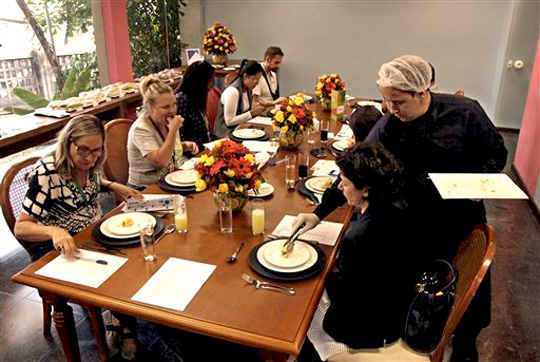
He demonstrated, lifting a tiny sandwich slice up to his nose, one made of ham, mozzarella, cream cheese and lettuce. He checked for texture and presentation, and finally took a small bite. Next he graded the offering on a checklist.

"I'll tell you the truth, I can't stand the testing," he said. "This means eating the whole day. Actually, not eating. Tasting. You bite and you leave it."

Rio will also offer different breakfast styles. For the Japanese palette there might be rice and miso soup, or fish and natto, the gooey, pungent paste made from fermented soybeans.

"We're also very careful with the spice," Cordeiro said.

The athletes village consists of 31 apartment towers containing 10,160 bedrooms. It is just one part of the Olympic food operation. Deborah Cordiner is handling most of the rest, including athletes' food at venues, and support centers for volunteers and accredited guests.

"We always face the same challenges, the transport, the volume of food," said Cordiner, a Scot who has worked at all but two Olympics — Salt Lake City and Sochi — since the 2000 games in Sydney.

She said athletes at venues will munch on "tens of thousands" of sandwiches.

A spokesman for the organizing committee declined to give the names of catering companies under contract, saying they "are not sponsors, so they don't have a right to be associated with the games."

The International Olympic Committee and organizers receive billions from sponsors like McDonald's.

Cordeiro said he is worried less about the menu — he has about 20 chefs, several from outside Brazil — than he is about food safety. He must guarantee the food is free from steroids or other ingredients that might cause an athlete to test positive on a doping test.

A major offender is the steroid Clenbuterol, which is fed to livestock in some countries to produce leaner meat.

"To assure that our ingredients are free of steroids and other kinds of chemicals, we are making sure our suppliers have all the certificates that are demanded by our national food and drug agency," Cordeiro said. "People don't know how complex it is to put out safe food. We know that this is a very sensitive subject that could influence a result or an athlete's medal."

He said almost all the food was coming from Brazil, save for items like kimchee and some spices.

Athletes will be forbidden from taking their own food into the dining area, though many will eat away from the village — often in training areas set up by their national teams.

"If an athlete brings something in from outside and eats it the dining hall and gets sick, then it can be blamed on the village food," he said. "But in the end we know that athletes can go anywhere and buy a hot dog and possibly get it inside."

Comments

Add new comment

  • Coastaldigest.com reserves the right to delete or block any comments.
  • Coastaldigset.com is not responsible for its readers’ comments.
  • Comments that are abusive, incendiary or irrelevant are strictly prohibited.
  • Please use a genuine email ID and provide your name to avoid reject.
News Network
May 13,2020

May 13: With the Olympics postponed due to the coronavirus, top Japanese fencer Ryo Miyake has swapped his metal mask and foil for a bike and backpack as a Tokyo UberEats deliveryman.

The 29-year-old, who won silver in the team foil at the 2012 London Olympics and was itching to compete in a home Games, says the job keeps him in shape physically and mentally -- and brings in much-needed cash.

"I started this for two reasons -- to save money for travelling (to future competitions) and to keep myself in physical shape," he told AFP.

"I see how much I am earning on the phone, but the number is not just money for me. It's a score to keep me going."

Japanese media have depicted Miyake as a poor amateur struggling to make ends meet but he himself asked for his three corporate sponsorships to be put on hold -- even if that means living off savings.

Like most of the world's top athletes, he is in limbo as the virus forces competitions to be cancelled and plays havoc with training schedules.

"I don't know when I can resume training or when the next tournament will take place. I don't even know if I can keep up my mental condition or motivation for another year," he said.

"No one knows how the qualification process will go. Pretending everything is OK for the competition is simply irresponsible."

In the meantime, he is happy criss-crossing the vast Japanese capital with bike and smartphone, joining a growing legion of Uber delivery staff in demand during the pandemic.

"When I get orders in the hilly Akasaka, Roppongi (downtown) district, it becomes good training," he smiles.

The unprecedented postponement of the Olympics hit Miyake hard, as he was enjoying a purple patch in his career.

After missing out on the Rio 2016 Olympics, Miyake came 13th in last year's World Fencing Championships -- the highest-ranked Japanese fencer at the competition.

The International Olympics Committee has set the new date for the Olympics on July 23, 2021.

But with no vaccine available for the coronavirus that has killed nearly 300,000 worldwide, even that hangs in the balance.

Miyake said the Japanese fencing team heard about the postponement the day after arriving in the United States for one of the final Olympic qualifying events.

With his diary suddenly free of training and competition, he said he spent the month of April agonising over what to do before hitting on the Uber idea.

"Sports and culture inevitably come second when people have to survive a crisis," he said.

"Is the Olympics really needed in the first place? Then what do I live for if not for the sport? That is what I kept thinking."

However, the new and temporary career delivering food in Tokyo has given the fencer a new drive to succeed.

"The most immediate objective for me is to be able to start training smoothly" once the emergency is lifted, he said.

"I need to be ready physically and financially for the moment. That is my biggest mission now."

But not all athletes may cope mentally with surviving another "nerve-wracking" pre-Olympic year, he said.

"It's like finally getting to the end of a 42-kilometre marathon and then being told you have to keep going."

As a child, Miyake practised his attacks on every wall of his house -- and he said his passion for the sport was what was driving him now.

"I love fencing. I want to be able to travel for matches and compete in the Olympics. That is the only reason I am doing this."

Comments

Add new comment

  • Coastaldigest.com reserves the right to delete or block any comments.
  • Coastaldigset.com is not responsible for its readers’ comments.
  • Comments that are abusive, incendiary or irrelevant are strictly prohibited.
  • Please use a genuine email ID and provide your name to avoid reject.
News Network
March 12,2020

New Delhi, Mar 12: No foreign player will be available for this year's IPL till April 15 due to visa restrictions imposed by the government to contain the novel coronavirus threat, a top BCCI source told PTI on Thursday, casting fresh doubts on the fate of the event.

"The foreign players who play in the IPL come under the Business Visa category. As per the government's directive, they can't come till April 15," a BCCI source told PTI on conditions of anonymity.

The government issued fresh advisory with a ban on all existing foreign visas, except a few categories like diplomatic and employment, till April 15 in the wake of new positive cases of novel coronavirus in the country.

India has reported 60 positive cases in the outbreak which has led to over 4,000 deaths globally.

The fate of the IPL itself will be decided on March 14 at the event's Governing Council meeting in Mumbai. "All decisions will be taken by the GC in Mumbai," the source said.

Having the IPL, starting March 29, played in empty stadiums is an option being explored.

Comments

Add new comment

  • Coastaldigest.com reserves the right to delete or block any comments.
  • Coastaldigset.com is not responsible for its readers’ comments.
  • Comments that are abusive, incendiary or irrelevant are strictly prohibited.
  • Please use a genuine email ID and provide your name to avoid reject.
News Network
March 16,2020

Mar 16: With COVID-19 outbreak killing over 5,400 people globally, former Pakistan cricketer Shoaib Akhtar has lashed out at those responsible for making the coronavirus infect humans and blamed China solely for the outbreak.

"I don't understand why you have to eat things like bats, drink their blood and urine and spread some virus across the globe...I'm talking about the Chinese people. They have put the world at stake. I really don't understand how you can eat bats, dogs, and cats. I'm really angry," Akhtar said in a video posted on his Youtube channel.

"The whole world is at risk now. The tourism industry has been hit, the economy is badly affected and the whole world is going towards a lockdown.

"I'm not against the people of China but I'm against the law of animals. I understand this may be your culture but this is not benefitting you now, it is killing humanity. I'm not saying you boycott the Chinese but there has to be some law. You cannot go on and eat anything and everything," he added.

Coronavirus, which originated in China's Wuhan city, has so far spread to more than 100 countries, infecting over 1,30,000 people.

In Pakistan, the number of positive cases reached 28 on Saturday.

Many sporting events, including the Indian Premier League (IPL) and Pakistan Super League (PSL), have been affected by the disease which has now been declared a pandemic by the World Health Organisation (WHO).

While the IPL 2020, which was originally scheduled to start from March 29, has been postponed till April 15, the playoff stage of PSL has been curtailed and will be played behind closed doors.

"The biggest reason for anger is PSL...Cricket returned to Pakistan after so many years, the PSL was happening in our country for the first time now even that is at risk. The foreign players are leaving, it will take place behind closed doors," said Akhtar.

The total number of confirmed coronavirus cases across India has crossed 80 while two people have lost their lives due to the deadly disease. But Akhtar did not have the information and added: "God forbid the virus doesn't reach India. There are around 130 crore people there. I've been in touch with my friends in India and wishing them well."

In PSL, there will be no playoffs and the top four teams will now play semi-finals and then the final on March 17 and 18. The final was originally scheduled to be held on March 22.

"I've also heard that IPL has been postponed till April 15. The hotel industries, travel industries, broadcasters everything will incur losses because of this," he said.

The former Pakistan pacer also called on the world authorities to come out with a new animal protection law so that such diseases don't resurface in the future.

Comments

Add new comment

  • Coastaldigest.com reserves the right to delete or block any comments.
  • Coastaldigset.com is not responsible for its readers’ comments.
  • Comments that are abusive, incendiary or irrelevant are strictly prohibited.
  • Please use a genuine email ID and provide your name to avoid reject.