


Rio Olympic Spread: Anything from Halal to Kosher to Kimchi

May 10, 2016

Rio De Janeiro, May 10: The dining room for the athletes village at the Rio de Janeiro Olympics will be bigger than two football fields, and the kitchen being built in the same massive tent will be as large as one.
Rio

The setting hints at quite a spread when the games open in just under three months.

"We want to make sure when there is a medal or a record, part of that record also goes to our food team," said Marcello Cordeiro, Rio's director of food and beverages, in an interview with The Associated Press.

At its peak, the athletes village kitchen will prepare 60,000 meals daily, produced from daily shipments of 210,000 kilograms (460,000 pounds) of raw ingredients — all served up on 4 million biodegradable plates for 18,000 athletes, coaches and staff.

Diners will choose from five different buffets — Brazilian, Asian, International, Pasta and Pizza, Halal and Kosher.

Food for Muslim and Jewish athletes will adhere to their specific religious dietary laws. Koreans will even get spicy kimchee — the nation's famous fermented cabbage, scallions and assorted vegetables — shipped directly from home.

And everyone can try 40 varieties of Brazil's exotic fruits like caju, acai, carambola, caqui, goiaba and maracuja, often squeezed into Brazil's famously delicious juices (sucos in Portuguese).

The subsequent Paralympics will offer the same variety, though the numbers will be smaller.

"We are confident our Brazilian food is going to be a success, we'll make a bit more to be safe," Cordeiro said. "We are doing our best to bring the world to Brazil."

He listed key ingredients of the basic Brazilian diet: rice, black beans, farofa (flour from toasted cassava often sprinkled on top of food) and meat. But the regional specialties are as large as the continent-size country itself.

Buffet-style eateries are popular in Brazil, where they charge by the weight — so-called "Kilo Restaurants." There will be no charge for the athletes.

"They can eat all they want,' Cordeiro said. "No scales. We know athletes know exactly what they need to eat."

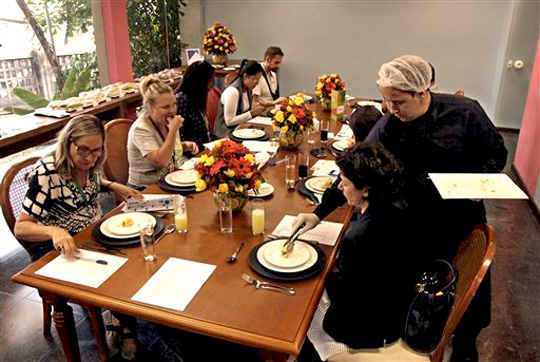
To prepare the final menus, Cordeiro and colleagues are holding about 20 food testings before the Olympics open Aug. 5. They've been through seven or eight already, including one a few days ago.

"Imagine you start eating at 10 a.m. and you finish 8 p.m.," Cordeiro said. "Everyone thinks that food-tasting is super-duper, but this is how you eat."

He demonstrated, lifting a tiny sandwich slice up to his nose, one made of ham, mozzarella, cream cheese and lettuce. He checked for texture and presentation, and finally took a small bite. Next he graded the offering on a checklist.

"I'll tell you the truth, I can't stand the testing," he said. "This means eating the whole day. Actually, not eating. Tasting. You bite and you leave it."

Rio will also offer different breakfast styles. For the Japanese palette there might be rice and miso soup, or fish and natto, the gooey, pungent paste made from fermented soybeans.

"We're also very careful with the spice," Cordeiro said.

The athletes village consists of 31 apartment towers containing 10,160 bedrooms. It is just one part of the Olympic food operation. Deborah Cordiner is handling most of the rest, including athletes' food at venues, and support centers for volunteers and accredited guests.

"We always face the same challenges, the transport, the volume of food," said Cordiner, a Scot who has worked at all but two Olympics — Salt Lake City and Sochi — since the 2000 games in Sydney.

She said athletes at venues will munch on "tens of thousands" of sandwiches.

A spokesman for the organizing committee declined to give the names of catering companies under contract, saying they "are not sponsors, so they don't have a right to be associated with the games."

The International Olympic Committee and organizers receive billions from sponsors like McDonald's.

Cordeiro said he is worried less about the menu — he has about 20 chefs, several from outside Brazil — than he is about food safety. He must guarantee the food is free from steroids or other ingredients that might cause an athlete to test positive on a doping test.

A major offender is the steroid Clenbuterol, which is fed to livestock in some countries to produce leaner meat.

"To assure that our ingredients are free of steroids and other kinds of chemicals, we are making sure our suppliers have all the certificates that are demanded by our national food and drug agency," Cordeiro said. "People don't know how complex it is to put out safe food. We know that this is a very sensitive subject that could influence a result or an athlete's medal."

He said almost all the food was coming from Brazil, save for items like kimchee and some spices.

Athletes will be forbidden from taking their own food into the dining area, though many will eat away from the village — often in training areas set up by their national teams.

"If an athlete brings something in from outside and eats it the dining hall and gets sick, then it can be blamed on the village food," he said. "But in the end we know that athletes can go anywhere and buy a hot dog and possibly get it inside."

Comments

Add new comment

  • Coastaldigest.com reserves the right to delete or block any comments.
  • Coastaldigset.com is not responsible for its readers’ comments.
  • Comments that are abusive, incendiary or irrelevant are strictly prohibited.
  • Please use a genuine email ID and provide your name to avoid reject.
News Network
January 27,2020

Hamilton, Jan 27: In awe of Jasprit Bumrah, New Zealand wicketkeeper Tim Seifert says the Indian speedster's subtle variations have been difficult to pick in the ongoing T20 series and his side needs to a learn a thing or two about adapting from the visitors.

India beat New Zealand by seven wickets in the second T20 International in Auckland on Sunday to grab a 2-0 lead in the five-match series.

Bumrah returned with figures of 1-21 from his four overs as Indian skipper Virat Kohli changed his bowling plans from the first game.

"Even in the first game, Bumrah bowled slower balls that were going wider. Normally, death bowlers get into straighter lines, plus yorkers and mix it with chest height. He kind of changes things a lot and is tougher to play," Seifert said.

"...the ball was holding a lot more which made it tougher. So sometimes as a batsman you have to move away from the stumps and see if they bowl straight. I was backing myself to do something different instead of just standing there at the wicket," said the stumper, who remained unbeaten on 33 off 26 balls.

"It was tricky and the ball was holding a little bit. When Kane (Williamson) got out in the over against Yuzvendra Chahal, we knew it was the over to push because they had Bumrah coming back," he added.

He said New Zealand batsmen need to take a cue from their Indian counterparts on how to adapt to different conditions quickly.

"...Indian batsmen showed how to get under the ball and time it. They showed it a couple of times that and on the slower wickets you just have to keep it like that. Once you lose your shape, you are not in position," he said.

"Try to get them (bowlers) off line or off balance, try to get into that position to hit good balls. That's T20 cricket as well. Sometimes it's going 100 per cent but some times you have to take a breath and re-assess. Indian batters did that well."

Seifert believes New Zealand bowlers did reasonably well in the two games but they have been outplayed by the Indian batsmen.

"To be honest, in the first game they were 110-1 and they had wickets in hand. We didn't bowl too badly in that first game. In the second game, we only got 130 and it is tough to bowl at Eden Park (with that total)," he said.

"170 was the target in mind but once you get 130 on the board, that was going to be very hard at Eden Park against a team that is very strong and playing really well. But our spinners were outstanding. Good balls have gone to boundary.

He said coming into the T20 series on the back of a lost Test rubber in Australia also didn't help New Zealand's cause in the first two games.

"Boys are coming off a Test series (in Australia) and a lot of them haven't played T20 cricket for a while," he said.

"But for some like me, I have had the Super Smash for the last two months, so I have played a lot of T20 cricket. They have two games under their belt now so hopefully they will have a better understanding."

Asked if New Zealand would want to play on India's strength of chasing, Seifert replied, "Even in ODI cricket, India have chased down big totals but I think on that wicket it was going to get slower and slower.

"But with that small target on Eden Park, something special has to happen with top six (for a collapse). One batsman got fifty and the other was batting very well. We needed top five-six in the first 10 overs," he said.

The Black Caps are still confident of bouncing back in the series.

The third T20 will be played here on Wednesday before back-to-back matches in Wellington and Mt Maunganui. Seifert said they would like to replicate the 2019 tour of India, where New Zealand came out 2-1 victorious in the three-match series.

"We have lost the first two games but we haven't played badly. We definitely haven't played our best though while India has played very well. If we lose the series on Wednesday, it is not the end of the world. But if we can turn things around, and win, we will take things from there," he said.

"We won the series 2-1 last time, so we have to treat it like a three match series again. But we have to treat it like the first two are must-win games."

"We are not playing our best at the moment. There are 20-odd games before the World Cup, and that tournament is the pinnacle, so we will get there (in preparation),” he signed off.

Comments

Add new comment

  • Coastaldigest.com reserves the right to delete or block any comments.
  • Coastaldigset.com is not responsible for its readers’ comments.
  • Comments that are abusive, incendiary or irrelevant are strictly prohibited.
  • Please use a genuine email ID and provide your name to avoid reject.
News Network
May 30,2020

New York, May 30: Cricket superstar Virat Kohli remains the only Indian in the Forbes' list of world's highest-paid athletes with total earnings of USD 26 million, jumping to the 66th spot from 100 in the 2020 standings.

Kohli's earnings from endorsement stand at USD 24 million and USD 2 million from salary/winnings. The 31-year-old is also the only cricketer in the top-100 list.

With earnings of USD 25 million, Kohli was ranked 100th in 2019 and 83rd in 2018 with USD 24 million.

Tennis legend Roger Federer has toped the list for the first time with earnings of USD 106.3 million, rising from fifth place last year.

Football icons Cristiano Ronaldo and Lionel Messi are second and third respectively with earnings of USD 105 and USD 104 million.

The others in the top-10 are Neymar (football), LeBron James (basketball), Stephen Curry (basketball), Kevin Durrant (basketball), Tigers Woods (golf), Kirk Cousins (American football) and Carson Wentz (American football).

The athletes' earnings have been impacted by the COVID-19 pandemic which led to suspension of sporting activities all around the world.

Comments

Ismail
 - 
Sunday, 31 May 2020

Saina Nehwal is the only Indian to feature in the world’s 20 most charitable athletes, as per a list compiled by the US based website in Athletes Gone Good. 

Add new comment

  • Coastaldigest.com reserves the right to delete or block any comments.
  • Coastaldigset.com is not responsible for its readers’ comments.
  • Comments that are abusive, incendiary or irrelevant are strictly prohibited.
  • Please use a genuine email ID and provide your name to avoid reject.
Agencies
February 4,2020

Potchefstroom, Feb 4: Yashasvi Jaiswal and Divyaansh Saxena guided India to a comfortable ten wickets win over Pakistan in the ICC U19 World Cup semifinal at Senwes Park on Tuesday and progressed to the final of the tournament.

Chasing 173, Indian openers Jaiswal and Saxena played cautiously and stitched an unbeaten partnership of 176 runs.

The duo built the highest opening partnership of the tournament's history. Jaiswal, the left-handed batsman, scored his maiden century of the tournament as he amassed unbeaten 105 runs studded with eight fours and four sixes.

Saxena scored 59* off 99 balls including six fours. India chased down the total in 35.2 overs. This is the first time in the history of the U19 World Cup that a team won a knockout match by ten wickets.

Earlier, Pakistan won the toss and elected to bat.

Opener Haider Ali and skipper Rohail Nazir's half-centuries guided the side to a respectable total of 172. Ali played a knock of 56 runs while Nazir accumulated 62 runs including six boundaries.

Pakistan did not have a good start as they lost Mohammad Hurair (4) in the second over. Fahad Munir, came to bat at number three, failed to score a single run and was departed by Ravi Bishnoi on a duck in ninth over.

Apart from Ali and Nazir, Mohammad Haris was the only batsman to score runs in double digits. He played an innings of 21 runs off 15 balls. Indian bowlers showed a spirited performance as they bowled out arch-rival in 43.1 overs.

Pacers Karthik Tyagi and Sushant Mishra bagged two and three wickets respectively. Spinner Ravi Bishnoi clinched two scalps and conceded 46 runs in his ten overs.

Comments

Add new comment

  • Coastaldigest.com reserves the right to delete or block any comments.
  • Coastaldigset.com is not responsible for its readers’ comments.
  • Comments that are abusive, incendiary or irrelevant are strictly prohibited.
  • Please use a genuine email ID and provide your name to avoid reject.