


Rio Olympic Spread: Anything from Halal to Kosher to Kimchi

May 10, 2016

Rio De Janeiro, May 10: The dining room for the athletes village at the Rio de Janeiro Olympics will be bigger than two football fields, and the kitchen being built in the same massive tent will be as large as one.
Rio

The setting hints at quite a spread when the games open in just under three months.

"We want to make sure when there is a medal or a record, part of that record also goes to our food team," said Marcello Cordeiro, Rio's director of food and beverages, in an interview with The Associated Press.

At its peak, the athletes village kitchen will prepare 60,000 meals daily, produced from daily shipments of 210,000 kilograms (460,000 pounds) of raw ingredients — all served up on 4 million biodegradable plates for 18,000 athletes, coaches and staff.

Diners will choose from five different buffets — Brazilian, Asian, International, Pasta and Pizza, Halal and Kosher.

Food for Muslim and Jewish athletes will adhere to their specific religious dietary laws. Koreans will even get spicy kimchee — the nation's famous fermented cabbage, scallions and assorted vegetables — shipped directly from home.

And everyone can try 40 varieties of Brazil's exotic fruits like caju, acai, carambola, caqui, goiaba and maracuja, often squeezed into Brazil's famously delicious juices (sucos in Portuguese).

The subsequent Paralympics will offer the same variety, though the numbers will be smaller.

"We are confident our Brazilian food is going to be a success, we'll make a bit more to be safe," Cordeiro said. "We are doing our best to bring the world to Brazil."

He listed key ingredients of the basic Brazilian diet: rice, black beans, farofa (flour from toasted cassava often sprinkled on top of food) and meat. But the regional specialties are as large as the continent-size country itself.

Buffet-style eateries are popular in Brazil, where they charge by the weight — so-called "Kilo Restaurants." There will be no charge for the athletes.

"They can eat all they want,' Cordeiro said. "No scales. We know athletes know exactly what they need to eat."

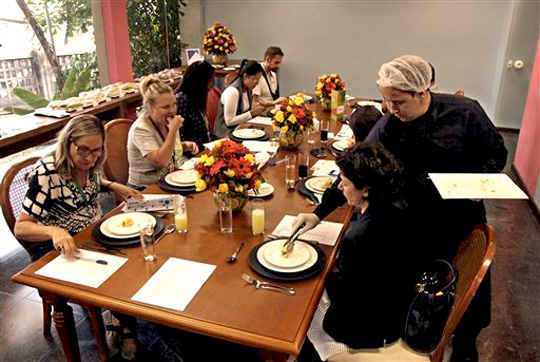
To prepare the final menus, Cordeiro and colleagues are holding about 20 food testings before the Olympics open Aug. 5. They've been through seven or eight already, including one a few days ago.

"Imagine you start eating at 10 a.m. and you finish 8 p.m.," Cordeiro said. "Everyone thinks that food-tasting is super-duper, but this is how you eat."

He demonstrated, lifting a tiny sandwich slice up to his nose, one made of ham, mozzarella, cream cheese and lettuce. He checked for texture and presentation, and finally took a small bite. Next he graded the offering on a checklist.

"I'll tell you the truth, I can't stand the testing," he said. "This means eating the whole day. Actually, not eating. Tasting. You bite and you leave it."

Rio will also offer different breakfast styles. For the Japanese palette there might be rice and miso soup, or fish and natto, the gooey, pungent paste made from fermented soybeans.

"We're also very careful with the spice," Cordeiro said.

The athletes village consists of 31 apartment towers containing 10,160 bedrooms. It is just one part of the Olympic food operation. Deborah Cordiner is handling most of the rest, including athletes' food at venues, and support centers for volunteers and accredited guests.

"We always face the same challenges, the transport, the volume of food," said Cordiner, a Scot who has worked at all but two Olympics — Salt Lake City and Sochi — since the 2000 games in Sydney.

She said athletes at venues will munch on "tens of thousands" of sandwiches.

A spokesman for the organizing committee declined to give the names of catering companies under contract, saying they "are not sponsors, so they don't have a right to be associated with the games."

The International Olympic Committee and organizers receive billions from sponsors like McDonald's.

Cordeiro said he is worried less about the menu — he has about 20 chefs, several from outside Brazil — than he is about food safety. He must guarantee the food is free from steroids or other ingredients that might cause an athlete to test positive on a doping test.

A major offender is the steroid Clenbuterol, which is fed to livestock in some countries to produce leaner meat.

"To assure that our ingredients are free of steroids and other kinds of chemicals, we are making sure our suppliers have all the certificates that are demanded by our national food and drug agency," Cordeiro said. "People don't know how complex it is to put out safe food. We know that this is a very sensitive subject that could influence a result or an athlete's medal."

He said almost all the food was coming from Brazil, save for items like kimchee and some spices.

Athletes will be forbidden from taking their own food into the dining area, though many will eat away from the village — often in training areas set up by their national teams.

"If an athlete brings something in from outside and eats it the dining hall and gets sick, then it can be blamed on the village food," he said. "But in the end we know that athletes can go anywhere and buy a hot dog and possibly get it inside."

Comments

Add new comment

  • Coastaldigest.com reserves the right to delete or block any comments.
  • Coastaldigset.com is not responsible for its readers’ comments.
  • Comments that are abusive, incendiary or irrelevant are strictly prohibited.
  • Please use a genuine email ID and provide your name to avoid reject.
News Network
March 2,2020

Mar 2: Indian captain Virat Kohli was left frustrated and deflated as New Zealand won the second Test inside three days in Christchurch on Monday to sweep the series.

India started the day at 90 for six and were all out for 124, before New Zealand chased down the required 132 to win for the loss of three wickets in 36 overs.

It ended a disappointing tour for India and Kohli as New Zealand, who won the first Test by 10 wickets early on day four, wrapped up the series with ease.

New Zealand are now unbeaten in their last 13 home Tests, winning nine of them, and in the past decade their record as hosts is played 39, won 20, drawn 13 and lost five.

In the latest series, on traditional New Zealand green wickets, India managed scores of 165, 191, 242 and 124, reflecting the low contributions from Kohli of 2, 19, 3 and 14.

Kohli came to New Zealand as the world's top Test batsman and oozing charm as he described New Zealand as the “nice guys” of cricket.

But during the series he lost his top ranking to Australian Steve Smith and when Kane Williamson went for three in the first innings of the second Test the pressure showed when he gave the New Zealand skipper a very animated send-off.

There was further evidence of frustration when he was caught on camera yelling an obscenity at a group of New Zealand supporters on Sunday.

The end came quickly for India on day three as Tim Southee and Trent Boult tormented the batsmen with their variety of inswing and outswing deliveries targeting both sides of the stumps.

Hanuma Vihari was the first to fall, in Southee's second over, when he turned a legside delivery too fine and was caught by BJ Watling diving to his left.

Five balls later and with no addition to the score, India's other overnight batsman Rishabh Pant was caught behind off a Boult delivery that swung away.

Mohammed Shami was caught for five by Tom Blundell at deep mid-wicket and Jasprit Bumrah was run out when trying to give the strike to Ravindra Jadeja, who was unbeaten on 16.

Boult and Southee signed for most of the dismissals with Boult taking four for 28 and Southee three for 36. The swing pair accounted for 25 of the 40 Indian wickets in the series.

There was enough seam and swing available for India to keep the New Zealand batsmen guessing but Bumrah and Umesh Yadav were unable to apply consistent pressure and Mohammed Shami was troubled by a sore shoulder.

New Zealand coasted through a century opening stand by Tom Latham and Blundell before losing three quick wickets.

Latham notched his 18th half-century and second of the Test before he was caught behind off Yadav for 52, Kane Williamson had a short stay for five, and Blundell went for 55.

Comments

Add new comment

  • Coastaldigest.com reserves the right to delete or block any comments.
  • Coastaldigset.com is not responsible for its readers’ comments.
  • Comments that are abusive, incendiary or irrelevant are strictly prohibited.
  • Please use a genuine email ID and provide your name to avoid reject.
News Network
April 8,2020

New Delhi, Apr 8: Former Pakistan pacer Shoaib Akhtar on Wednesday proposed a three-match ODI series against arch-rivals India to raise funds for the fight against the Covid19 pandemic in both the countries.

The two nations have not played a full-series since 2007 due to the terrorist attacks on India by Pakistan-based outfits and the resultant diplomatic tension. They only play each other in ICC events and Asia Cup.

"In this time of crisis, I want to propose a three-match series in which for the first time, the people of neither country would be upset at the outcome of the games," Akhtar told PTI from Islamabad.

"If Virat (Kohli) scores a hundred, we will be happy, if Babar Azam scores a hundred, you will be happy. Both teams will be winners irrespective of whatever happens on the field," he said.

"You are bound to get massive viewership for the games. For the first time, both countries will play for each other. And whatever funds are generated through this can be donated equally to the government of India and Pakistan to fight this pandemic," added the 44-year-old.

No idea of logistics

With both countries in a lockdown amid the fast-spreading pandemic, the games can only be organised when things improve. However, Akhtar feels the sooner they are held, the better it would be but could not tell how the logistics of such an initiative would be worked out.

"Everyone is sitting at home at the moment, so there will be a massive following for the games. May be not now, when things start improving, the games could be organised at a neutral location like Dubai. Chartered flights could be arranged and the matches could he held.

"The whole world will tune into it, so much money can be raised to deal with this crisis. In difficult times, the character of the nation comes forward."

Start of a new era?

"It could even lead to resumption of bilateral cricketing ties and relations of both countries improve diplomatically. You never know," said the 'Rawalpindi Express'.

In these extraordinary times, Akhtar feels both countries should help each other. "We can only propose the matches. The rest is up to the authorities (to decide)."

India cricketers Yuvraj Singh and Harbhajan Singh were recently trolled for asking their social media followers to donate to Shahid Afridi's charity foundation which is doing its bit in Pakistan's fight against the deadly virus.

"It was inhuman to criticise them. It is not about countries or religion at the moment, it is about humanity," he opined.

India memories

Akhtar has spent a lot of time in India as a commentator. He fondly recalled his days in Mumbai during the World T20 in 2016, the last time he came to India for work.

"I am forever grateful about the love I have received from the people of India. For the first time I am revealing this, whatever I used to earn from India, I made a significant amount there, thirty percent of it, I used to distribute among the low income staff who used to work with me in the TV," he remembered.

Akhtar used to visit the city's slum areas with his face covered to hand out financial help to elder women there.

"From drivers, runners to my security guys. I took care of a lot of people. I was like if am earning from this country, I have to help my colleagues also.

"I also remember visiting slums of Dharavi and Sion in the wee hours to meet people I worked with," added Akhtar.

Comments

Add new comment

  • Coastaldigest.com reserves the right to delete or block any comments.
  • Coastaldigset.com is not responsible for its readers’ comments.
  • Comments that are abusive, incendiary or irrelevant are strictly prohibited.
  • Please use a genuine email ID and provide your name to avoid reject.
Agencies
July 7,2020

Mumbai, Jul 7: Australias second largest city Melbourne is set to go for another round of lockdown — for six weeks — from midnight Wednesday as the coronavirus has reared its ugly head in Victoria. And this has further confirmed that this years T20 World Cup in Australia is practically not possible. Even as the ICC keeps delaying the announcement, BCCI hopes that the official call will now be taken with this latest development.

Despite ICC's Financial and Commercial Affairs Committee (F&CA) chief Ehsan Mani as well as Cricket Australia making it clear time and again that hosting a T20 World Cup in the October-November window is practically impossible, the ICC hasn't made an official announcement and that hasn't impressed the Board of Control for Cricket in India (BCCI).

Speaking to media persons, a BCCI official said that it is only the ICC which has kept speaking about delaying the inevitable — announcing a postponement — even as Cricket Australia chairman Earl Eddings wrote to the international body that it looks highly unlikely that a T20 World Cup can be hosted in these trying times.

"As it is there were so many logistical difficulties and that is perfectly understandable. The Australian government has been addressing the public health issue efficiently and there are regulations in place which are crucial to address the challenges. In that background even Cricket Australia has been practical in their assessment of the situation.

"With this present situation where Melbourne is in lockdown, the ICC really must take the final call of closure on the issue if they have any concept of responsible decision making," the official said.

Not just CA chairman Eddings, but also Mani — who is also the PCB chief — recently told the media that the T20 World Cup cannot be held in a bio-secure environment.

"We have had a lot of discussions and the feeling is it (T20 World Cup) would not be possible this year. ICC has World Cups lined up in 2021 and 2023, so we have a gap year where we can adjust this event. God forbid if some player(s) falls ill or mishap occurs during the tournament, it will have a big impact and create panic in the cricket world and we can't take that risk. Having a bio-bubble environment is feasible for say a bilateral series like Pakistan in England, but it is very difficult when 16 teams are involved," he had said.

Cricket Australia's interim CEO Nick Hockley echoed the sentiments when he said the biggest challenge was to get the players from so many teams into the country.

"Our biggest challenge is getting 15 teams into the country. If I compare it with the prospect of a bilateral tour, you're talking about bringing one team in and then playing individual matches. But the prospect of bringing 15 teams in and having six or seven teams in one city at the same time, it's a much more complex exercise," he had said.

Comments

Add new comment

  • Coastaldigest.com reserves the right to delete or block any comments.
  • Coastaldigset.com is not responsible for its readers’ comments.
  • Comments that are abusive, incendiary or irrelevant are strictly prohibited.
  • Please use a genuine email ID and provide your name to avoid reject.