


Rio Olympic Spread: Anything from Halal to Kosher to Kimchi

May 10, 2016

Rio De Janeiro, May 10: The dining room for the athletes village at the Rio de Janeiro Olympics will be bigger than two football fields, and the kitchen being built in the same massive tent will be as large as one.
Rio

The setting hints at quite a spread when the games open in just under three months.

"We want to make sure when there is a medal or a record, part of that record also goes to our food team," said Marcello Cordeiro, Rio's director of food and beverages, in an interview with The Associated Press.

At its peak, the athletes village kitchen will prepare 60,000 meals daily, produced from daily shipments of 210,000 kilograms (460,000 pounds) of raw ingredients — all served up on 4 million biodegradable plates for 18,000 athletes, coaches and staff.

Diners will choose from five different buffets — Brazilian, Asian, International, Pasta and Pizza, Halal and Kosher.

Food for Muslim and Jewish athletes will adhere to their specific religious dietary laws. Koreans will even get spicy kimchee — the nation's famous fermented cabbage, scallions and assorted vegetables — shipped directly from home.

And everyone can try 40 varieties of Brazil's exotic fruits like caju, acai, carambola, caqui, goiaba and maracuja, often squeezed into Brazil's famously delicious juices (sucos in Portuguese).

The subsequent Paralympics will offer the same variety, though the numbers will be smaller.

"We are confident our Brazilian food is going to be a success, we'll make a bit more to be safe," Cordeiro said. "We are doing our best to bring the world to Brazil."

He listed key ingredients of the basic Brazilian diet: rice, black beans, farofa (flour from toasted cassava often sprinkled on top of food) and meat. But the regional specialties are as large as the continent-size country itself.

Buffet-style eateries are popular in Brazil, where they charge by the weight — so-called "Kilo Restaurants." There will be no charge for the athletes.

"They can eat all they want,' Cordeiro said. "No scales. We know athletes know exactly what they need to eat."

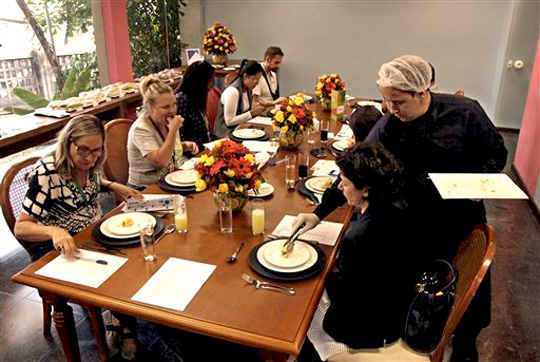
To prepare the final menus, Cordeiro and colleagues are holding about 20 food testings before the Olympics open Aug. 5. They've been through seven or eight already, including one a few days ago.

"Imagine you start eating at 10 a.m. and you finish 8 p.m.," Cordeiro said. "Everyone thinks that food-tasting is super-duper, but this is how you eat."

He demonstrated, lifting a tiny sandwich slice up to his nose, one made of ham, mozzarella, cream cheese and lettuce. He checked for texture and presentation, and finally took a small bite. Next he graded the offering on a checklist.

"I'll tell you the truth, I can't stand the testing," he said. "This means eating the whole day. Actually, not eating. Tasting. You bite and you leave it."

Rio will also offer different breakfast styles. For the Japanese palette there might be rice and miso soup, or fish and natto, the gooey, pungent paste made from fermented soybeans.

"We're also very careful with the spice," Cordeiro said.

The athletes village consists of 31 apartment towers containing 10,160 bedrooms. It is just one part of the Olympic food operation. Deborah Cordiner is handling most of the rest, including athletes' food at venues, and support centers for volunteers and accredited guests.

"We always face the same challenges, the transport, the volume of food," said Cordiner, a Scot who has worked at all but two Olympics — Salt Lake City and Sochi — since the 2000 games in Sydney.

She said athletes at venues will munch on "tens of thousands" of sandwiches.

A spokesman for the organizing committee declined to give the names of catering companies under contract, saying they "are not sponsors, so they don't have a right to be associated with the games."

The International Olympic Committee and organizers receive billions from sponsors like McDonald's.

Cordeiro said he is worried less about the menu — he has about 20 chefs, several from outside Brazil — than he is about food safety. He must guarantee the food is free from steroids or other ingredients that might cause an athlete to test positive on a doping test.

A major offender is the steroid Clenbuterol, which is fed to livestock in some countries to produce leaner meat.

"To assure that our ingredients are free of steroids and other kinds of chemicals, we are making sure our suppliers have all the certificates that are demanded by our national food and drug agency," Cordeiro said. "People don't know how complex it is to put out safe food. We know that this is a very sensitive subject that could influence a result or an athlete's medal."

He said almost all the food was coming from Brazil, save for items like kimchee and some spices.

Athletes will be forbidden from taking their own food into the dining area, though many will eat away from the village — often in training areas set up by their national teams.

"If an athlete brings something in from outside and eats it the dining hall and gets sick, then it can be blamed on the village food," he said. "But in the end we know that athletes can go anywhere and buy a hot dog and possibly get it inside."

Comments

Add new comment

  • Coastaldigest.com reserves the right to delete or block any comments.
  • Coastaldigset.com is not responsible for its readers’ comments.
  • Comments that are abusive, incendiary or irrelevant are strictly prohibited.
  • Please use a genuine email ID and provide your name to avoid reject.
News Network
June 6,2020

Mumbai, Jun 6: Reminiscing about his 'special knock' of 208 runs from 153 balls, Indian cricketer Rohit Sharma revealed why his wife Ritika had got emotional after he smashed his third double century in ODIs.

Rohit narrated the incident during his appearance in Episode 2 of the 'Open nets with Mayank'.

The batsman, who was accompanied by Shikhar Dhawan and Mayank on the show, said his wife thought that he had twisted his hand while diving for the 196th run during the innings.

"As you can see my wife got emotional there, this day was special as it was my anniversary. Probably the best gift I could give it to her while I am on the field, it was quite emotional though," said Rohit during the candid chat.

"When I came from the ground, I just asked her why did you (Ritika) cry? So she told me that she thought I (Rohit) twisted my hand when I dived for my 196th run and that was a little worrying factor for her, she got little emotional of because of that I guess," Rohit added.

In the match, the 32-year-old scored 208 runs with 13 fours and 12 sixes against Sri Lanka at Punjab Cricket Association IS Bindra Stadium in Mohali.

This enabled India to post a score of 392/4 in the allotted fifty overs.

India then went on to win the match by 141 runs.

"To be honest I was going pretty slow, I never thought I will get to a double hundred but once you cross 125, I feel it gets easier for you because bowlers are under pressure. Unless you make a mistake I don't think you can get out," said Rohit.

Rohit has scored two double hundreds against Sri Lanka and one against Australia in ODIs. The right-handed batsman is the only cricketer to make three double hundreds in ODI history.

Rohit, Shikhar, and Mayank would have been in action for Mumbai Indians, Delhi Capitals, and Kings XI Punjab respectively, had the Indian Premier League (IPL) commenced from March 29. However, the tournament was suspended indefinitely due to the coronavirus pandemic.

Comments

Add new comment

  • Coastaldigest.com reserves the right to delete or block any comments.
  • Coastaldigset.com is not responsible for its readers’ comments.
  • Comments that are abusive, incendiary or irrelevant are strictly prohibited.
  • Please use a genuine email ID and provide your name to avoid reject.
Agencies
May 26,2020

Some of the ICC guidelines on resumption of cricket border on the impractical and will need a review when the cricketing world is closer to action, feel former players Aakash Chopra, Irfan Pathan and Monty Panesar.

Last week, the International Cricket Council recommended a host of "back to cricket" guidelines including 14-day pre-match isolation training camps to ensure the teams are free from COVID-19.

The world body issued training as well as playing guidelines which will drastically change the way the game is played.

Among them are regular hand sanitising when in contact with the ball, no loo or shower breaks while training, minimising time spent in the changing room before and after a game, no use of saliva on ball and no handing over of personal items (cap, sunglasses, towels) to fellow teammates or the on-field umpires.

"Social distancing is very doable in individual sport but very tough in a team sport like cricket and football. If you need a slip during the game, would you not employ it?

"If the team is going through a 14-day quarantine and is being tested for COVID-19, I am fine with that process. Now, after that, if we have more guidelines for the players during the game, then you are making things complicated. Then there is no point of a quarantine period," former India pacer Pathan told PTI.

Safety cannot be compromised but regularly sanitising hands during the game will be too much to ask from the players.

"Safety is paramount but we should not make the game complicated. If a bowler or fielder has to sanitise hands every time he touches the ball, then it would be very difficult.

"You can shorten the process of giving the ball to the bowler. Instead of the usual chain (wicket-keeper to cover fielder to bowler), the keeper can straight away give the ball to the bowler but even then the bowler will have to sanitise hands six times in an over," said Pathan seeking more clarity on the guidelines.

Former India opener Chopra said it is still pre-mature to prepare a fixed set of guidelines for resumption of cricket as the situation is evolving "every day".

"That (regular hand sanitisation after contact with ball) is obviously impractical but my big question is when the game happens in a bio secure environment and everyone is quarantined and tested, do these additional measures make a difference?

"On the field, I can still understand but what happens when you go back into the dressing room? How do you practice social distancing there? So it becomes quite complicated.

"To be honest it is all very premature. Once they get closer to resumption, which will take some time, there will be more clarity," said Chopra.

International cricket is likely to resume in July with England hosting West Indies and then Pakistan.

Bundesliga football league has already begun in Germany behind closed doors and by the time cricket resumes, more sporting competitions would have restarted and Chopra feels that will help cricket decide the way forward in post COVID-19 times.

"By the time cricket resumes, more football would have started after Bundesliga. Cricket can take lessons from there, collect data and ideas and see what is practical and what is not."

Former England spinner Panesar foresees the start of the England-West Indies series making things a lot clearer for the entire fraternity than they are at the moment.

"The 14 day quarantine is very much needed and well done to the ICC for including that. I think we will see resumption of international cricket with England hosting West Indies in July. We might have some practical ideas then, the other countries would also be watching keenly and will learn how to go about it.

"But measures like regular hand sanitising is not going to be practical. May be you could sanitise every one hour but it can't be regular during the game," said Panesar.

While Pathan feels the on-field safety measures will make managing over-rate a bigger challenge for teams, Chopra said no loo or shower breaks during training won't be that much of an issue.

"Training is still controllable. You don't have to be there for a long time but you would still have to use the restroom at some stage. You may avoid taking a shower but you will have to use the restroom.

"I think the idea of these guidelines is to make cricketers more aware that you have to take care of yourself and inculcate habits which are in everyone's interest in the current scenario," added Chopra.

Comments

Add new comment

  • Coastaldigest.com reserves the right to delete or block any comments.
  • Coastaldigset.com is not responsible for its readers’ comments.
  • Comments that are abusive, incendiary or irrelevant are strictly prohibited.
  • Please use a genuine email ID and provide your name to avoid reject.
News Network
January 27,2020

Los Angeles, Jan 27: Kobe Bryant, the 18-time NBA All-Star who won five championships and became one of the greatest basketball players of his generation during a 20-year career with the Los Angeles Lakers, died in a helicopter crash Sunday. He was 41.

Bryant died in a helicopter crash near Calabasas, California, a person familiar with the situation told The Associated Press. A different person familiar with the case confirmed that Bryant's 13-year-old daughter Gianna also was killed.

Both spoke on condition of anonymity because details of the crash had not been released publicly. The crash happened around 10 a.m. about 30 miles northwest of downtown Los Angeles.

Federal Aviation Administration spokesman Allen Kenitzer said it was a Sikorsky S-76 and it was not known what caused the crash. The LA County Sheriff's Department confirmed five dead in the crash, but had not released identities.

Bryant lived south of Los Angeles in coastal Orange County for much of his adult life, and he often used helicopters to save time and avoid Southern California's notorious traffic. Even as a player, he often traveled to practices and games by helicopter, and he kept up the practice after retirement as he attended to his business ventures.

The crash occurred several miles from Mamba Sports Academy, Bryant's basketball training complex in Thousand Oaks, California. Bryant, who had four daughters with his wife, Vanessa, dedicated himself to boosting women's sports in his retirement.

Colin Storm was in his living room in Calabasas when he heard ``what sounded like a low-flying airplane or helicopter.''

“It was very foggy so we couldn't see anything,'' he said. ``But then we heard some sputtering, and then a boom.''

A short time later the fog cleared a bit and Storm could see smoke rising from the hillside in front of his home.

Bryant retired in 2016 as the third-leading scorer in NBA history, finishing two decades with the Lakers as a prolific scorer with a sublime all-around game and a relentless competitive ethic. He held that spot in the league scoring ranks until Saturday night, when the Lakers' LeBron James passed him for third place during a game in Philadelphia, Bryant's hometown.

“Continuing to move the game forward (at)KingJames,'' Bryant wrote in his last tweet. “Much respect my brother.''

Bryant had one of the greatest careers in recent NBA history and became one of the game's most popular players as the face of the 16-time NBA champion Lakers franchise. He was the league MVP in 2008 and a two-time NBA scoring champion, and he earned 12 selections to the NBA's All-Defensive teams.

He teamed with Shaquille O'Neal in a combustible partnership to lead the Lakers to NBA titles in 2000, 2001 and 2002. He later teamed with Pau Gasol to win two more titles in 2009 and 2010.

Bryant retired in 2016 after scoring 60 points in his final NBA game.

Bryant looms large over the current generation of NBA players. After James passed Bryant on Saturday, he remembered listening to Bryant when the superstar came to speak at a childhood basketball camp.

“I remember one thing he said: If you want to be great at it, or want to be one of the greats, you've got to put the work in,'' James said. “There's no substitution for work.''

James later teamed up with Bryant on the 2008 U.S. Olympic team in Beijing.

“He had zero flaws offensively,'' James said. “Zero. You backed off of him, he could shoot the 3. You body him up a little bit, he could go around you. He could shoot from mid-range. He could post. He could make free throws. ... He was just immortal offensively because of his skill set and his work ethic.''

Bryant was a basketball superstar for his entire adult life. He entered the NBA draft straight out of high school in 1996 after a childhood spent partly in Italy, where his father, former NBA player Joe “Jellybean'' Bryant, played professionally.

The Lakers acquired the 17-year-old Bryant in a trade shortly after Charlotte drafted him, and he immediately became one of the most exciting and intriguing players in the sport alongside O'Neal, who had signed with the Lakers as a free agent. Bryant won the Slam Dunk Contest as an upstart rookie, and the Lakers gradually grew into a team that won three consecutive championships.

Bryant and Gasol formed the nucleus of another championship team in 2008, reaching three straight NBA Finals and eventually winning two more titles.

In 2003, Bryant was charged with attacking a 19-year-old employee at a Colorado resort. He had said the two had consensual sex. Prosecutors later dropped the felony sexual assault charge against Bryant at the request of the accuser.

Comments

Add new comment

  • Coastaldigest.com reserves the right to delete or block any comments.
  • Coastaldigset.com is not responsible for its readers’ comments.
  • Comments that are abusive, incendiary or irrelevant are strictly prohibited.
  • Please use a genuine email ID and provide your name to avoid reject.