


Rio Olympics: Carnival After Hangover as 2016 Games Get Under Way

August 5, 2016

Rio de Janeiro, Aug 5: The most crisis-ridden Olympic Games in history opens on Friday with Rio organisers hoping to draw a line under a turbulent seven-year build-up to the greatest sporting show on Earth.
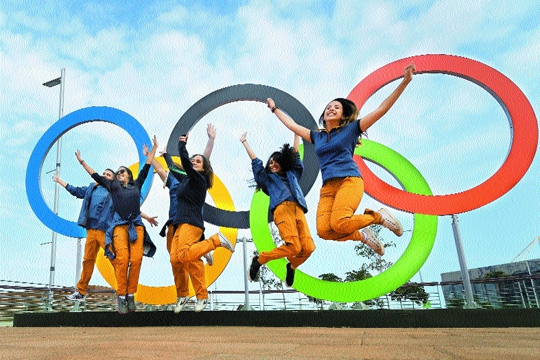
Rio

Football legend Pele is tipped to ignite the Olympic flame at Rio's iconic Maracana Stadium in Friday's opening ceremony, as the four-yearly celebration of sporting endeavour arrives in South America for the first time.

Olympic chiefs will hope the ceremony marks the start of a 17-day carnival of sport, a feast of drama framed by a Rio backdrop of breathtaking natural beauty.

Jamaican sprint king Usain Bolt will compete under the gaze of the Christ the Redeemer statue, sailors will duel in the shadow of Sugarloaf Mountain while the golden sands of Copacabana will host the spiritual homecoming of the beach volleyball tournament.

Yet the sporting spectacle comes after a frequently chaotic build-up which at times has threatened to leave the city nursing a nasty hangover before the party even starts.

When Rio successfully won the race for the Games in 2009, the 2016 Olympics looked set to be the crowning glory of a dynamic, newly-confident Brazil.

But a brutal recession, double-digit unemployment, fears about the mosquito-borne Zika virus, embarrassing infrastructure stumbles and a political crisis that led to the impeachment of President Dilma Rousseff have all but extinguished the euphoria that greeted the vote victory.

More than one million tickets, or 20 percent of the total, including for coveted events such as the men's 100-metres final, remained unsold as of Wednesday.

'The country is very sad'

"In a way the Olympics is good for Brazil to help us develop, but the country is very sad, full of violence and unemployment," Carlos Roberto, 56, a dockyard worker said.

"You go into a hospital and can't find a doctor or medicines."

"It will bring some happiness, yes it will," added pharmacist Edna Carla Assis, 31. "But nothing more."

Several ambitious plans to transform Rio have long since been abandoned, including a pledge to clean up the city's filthy Guanabara Bay.

That failure means athletes in Olympic sailing and windsurfing events will be forced to compete in a toxic soup of raw sewage from half of the city's population.

The Zika virus -- which can cause serious birth defects if pregnant mothers are infected -- has prompted all of the world's top four golfers to withdraw from the games.

Brazilian officials insist that the threat of infection is near zero in what is one of the coolest times of the year.

A vast security blanket of 85,000 military personnel and police -- twice the number on duty at the 2012 London Games -- will be draped over the city to ward off the threat of terror attacks.

Not even the beefed-up security, however, is likely to offer total protection against Rio's long-running problems with high crime.

Danish, Chinese and Australian delegations have already reported thefts from team members since arriving in Brazil, while in May members of Spain's sailing team were mugged at gunpoint.

While Rio has had its hands full scrambling to manage the grim litany of problems, the Olympic movement has been battling to cope with the Russian doping scandal.

A devastating report by a World Anti-Doping Agency (WADA) investigative panel issued last November detailed a state-supporting doping program that harked back to the worst steroid scandals of the Cold War-era.

The International Association of Athletics Federations (IAAF) subsequently banned Russian track and field athletes from all international competition for six months.

The IAAF later extended that suspension to cover the Olympics after ruling that Russia had not taken sufficient steps to overhaul its anti-doping regime.

More damning revelations erupted last month with the release of a WADA report by Canadian lawyer Richard McLaren which documented the full scale of Russian cheating, including an elaborate scheme to cover-up positive drug tests at the 2014 Winter Olympics and 2013 World Athletics Championships.

Bolt, Phelps return

The fallout from the drugs scandal should give way to several compelling sporting storylines once the action gets under way.

Once again, Jamaican superstar Bolt could electrify his sport when he attempts to defend his 100m, 200m and 4x100m relay crowns in the blue riband track and field event.

All eyes will turn to the Olympic swimming pool in the opening week when US star Michael Phelps returns for his swansong.

The most decorated Olympian in history -- 22 medals, 18 golds -- has returned from retirement for one last crack at glory at the age of 31.

Gymnastics meanwhile could see the coronation of a new darling with America's teenage star Simone Biles while football superstar Neymar bids to inspire Brazil to a first ever Olympic gold medal.

New sports making their debut in Rio will include seven-a-side rugby and golf.

As always, however, while millionaire globally renowned stars like Bolt, Phelps and Neymar chase gold, it is the lesser known athletes who will relish their moment in the spotlight.

The 10 athletes who comprise the first ever Olympic Refugee team are among the hundreds of inspiring human stories to be found in Rio.

They include Yusra Mardini, an 18-year-old from Syria who less than a year ago was forced to swim for her life during a perilous journey across the Mediterranean as she fled her war-torn homeland.

Another refugee athlete, judoka Yolande Mabika, said simply: "This is not just a struggle for sport -- it's a struggle for life."

Comments

Add new comment

  • Coastaldigest.com reserves the right to delete or block any comments.
  • Coastaldigset.com is not responsible for its readers’ comments.
  • Comments that are abusive, incendiary or irrelevant are strictly prohibited.
  • Please use a genuine email ID and provide your name to avoid reject.
News Network
March 16,2020

Mar 16: With COVID-19 outbreak killing over 5,400 people globally, former Pakistan cricketer Shoaib Akhtar has lashed out at those responsible for making the coronavirus infect humans and blamed China solely for the outbreak.

"I don't understand why you have to eat things like bats, drink their blood and urine and spread some virus across the globe...I'm talking about the Chinese people. They have put the world at stake. I really don't understand how you can eat bats, dogs, and cats. I'm really angry," Akhtar said in a video posted on his Youtube channel.

"The whole world is at risk now. The tourism industry has been hit, the economy is badly affected and the whole world is going towards a lockdown.

"I'm not against the people of China but I'm against the law of animals. I understand this may be your culture but this is not benefitting you now, it is killing humanity. I'm not saying you boycott the Chinese but there has to be some law. You cannot go on and eat anything and everything," he added.

Coronavirus, which originated in China's Wuhan city, has so far spread to more than 100 countries, infecting over 1,30,000 people.

In Pakistan, the number of positive cases reached 28 on Saturday.

Many sporting events, including the Indian Premier League (IPL) and Pakistan Super League (PSL), have been affected by the disease which has now been declared a pandemic by the World Health Organisation (WHO).

While the IPL 2020, which was originally scheduled to start from March 29, has been postponed till April 15, the playoff stage of PSL has been curtailed and will be played behind closed doors.

"The biggest reason for anger is PSL...Cricket returned to Pakistan after so many years, the PSL was happening in our country for the first time now even that is at risk. The foreign players are leaving, it will take place behind closed doors," said Akhtar.

The total number of confirmed coronavirus cases across India has crossed 80 while two people have lost their lives due to the deadly disease. But Akhtar did not have the information and added: "God forbid the virus doesn't reach India. There are around 130 crore people there. I've been in touch with my friends in India and wishing them well."

In PSL, there will be no playoffs and the top four teams will now play semi-finals and then the final on March 17 and 18. The final was originally scheduled to be held on March 22.

"I've also heard that IPL has been postponed till April 15. The hotel industries, travel industries, broadcasters everything will incur losses because of this," he said.

The former Pakistan pacer also called on the world authorities to come out with a new animal protection law so that such diseases don't resurface in the future.

Comments

Add new comment

  • Coastaldigest.com reserves the right to delete or block any comments.
  • Coastaldigset.com is not responsible for its readers’ comments.
  • Comments that are abusive, incendiary or irrelevant are strictly prohibited.
  • Please use a genuine email ID and provide your name to avoid reject.
News Network
January 20,2020

Jan 20: Both Steve Smith and Rohit Sharma made sparkling centuries in Bengaluru, but it was the Indian who finished on the winning side, leading his team to a 2-1 series win.

Smith, having run out his captain Aaron Finch early on, dug in to bring up his ninth ODI century, his 131 off 132 balls setting India a target of 287 on Sunday, 19 January. Continuing the dazzling display of batting at the M Chinnaswamy stadium, Rohit struck 119 in 128 balls, and skipper Virat Kohli chipped in with 89, as the hosts chased down the target with seven wickets to spare in 47.3 overs.

With Shikhar Dhawan hurting his shoulder in the fifth over of the day and sidelined for the rest of the match, Rohit was reunited with KL Rahul – who had a chance to open the innings after coming in at No.3 and No.5 in the first two matches, while also standing in as wicket-keeper. The vice-captain was on the ball right away, dominating the scoring as India raced to 61/0 in the first 10 overs.

The introduction of spin gave Australia a vital breakthrough: Ashton Agar trapped Rahul in front on review, and although the new pair of Rohit and Kohli weren't unduly troubled, the run-rate slowed down. Josh Hazlewood, playing his first ODI in India and his first match in the format in 14 months, was especially miserly, conceding just 10 runs in his first five overs.

But, having settled in, the duo built a useful partnership of 137 and gave themselves the chance to hit out with wickets in hand. The part-time bowling of Finch and Marnus Labuschagne was punished, Rohit lapping up the short balls and sending them soaring into the stands. His century, his eighth against Australia, came with a single to third man.

Zampa finally got the breakthrough, having him caught in the deep going for another big one. But with Kohli having loosened his arms with a couple of beautiful fours off Pat Cummins to go past his half-century, India remained on course.

The skipper missed out on a hundred, but with Shreyas Iyer too clearing the ropes, there were no hurdles as India wrapped up an entertaining series win.

Earlier, the Indian bowlers struggled to find their lines after Australia chose to bat, but Australia weren't able to fully capitalise. David Warner was thrown by the movement to nick Mohammed Shami to the wicket-keeper, while Finch was caught short after Smith pulled out of a run, to leave the hosts at 46/2.

Labuschagne and Smith, though, combined for another special partnership, going at a brisk rate and showing delectable timing against spin. They had guided their side to 173 in the 32nd over when the a sharp piece of fielding from the home captain and strong bowling pulled things back.

Kohli, at cover, plucked a drive from Labuschagne soon after the batsman had reached his maiden fifty. Ravindra Jadeja had his second of the over when the experiment to send Mitchell Starc at No.5 lasted just three balls.

Alex Carey gave Smith company as he brought up a well-earned century, having fallen just short the previous game. The former skipper stepped up the scoring once he crossed three figures, a wristy helicopter six over deep square leg the highlight of his innings. But, excellent death bowling by Shami, who finished with four wickets, ensured the tourists were kept to under 300 – a total that proved below par.

Comments

Add new comment

  • Coastaldigest.com reserves the right to delete or block any comments.
  • Coastaldigset.com is not responsible for its readers’ comments.
  • Comments that are abusive, incendiary or irrelevant are strictly prohibited.
  • Please use a genuine email ID and provide your name to avoid reject.
News Network
May 10,2020

New Delhi, May 10: Former Australia captain Ian Chappell has proposed radical changes in the LBW laws, stating that a batsman should be given out leg before as long as the ball is hitting the stumps irrespective of the spot of its landing and impact.

Chappell also said captains should agree on one way of working up the ball which will encourage swing bowling, even as the ICC is considering the use of artificial substances to shine the ball instead of sweat and saliva in post-COVID-19 scenario.

"The new lbw law should simply say: 'Any delivery that strikes the pad without first hitting the bat and, in the umpire's opinion, would go on to hit the stumps is out regardless of whether or not a shot is attempted'," he wrote in a column for ESPNcricinfo.

"Forget where the ball pitches and whether it strikes the pad outside the line or not; if it's going to hit the stumps, it's out."

The 76-year-old said the change in lbw law would attract expected criticism from the batsmen but it would make the game more fair.

"There will be screams of horror - particularly from pampered batsmen - but there are numerous positives this change would bring to the game. Most important is fairness.

"If a bowler is prepared to attack the stumps regularly, the batsman should only be able to protect his wicket with the bat. The pads are there to save the batsman from injury not dismissal.

"It would also force batsmen to seek an attacking method to combat a wristspinner pitching in the rough outside the right-hander's leg stump," said Chappell.

He cited Sachin Tendulkar's example on how he negotiated Shane Warne's round the wicket tactic during the 1997-98 Test series in India.

"Contrast Sachin Tendulkar's aggressive and successful approach to Shane Warne coming round the wicket in Chennai in 1997-98 with a batsman who kicks away deliveries pitching in the rough and turning in toward the stumps. Which would you rather watch?

"The current law encourages "pad play" to balls pitching outside leg while this change would force them to use their bat. The change would reward bowlers who attack the stumps and decrease the need for negative wide deliveries to a packed off-side field," he said.

Chappell said his proposed change to the lbw law would also cut down "frivolous" DRS challenges.

"This change to the lbw law would also simplify umpiring and result in fewer frivolous DRS challenges. Consequently, it would speed up a game that has slowed drastically in recent times.

"It would also make four-day Tests an even more viable proposition as mind-numbing huge first-innings totals would be virtually non-existent."

On the substitute of shining the ball without sweat and saliva, Chappell said international captains should find out a way of working up the ball.

"With ball-tampering always a hot topic, in the past I've suggested that administrators ask international captains to construct a list (i.e. the use of natural substances) detailing the things bowlers feel will help them to swing the ball.

"From this list, the administrators should deem one method to be legal with all others being punishable as illegal," the cricketer-turned-commentator added.

Comments

Add new comment

  • Coastaldigest.com reserves the right to delete or block any comments.
  • Coastaldigset.com is not responsible for its readers’ comments.
  • Comments that are abusive, incendiary or irrelevant are strictly prohibited.
  • Please use a genuine email ID and provide your name to avoid reject.