


Rio Olympics: Carnival After Hangover as 2016 Games Get Under Way

August 5, 2016

Rio de Janeiro, Aug 5: The most crisis-ridden Olympic Games in history opens on Friday with Rio organisers hoping to draw a line under a turbulent seven-year build-up to the greatest sporting show on Earth.
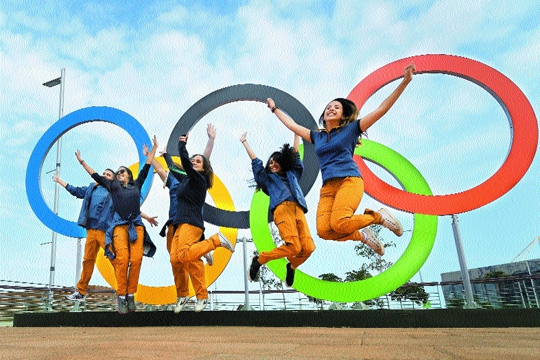
Rio

Football legend Pele is tipped to ignite the Olympic flame at Rio's iconic Maracana Stadium in Friday's opening ceremony, as the four-yearly celebration of sporting endeavour arrives in South America for the first time.

Olympic chiefs will hope the ceremony marks the start of a 17-day carnival of sport, a feast of drama framed by a Rio backdrop of breathtaking natural beauty.

Jamaican sprint king Usain Bolt will compete under the gaze of the Christ the Redeemer statue, sailors will duel in the shadow of Sugarloaf Mountain while the golden sands of Copacabana will host the spiritual homecoming of the beach volleyball tournament.

Yet the sporting spectacle comes after a frequently chaotic build-up which at times has threatened to leave the city nursing a nasty hangover before the party even starts.

When Rio successfully won the race for the Games in 2009, the 2016 Olympics looked set to be the crowning glory of a dynamic, newly-confident Brazil.

But a brutal recession, double-digit unemployment, fears about the mosquito-borne Zika virus, embarrassing infrastructure stumbles and a political crisis that led to the impeachment of President Dilma Rousseff have all but extinguished the euphoria that greeted the vote victory.

More than one million tickets, or 20 percent of the total, including for coveted events such as the men's 100-metres final, remained unsold as of Wednesday.

'The country is very sad'

"In a way the Olympics is good for Brazil to help us develop, but the country is very sad, full of violence and unemployment," Carlos Roberto, 56, a dockyard worker said.

"You go into a hospital and can't find a doctor or medicines."

"It will bring some happiness, yes it will," added pharmacist Edna Carla Assis, 31. "But nothing more."

Several ambitious plans to transform Rio have long since been abandoned, including a pledge to clean up the city's filthy Guanabara Bay.

That failure means athletes in Olympic sailing and windsurfing events will be forced to compete in a toxic soup of raw sewage from half of the city's population.

The Zika virus -- which can cause serious birth defects if pregnant mothers are infected -- has prompted all of the world's top four golfers to withdraw from the games.

Brazilian officials insist that the threat of infection is near zero in what is one of the coolest times of the year.

A vast security blanket of 85,000 military personnel and police -- twice the number on duty at the 2012 London Games -- will be draped over the city to ward off the threat of terror attacks.

Not even the beefed-up security, however, is likely to offer total protection against Rio's long-running problems with high crime.

Danish, Chinese and Australian delegations have already reported thefts from team members since arriving in Brazil, while in May members of Spain's sailing team were mugged at gunpoint.

While Rio has had its hands full scrambling to manage the grim litany of problems, the Olympic movement has been battling to cope with the Russian doping scandal.

A devastating report by a World Anti-Doping Agency (WADA) investigative panel issued last November detailed a state-supporting doping program that harked back to the worst steroid scandals of the Cold War-era.

The International Association of Athletics Federations (IAAF) subsequently banned Russian track and field athletes from all international competition for six months.

The IAAF later extended that suspension to cover the Olympics after ruling that Russia had not taken sufficient steps to overhaul its anti-doping regime.

More damning revelations erupted last month with the release of a WADA report by Canadian lawyer Richard McLaren which documented the full scale of Russian cheating, including an elaborate scheme to cover-up positive drug tests at the 2014 Winter Olympics and 2013 World Athletics Championships.

Bolt, Phelps return

The fallout from the drugs scandal should give way to several compelling sporting storylines once the action gets under way.

Once again, Jamaican superstar Bolt could electrify his sport when he attempts to defend his 100m, 200m and 4x100m relay crowns in the blue riband track and field event.

All eyes will turn to the Olympic swimming pool in the opening week when US star Michael Phelps returns for his swansong.

The most decorated Olympian in history -- 22 medals, 18 golds -- has returned from retirement for one last crack at glory at the age of 31.

Gymnastics meanwhile could see the coronation of a new darling with America's teenage star Simone Biles while football superstar Neymar bids to inspire Brazil to a first ever Olympic gold medal.

New sports making their debut in Rio will include seven-a-side rugby and golf.

As always, however, while millionaire globally renowned stars like Bolt, Phelps and Neymar chase gold, it is the lesser known athletes who will relish their moment in the spotlight.

The 10 athletes who comprise the first ever Olympic Refugee team are among the hundreds of inspiring human stories to be found in Rio.

They include Yusra Mardini, an 18-year-old from Syria who less than a year ago was forced to swim for her life during a perilous journey across the Mediterranean as she fled her war-torn homeland.

Another refugee athlete, judoka Yolande Mabika, said simply: "This is not just a struggle for sport -- it's a struggle for life."

Comments

Add new comment

  • Coastaldigest.com reserves the right to delete or block any comments.
  • Coastaldigset.com is not responsible for its readers’ comments.
  • Comments that are abusive, incendiary or irrelevant are strictly prohibited.
  • Please use a genuine email ID and provide your name to avoid reject.
News Network
June 1,2020

Jun 1: Premier India pacer Jasprit Bumrah won't miss the hugs and high-fives as part of a wicket celebration but he will certainly miss applying saliva on the ball and feels an alternative should be provided to maintain the red cherry.

The ICC Cricket Committee, led by former India captain Anil Kumble, recommended a ban on using saliva on the ball as an interim measure to deal with the COVID-19 pandemic. However, the Committee did not allow the use of artificial substances as a substitute move.

The new rule makes life tougher for the bowlers and Bumrah, like many former and current fast bowlers, feels there ought to be an alternative.

"I was not much of a hugger anyway and not a high-five person as well, so that doesn't trouble me a lot. The only thing that interests me is the saliva bit," said Bumrah in a chat with Ian Bishop and Shaun Pollock on ICC's video series 'Inside Out'.

"I don't know what guidelines we'll have to follow when we come back, but I feel there should be an alternative," he added.

Bumrah said not being able to use saliva makes the game more batsman-friendly.

"If the ball is not well maintained, it's difficult for the bowlers. The grounds are getting shorter and shorter, the wickets are becoming flattered and flatter.

"So we need something, some alternative for the bowlers to maintain the ball so that it can do something - maybe reverse in the end or conventional swing."

When former West Indian pacer Bishop pointed out that the conditions have been favorable to the fast bowlers over the last couple of years, Bumrah nodded in agreement.

"In Test match cricket, yes. That is why it's my favorite format because we have something over there. But in one-day cricket and T20 cricket… one-day cricket there are two new balls, so it hardly reverses at the end.

"We played in New Zealand, the ground (boundary) was 50 metres. So even if you are not looking to hit a six, it will go for six. In Test matches I have no problem, I'm very happy with the way things are going."

He finds it amusing that the batsmen keep complaining about the swinging ball.

"Whenever you play, I've heard the batsmen - not in our team, everywhere - complaining the ball is swinging. But the ball is supposed to swing! The ball is supposed to do something! We are not here just to give throwdowns, isn't it? (laughter)

"This is what I tell batsmen all the time. In one-day cricket, when did the ball reverse last, I don't know. Nowadays the new ball doesn't swing a lot as well. So whenever I see batsmen say the ball is swinging or seaming and that is why I got out - the ball is supposed to do that.

"Because it doesn't happen so much in the other formats, it's a new thing for the batsmen when the ball is swinging or seaming," said the 26-year-old.

The Ahmedabad-born pacer finds himself in an unusual position as he has not bowled for over two months due to the lockdown imposed in the wake of the coronavirus outbreak.

When India will play next is not clear yet and Bumrah said he is not sure about how his body will hold up when he returns to action.

"I really don't know how your body reacts when you don't bowl for two months, three months. I'm trying to keep up with training so that as soon as the grounds open up, the body is in decent shape.

"I've been training almost six days a week but I've not bowled for a long period of time so I don't know how the body will react when I bowl the first ball.

"I'm looking at it as a way to renew your own body. We'll never get such a break again, so even if you have a small niggle here and there, you can be a refreshed person when you come back. You can prolong your career," he said.

Bumrah has risen rapidly in international cricket despite experts having reservations about his longevity due to his unorthodox action.

The gritty fast bowler sees similarities in his career graph to Swedish football star Zlatan Ibrahimovic.

"Our personalities are different. But the story I could relate to is that not many people thought he would make it big. There was a similar case with me growing up as well.

"Wherever I went, it was the general feedback from people that 'this guy would not do anything, he would not be a top-rated bowler, he won't be able to play for a long period of time with this kind of action'.

"So, having the self-belief is important and the only validation that is required is your own validation. I saw that in his (Ibrahimovic's) story, so that's the thing I could relate to," added Bumrah.

Comments

Add new comment

  • Coastaldigest.com reserves the right to delete or block any comments.
  • Coastaldigset.com is not responsible for its readers’ comments.
  • Comments that are abusive, incendiary or irrelevant are strictly prohibited.
  • Please use a genuine email ID and provide your name to avoid reject.
News Network
June 25,2020

New Delhi, Jun 25: India spinner Ravichandran Ashwin on Thursday called the 1983 World Cup win as the 'landscape' changing moment for the game of cricket in the country.

Today, India is celebrating the completion of the 37 years of the maiden World Cup triumph under the leadership of Kapil Dev.

"Today 37 years ago, changed the cricketing landscape in India. Thank you @therealkapildev and team for making the game a career for many of us today. Deeply indebted," Ashwin tweeted.

In 1983, in the finals between India and West Indies, the latter won the toss and opted to bowl first.

The Kapil Dev-led side managed to score just 183 runs as Andy Roberts took three wickets while Malcolm Marshall, Michael Holding, and Larry Gomes picked up two wickets each.

Defending 183, India did a good job of keeping a check on the Windies run flow, reducing the side to 57/3.

Soon after, the team from the Caribbean was reduced to 76/6 and India was the favourites from there on to win the title.

Mohinder Amarnath took the final wicket of Michael Holding to give India their first-ever World Cup title win.

In the finals, West Indies was bowled out for 140, and as a result, India won the match by 43 runs.

Kapil Dev lifting the trophy at the balcony of Lord's Cricket Ground still remains an image to savour for all the Indian fans.

In the finals, Mohinder Amarnath was chosen as the Man of the Match as he scored 26 runs with the bat and also picked up three wickets with the ball.

India has been the regular participant in the World Cup from its beginning to the latest edition. The first edition was held in 1975 and from there on, it has taken place after a span of every four years.

West Indies won the first two World Cup titles (1975, 1979) and was the runner-up in 1983. India has won the title two times, in 1983 and in 2011.

MS Dhoni captained the 2011 team to win their second title after 28 years. Australia has won the tournament five times (1987, 1999, 2003, 2007, and 2015).

Comments

Add new comment

  • Coastaldigest.com reserves the right to delete or block any comments.
  • Coastaldigset.com is not responsible for its readers’ comments.
  • Comments that are abusive, incendiary or irrelevant are strictly prohibited.
  • Please use a genuine email ID and provide your name to avoid reject.
News Network
July 25,2020

New Delhi, Jul 25: Former India spinner Anil Kumble said that he has never understood why people compared him with Australia's Shane Warne.

Kumble was doing an Instagram live session with former Zimbabwe pacer Pommie Mbangwa and it was then that the spinner also talked about being the third-highest wicket-taker in Test cricket.

"It feels really wonderful to finish with these many wickets. I never bothered about statistics or what my average should be, I wanted to bowl the whole day and be the one to take wickets. To finish as the third-highest wicket-taker in Tests alongside Murali and Warne is very special. All three of us played in the same era, there were a lot of comparisons, I do not know why people compared me with Warne. Warne was someone really different and he was on a different plane," Kumble told Mbangwa during the interaction.
"These two guys could spin the ball on any surface so it became really difficult for me when they started comparing me with Warne and Murali. I learnt a lot by watching them both bowl," he added.

The Indian spinner announced his retirement from international cricket in 2008. He finished with 619 wickets in the longest format of the game.

He has the third-highest number of wickets in Tests, only behind Sri Lanka's Muttiah Muralitharan (800) and Australia's Shane Warne (708).

Kumble is the second bowler in the history of international cricket after England's Jim Laker to take all ten wickets in an innings of a Test match.

He had achieved the feat against Pakistan in 1999 at the Feroz Shah Kotla Stadium in Delhi. Kumble had bowling figures of 10-74 from 26.3 overs in the second innings of the Test match.
Kumble will be coaching Kings XI Punjab in the Indian Premier League (IPL). 

Comments

Add new comment

  • Coastaldigest.com reserves the right to delete or block any comments.
  • Coastaldigset.com is not responsible for its readers’ comments.
  • Comments that are abusive, incendiary or irrelevant are strictly prohibited.
  • Please use a genuine email ID and provide your name to avoid reject.