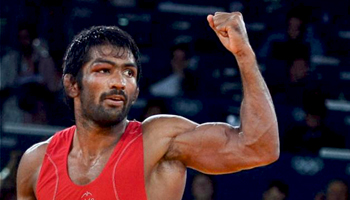
Rio Olympics: Narsingh Yadav is innocent, says Olympic medallist Yogeshwar Dutt

July 26, 2016

New Delhi, Jul 26: London Olympics bronze medallist wrestler Yogeshwar Dutt on Tuesday threw his weight behind Narsingh Yadav, who had flunked a dope test, jeopardising India's chance of a medal in the 74kg weight category at the upcoming the Rio Games.

yadavBarely 10 days ahead of the quadrennial extravaganza in Brazil, Narsingh's dope test came positive on Sunday, which he claimed was a conspiracy against him.

Yogeshwar, who had supported the 26-year-old Narsingh, when two time Olympic medallist Sushil Kumar had demanded a trial to decide India's representative for the 74kg freestyle category, once again came out in support of the Mumbai-based grappler. He also demanded an enquiry into the whole controversy.

"Khusti ke liye bht dukhi hun. Iski janch honi bht zaruri hai. Mujhe vishwas hai Narsingh aesa nai kar sakta (I am very sad about the state of wrestling. This matter should be investigated. I am sure that Narsingh cannot do something like this)," Yogeshwar wrote on his Twitter handle.

On Monday, Wrestling Federation of India (WFI) President Brij Bhushan Sharan Singh extended his support to Narsingh, calling him "innocent" and claiming it to be a case of sabotage.

Sports Minister Vijay Goel, however, indicated that Narsingh's Olympic chances were almost over when he said on Monday that an Indian contingent of 119 athletes is all set to represent India at the Games.

Narsingh, who has been provisionally suspended as of now, will get a chance to prove his innocence when he faces the National Anti Doping Agency (NADA) disciplinary panel on Wednesday.

Comments

Add new comment

  • Coastaldigest.com reserves the right to delete or block any comments.
  • Coastaldigset.com is not responsible for its readers’ comments.
  • Comments that are abusive, incendiary or irrelevant are strictly prohibited.
  • Please use a genuine email ID and provide your name to avoid reject.
News Network
February 9,2020

Potchefstroom, Feb 9: Defending champions India are overwhelming favourites to win a record fifth U19 World Cup title on Sunday but a tough fight is expected from first-timers Bangladesh in an all-Asian final.

If the India squad for the 2018 edition had the likes of Prithvi Shaw and Shubman Gill, who have expectedly gone on to play for the senior team, the exploits of opener Yashasvi Jaiswal, spinner Ravi Bishnoi and pacer Kartik Tyagi in the current edition have made them overnight stars.

Irrespective of what happens in the final, India have reinforced the fact that they are undisputed leaders at the under-19 level and the cricketing structure the BCCI has developed is working better than any other board in the world.

India, who walloped arch-rivals Pakistan by 10 wickets in the semifinal Tuesday, will be playing their seventh final since 2000 when they lifted the trophy for the first time.

Having said that, success at the U-19 level doesn’t guarantee success at the highest level as not all players have the ability to go on and play for India. Some also lose their way like Unmukt Chand did after leading India to the title in 2012.

His career promised so much back then but now it has come to a stage where he is struggling to make the eleven in Uttarakhand’s Ranji Trophy team, having shifted base from Delhi last year.

Only the exceptionally talented like Shaw and Gill get to realise their dream as the competition is only getting tougher in the ever-improving Indian cricket.

India probably is the only side which fields a fresh squad in every U-19 World Cup edition and since there is no dearth of talent and a proper structure is in place, the talent keeps coming up.

“The fact that we allow a cricketer to play the U-19 World Cup only once is a big reason behind the team’s success. While most teams have cricketers who have played in the previous edition,” India U-19 fielding coach Abhay Sharma said from Potchefstroom.

“It just goes to show that the system under the visionary leadership of Rahul Dravid (NCA head) is flourishing. Credit to BCCI as well that other teams want to follow our structure.”

Heading to the mega event, India colts played about 30-odd games in different part of the world. To get used to the South African conditions, they played a quadrangular series before they played their World Cup opener against Sri Lanka.

In the final, India run into Bangladesh, a team which too has reaped the benefits of meticulous planning since their quarterfinal loss at the 2018 edition.

Though the Priyam Garg-led Indian side got the better of them in the tri-series in England and Asia Cup last year, Bangladesh has always come up with a fight and fielding coach Sharma expects it would be no different Sunday.

They are a very good side. There is a lot of mutual respect. I can tell you that,” he said.

Considering it is their maiden final, it is a bigger game for Bangladesh. If they win, it will be sweet revenge against the sub-continental giants, who have found a way to tame Bangladesh at the senior level in close finals including the 2018 Nidahas Trophy and 2016 World T20.

“We don’t want to take unwanted pressure. India is a very good side. We have to play our ‘A’ game and do well in all three departments. Our fans are very passionate about their cricket. I would want to tell them, keep supporting us,” said Bangladesh skipper Akbar Ali after their semifinal win over New Zealand.

Comments

Add new comment

  • Coastaldigest.com reserves the right to delete or block any comments.
  • Coastaldigset.com is not responsible for its readers’ comments.
  • Comments that are abusive, incendiary or irrelevant are strictly prohibited.
  • Please use a genuine email ID and provide your name to avoid reject.
News Network
May 10,2020

New Delhi, May 10: Former Australia captain Ian Chappell has proposed radical changes in the LBW laws, stating that a batsman should be given out leg before as long as the ball is hitting the stumps irrespective of the spot of its landing and impact.

Chappell also said captains should agree on one way of working up the ball which will encourage swing bowling, even as the ICC is considering the use of artificial substances to shine the ball instead of sweat and saliva in post-COVID-19 scenario.

"The new lbw law should simply say: 'Any delivery that strikes the pad without first hitting the bat and, in the umpire's opinion, would go on to hit the stumps is out regardless of whether or not a shot is attempted'," he wrote in a column for ESPNcricinfo.

"Forget where the ball pitches and whether it strikes the pad outside the line or not; if it's going to hit the stumps, it's out."

The 76-year-old said the change in lbw law would attract expected criticism from the batsmen but it would make the game more fair.

"There will be screams of horror - particularly from pampered batsmen - but there are numerous positives this change would bring to the game. Most important is fairness.

"If a bowler is prepared to attack the stumps regularly, the batsman should only be able to protect his wicket with the bat. The pads are there to save the batsman from injury not dismissal.

"It would also force batsmen to seek an attacking method to combat a wristspinner pitching in the rough outside the right-hander's leg stump," said Chappell.

He cited Sachin Tendulkar's example on how he negotiated Shane Warne's round the wicket tactic during the 1997-98 Test series in India.

"Contrast Sachin Tendulkar's aggressive and successful approach to Shane Warne coming round the wicket in Chennai in 1997-98 with a batsman who kicks away deliveries pitching in the rough and turning in toward the stumps. Which would you rather watch?

"The current law encourages "pad play" to balls pitching outside leg while this change would force them to use their bat. The change would reward bowlers who attack the stumps and decrease the need for negative wide deliveries to a packed off-side field," he said.

Chappell said his proposed change to the lbw law would also cut down "frivolous" DRS challenges.

"This change to the lbw law would also simplify umpiring and result in fewer frivolous DRS challenges. Consequently, it would speed up a game that has slowed drastically in recent times.

"It would also make four-day Tests an even more viable proposition as mind-numbing huge first-innings totals would be virtually non-existent."

On the substitute of shining the ball without sweat and saliva, Chappell said international captains should find out a way of working up the ball.

"With ball-tampering always a hot topic, in the past I've suggested that administrators ask international captains to construct a list (i.e. the use of natural substances) detailing the things bowlers feel will help them to swing the ball.

"From this list, the administrators should deem one method to be legal with all others being punishable as illegal," the cricketer-turned-commentator added.

Comments

Add new comment

  • Coastaldigest.com reserves the right to delete or block any comments.
  • Coastaldigset.com is not responsible for its readers’ comments.
  • Comments that are abusive, incendiary or irrelevant are strictly prohibited.
  • Please use a genuine email ID and provide your name to avoid reject.
News Network
February 21,2020

Wellington, Feb 22: shant Sharma's lion-hearted bowling effort met its match in Kane Williamson's elegance as New Zealand ended an attritional second day of the opening Test against India with a slight upper-hand, here on Saturday.

After another lower-order collapse that saw India get bundled out for 165, Ishant, coming straight back from an ankle injury, took three for 31 in 15 overs despite Williamson's effortless 89 in New Zealand's day-end score of 216 for 5.

New Zealand now lead by 51 runs.

Mohammed Shami (1/61 in 17 overs), during his final spell of the day, removed Williamson, who couldn't check an uppish drive. Henry Nicholls' (17 off 62 balls) struggle seemed to have hampered Williamson's rhythm.

During the final hour, Ravichandran Ashwin (1/60 in 21 overs), who also bowled beautifully throughout the day, relieved Nicholls' of his agony with a delivery that had drift and a hint of turn as India skipper Virat Kohli snapped the low catch at second slip.

Williamson looked good as he hit some delightful strokes square off the wicket. The square drive on the rise off Jasprit Bumrah (0/62 in 18.1 overs), followed by a cover drive, showed his class.

In all, the New Zealand skipper hit 11 boundaries off 153 balls.

Bumrah, in particular, was punished by Williamson, who also back-cut him for a boundary and Taylor then punished another half volley through the covers.

There were quite a few loose deliveries on offer from the Indian pacers and in between a few did beat the bat. With the 'Basin' baked in sunshine, batting became lot more easier and Black Caps seized the initiative.

Bumrah, in particular, failed to find his length consistently. Either he bowled too full and drivable length deliveries or too short that even Rishabh Pant failed to gather with the ball going a couple feet over his head.

This is where Ishant came into the picture. While he was lucky to get opener Tom Latham out with a delivery drifting on leg-stump, the other opener Tom Blundell (30) had a typical Ishant dismissal written all over it.

The ball was full on the off-stump channel and jagged back enough to find the gap between his bat and pad.

Williamson and Taylor then had a partnership of 93 runs during which New Zealand also got the lead before Ishant, coming back for his third spell, bowled one that reared up from good length and proved to be an easy catch for Cheteshwar Pujara at short-leg.

Once Nicholls came in, Williamson, who was batting fluently, suddenly had a player at the opposite end who scored only 4 off 34 balls.

Looking good for his 22nd Test hundred, Williamson, in his bid to get another boundary, couldn't check a cover drive and the low catch was taken by substitute fielder Ravindra Jadeja.

Earlier, New Zealand's debutant Kyle Jamieson and veteran Tim Southee took four wickets apiece as Indian innings folded in 68.1 overs.

Jamieson (4/49 in 16 overs) and Southee (4/49 in 20.1 overs) took four of the five wickets that fell on the second morning with India adding only 43 runs to their overnight score of 122 for 5.

Rishabh Pant (19) started with a six but then a horrible mix-up with senior partner Ajinkya Rahane (46) resulted in a run-out and the little chance of recovery was gone for good.

It was a poor call from the senior player and Pant had to sacrifice his wicket in the process.

Ashwin then received a beauty from Southee, pretty similar to what Prithvi Shaw got, while Rahane inside edged one while trying to leave it alone.

With India at 132 for 7, Rahane knew that time was running out as he played a square drive off Trent Boult to get him a boundary.

Southee then got rid of Rahane when he tried to shoulder arm a delivery that made a late inward movement. Mohammed Shami's entertaining 21 then enabled the visitors to cross the 150-run mark.


Comments

Add new comment

  • Coastaldigest.com reserves the right to delete or block any comments.
  • Coastaldigset.com is not responsible for its readers’ comments.
  • Comments that are abusive, incendiary or irrelevant are strictly prohibited.
  • Please use a genuine email ID and provide your name to avoid reject.