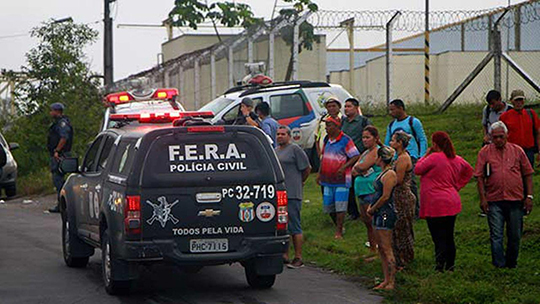
Riot in Brazil jail leaves 60 dead

January 3, 2017

Rio De Janeiro, Jan 3: At least 60 people were killed in a prison riot in Brazil's Amazon region when fighting broke out between rival gangs, an official said Monday.

jail

The riot happened on Sunday at a prison in Manaus, the capital of Amazonas state, said the head of the state's prisons administration, Pedro Florencio.

“There are 60 dead so far,” he told journalists.

The unrest ended early on Monday, police said, when the inmates surrendered their weapons and freed unharmed the last of 12 guards they had taken hostage.
According to BBC, six headless bodies were thrown over the perimeter fence of the prison.

Riots are common in Brazil's overcrowded and underfunded prisons.
Some 6,22,000 people were imprisoned in Brazil as of the end of 2014, according to a justice ministry report. Most of them are black males.

That makes it the world's fourth-largest prison population, the report said, after the United States, China and Russia.

The prison was built for 454 inmates, but it is thought to have held almost 600. Latest available figures dating back to October suggest there were 585 prisoners in the jail back then.

Human rights groups have long complained about the conditions in Brazilian prisons.

On October 18, deadly riots broke out at three separate prisons blamed on fighting between members of the country's two largest gangs.

Comments

Add new comment

  • Coastaldigest.com reserves the right to delete or block any comments.
  • Coastaldigset.com is not responsible for its readers’ comments.
  • Comments that are abusive, incendiary or irrelevant are strictly prohibited.
  • Please use a genuine email ID and provide your name to avoid reject.
Agencies
August 7,2020

Russia boasts that it's about to become the first country to approve a Covid-19 vaccine, with mass vaccinations planned as early as October using shots that are yet to complete clinical trials -- and scientists worldwide are sounding the alarm that the headlong rush could backfire.

Moscow sees a Sputnik-like propaganda victory, recalling the Soviet Union's launch of the world's first satellite in 1957.

But the experimental Covid-19 shots began first-in-human testing on a few dozen people less than two months ago, and there's no published scientific evidence yet backing Russia's late entry to the global vaccine race, much less explaining why it should be considered a front-runner.

“I'm worried that Russia is cutting corners so that the vaccine that will come out may be not just ineffective, but also unsafe,” said Lawrence Gostin, a global public health law expert at Georgetown University. “It doesn't work that way... Trials come first. That's really important.”

According to Kirill Dmitriev, head of Russia's Direct Investment Fund that bankrolled the effort, a vaccine developed by the Gamaleya research institute in Moscow may be approved in days, before scientists complete what's called a Phase 3 study.

That final-stage study, usually involving tens of thousands of people, is the only way to prove if an experimental vaccine is safe and really works.

Health Minister Mikhail Murashko said members of “risk groups,” such as medical workers, may be offered the vaccine this month.

He didn't clarify whether they would be part of the Phase 3 study that is said to be completed after the vaccine receives “conditional approval.”

Deputy Prime Minister Tatyana Golikova promised to start “industrial production” in September, and Murashko said mass vaccination may begin as early as October.

Dr Anthony Fauci, the top US infectious disease specialist, questioned the fast-track approach last week.

“I do hope that the Chinese and the Russians are actually testing a vaccine before they are administering the vaccine to anyone, because claims of having a vaccine ready to distribute before you do testing I think is problematic at best," he said.

Questions about this vaccine candidate come after the US, Britain and Canada last month accused Russia of using hackers to steal vaccine research from Western labs.

Delivering a vaccine first is a matter of national prestige for the Kremlin as it tries to assert the image of Russia as a global power capable of competing with the US and China.

The notion of being “the first in the world” dominated state news coverage of the effort, with government officials praising reports of the first-step testing.

In April, President Vladimir Putin ordered state officials to shorten the time of clinical trials for a variety of drugs, including potential coronavirus vaccines.

According to Russia's Association of Clinical Trials Organizations, the order set “an unattainable bar” for scientists who, as a result, "joined in on the mad race, hoping to please those at power.”

The association first raised concern in late May, when professor Alexander Gintsburg, head of the Gamaleya institute, said he and other researchers tried the vaccine on themselves.

The move was a “crude violation of the very foundations of clinical research, Russian law and universally accepted international regulations" the group said in an open letter to the government, urging scientists and health officials to adhere to clinical research standards.

But a month later, the Health Ministry authorized clinical trials of the Gamaleya product, with what appeared to be another ethical issue.

Human studies started June 17 among 76 volunteers. Half were injected with a vaccine in liquid form and the other half with a vaccine that came as soluble powder.

Some in the first half were recruited from the military, which raised concerns that servicemen may have been pressured to participate.

Some experts said their desire to perform well would affect the findings. “It's no coincidence media reports we see about the trials among the military said no one had any side effects, while the (other group) reported some," said Vasily Vlassov, a public health expert with Moscow's Higher School of Economics.

As the trials were declared completed and looming regulatory approval was announced last week, questions arose about the vaccine's safety and effectiveness.

Government assurances the drug produced the desired immune response and caused no significant side effects were hardly convincing without published scientific data describing the findings.

The World Health Organization said all vaccine candidates should go through full stages of testing before being rolled out.

“There are established practices and there are guidelines out,” WHO spokesman Christian Lindmeier said Tuesday.

“Between finding or having a clue of maybe having a vaccine that works, and having gone through all the stages, is a big difference.”

Offering an unsafe compound to medical workers on the front lines of the outbreak could make things worse, Georgetown's Gostin said, adding: “What if the vaccine started killing them or making them very ill?”

Vaccines that are not properly tested can cause harm in many ways — from a negative impact on health to creating a false sense of security or undermining trust in vaccinations, said Thomas Bollyky, director of the global health program at the Council on Foreign Relations. 

Comments

Add new comment

  • Coastaldigest.com reserves the right to delete or block any comments.
  • Coastaldigset.com is not responsible for its readers’ comments.
  • Comments that are abusive, incendiary or irrelevant are strictly prohibited.
  • Please use a genuine email ID and provide your name to avoid reject.
News Network
May 13,2020

Islamabad, May 13 : The number of confirmed COVID-19 cases in Pakistan rose to 34,370 on Wednesday after new infections were confirmed in the country.

As per province-wise breakup of the total tally cited by Radio Pakistan, so far 13,225 cases have been registered in Punjab, 12,610 in Sindh, 5,021 in Khyber Pakhtunkhwa, 2,158 in Balochistan, 759 in Islamabad, 475 in Gilgit Baltistan and 88 in Pakistan-occupied Kashmir.

As many as 2,255 cases positive were confirmed, while 31 deaths reported during the last 24 hours.

At least 737 patients have died so far while 8,812 stand recovered, the media reported further.

Comments

Add new comment

  • Coastaldigest.com reserves the right to delete or block any comments.
  • Coastaldigset.com is not responsible for its readers’ comments.
  • Comments that are abusive, incendiary or irrelevant are strictly prohibited.
  • Please use a genuine email ID and provide your name to avoid reject.
Agencies
February 17,2020

Islamabad, Feb 17: Prime Minister Imran Khan on Monday warned that Pakistan may face another refugee crisis if the international community failed to take notice of the current situation in India.

Speaking at the two-day refugee summit in Islamabad on 40 years of hosting Afghan refugees in Pakistan, he said India’s "ultranationalist ideology going unchecked could lead to destruction and the region could become a flashpoint", The Express Tribune quoted him as saying.

Khan said if the international community does not take notice of this situation, it will create another refugee crisis for Pakistan as Muslims of India will move to Pakistan.

"This is not the India of Jawaharlal Nehru and Mahatma Gandhi. The United Nations (UN) must play its role otherwise it will become a very big problem in the future," Duniya News quoted Khan as saying.

He said said that Prime Minister Narendra Modi’s statement that India can destroy Pakistan in 11 days is not a responsible statement by a premier of a nuclear state with a huge population, the paper reported.

Khan made the statement in the presence of visiting UN Secretary General Antonio Guterres, who was also attending the summit.

He said because of the "Hindutva" ideology, Kashmiris have been lockdown for over 200 days. He alleged under the same ideology, the BJP-led government passed two discriminatory nationalistic legislations, targeting 200 million Muslims in India.

Khan was referring to India's Citizenship (Amendment) Act and the revocation of the special status to Jammu and Kashmir.

The new citizenship law passed by the Indian Parliament in December 2019 offers citizenship to non-Muslim persecuted religious minorities from Pakistan, Bangladesh and Afghanistan.

The Indian government has maintained that the CAA is an internal matter of the country and stressed that the goal is to protect the oppressed minorities of neighbouring countries.

India revoked Jammu and Kashmir's special status on August 5. Reacting to India's move, Pakistan downgraded diplomatic ties with New Delhi and expelled the Indian High Commissioner.

India has always maintained that Jammu and Kashmir is its integral part and ruled out any third party mediation, including either from the UN or the US, saying it is a bilateral issue with Pakistan.

Comments

Add new comment

  • Coastaldigest.com reserves the right to delete or block any comments.
  • Coastaldigset.com is not responsible for its readers’ comments.
  • Comments that are abusive, incendiary or irrelevant are strictly prohibited.
  • Please use a genuine email ID and provide your name to avoid reject.