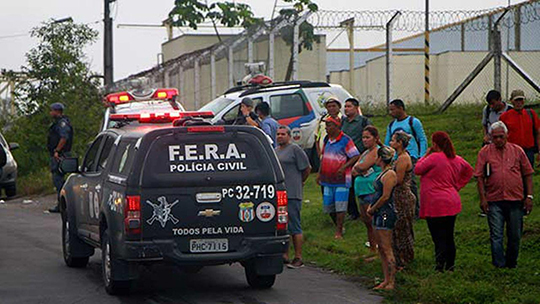
Riot in Brazil jail leaves 60 dead

January 3, 2017

Rio De Janeiro, Jan 3: At least 60 people were killed in a prison riot in Brazil's Amazon region when fighting broke out between rival gangs, an official said Monday.

jail

The riot happened on Sunday at a prison in Manaus, the capital of Amazonas state, said the head of the state's prisons administration, Pedro Florencio.

“There are 60 dead so far,” he told journalists.

The unrest ended early on Monday, police said, when the inmates surrendered their weapons and freed unharmed the last of 12 guards they had taken hostage.
According to BBC, six headless bodies were thrown over the perimeter fence of the prison.

Riots are common in Brazil's overcrowded and underfunded prisons.
Some 6,22,000 people were imprisoned in Brazil as of the end of 2014, according to a justice ministry report. Most of them are black males.

That makes it the world's fourth-largest prison population, the report said, after the United States, China and Russia.

The prison was built for 454 inmates, but it is thought to have held almost 600. Latest available figures dating back to October suggest there were 585 prisoners in the jail back then.

Human rights groups have long complained about the conditions in Brazilian prisons.

On October 18, deadly riots broke out at three separate prisons blamed on fighting between members of the country's two largest gangs.

Comments

Add new comment

  • Coastaldigest.com reserves the right to delete or block any comments.
  • Coastaldigset.com is not responsible for its readers’ comments.
  • Comments that are abusive, incendiary or irrelevant are strictly prohibited.
  • Please use a genuine email ID and provide your name to avoid reject.
News Network
January 27,2020

Shanghai, Jan 27: The death toll from a coronavirus outbreak in China rose to 81 on Monday, as the government extended the Lunar New Year holiday and more big businesses shut down or told staff to work from home in an effort to curb the spread.

Chinese Premier Li Keqiang visited the central city of Wuhan, the epicenter of the outbreak, as the government sought to signal it was responding seriously to the crisis.

The total number of confirmed cases in China rose about 30% to 2,744, about half of them in Hubei province, whose capital is Wuhan.

As worries grew around the world, Chinese-ruled Hong Kong, which has had eight confirmed cases, banned entry to people who had visited Hubei in the past 14 days. The ban did not cover Hong Kong residents.

The number of deaths from the flu-like virus in Hubei climbed to 76 from 56, health officials said, with five deaths elsewhere in China, including the southern island province of Hainan, which reported its first fatality on Monday.

While a small number of cases have been confirmed in more than 10 countries, linked to people who traveled from Wuhan, no deaths have been reported elsewhere.

Li is the most senior leader to visit Wuhan since the outbreak began. Clad in a blue protective suit and mask, he inspected efforts to contain the epidemic and spoke to patients and medical staff, the government said.

The government is extending the week-long Lunar New Year holiday by three days to February 2, in a bid to slow the spread of the virus. The Lunar New Year is usually a time for millions of people to travel, but many have had to cancel their plans because of travel curbs over the virus.

Incubation

Wuhan is already in virtual lockdown and severe limits on movement are in place in several other Chinese cities.

The city of 11 million clamped down further on Monday, announcing the suspension of visa and passport services until January 30.

Despite the curbs, the mayor of Wuhan said on Sunday that five million people had left the city for holidays and other reasons.

Images from Wuhan showing hospital corridors packed with people seeking treatment have circulated on social media, along with complaints of soaring prices for essentials such as vegetables.

Chinese leaders have urged transparency in the crisis, after public trust was eroded by the cover-up of the spread of Severe Acute Respiratory Syndrome (SARS), a coronavirus that originated in China and killed nearly 800 people globally in 2002 and 2003.

Much is not known about the newly identified coronavirus, including how easily it spreads and just how dangerous it is. It can cause pneumonia, which has been deadly in some cases.

National Health Commission minister Ma Xiaowei said on Sunday the incubation period could range from one to 14 days, and the virus was infectious during incubation, unlike SARS.

That compares with a World Health Organization (WHO) estimate of two to 10 days for the incubation period.

“Understanding the time when infected patients may transmit the virus to others is critical for control efforts,” the WHO said.

The virus is believed to have originated late last year in a Wuhan market illegally selling wildlife. It has spread to other cities, including Beijing and Shanghai, as well as more than 10 countries including France, Japan and the United States.

‘Overwhelmed’

Australia confirmed its fifth case on Monday involving a woman on the last flight out of Wuhan to Sydney before China’s travel ban.

Health minister Greg Hunt told the Australian Broadcasting Corporation (ABC) authorities aimed to get about 100 Australian children and young people out of Wuhan.

One father of two, Nathan Wang, told the ABC his wife was stuck in Wuhan with the children. “We absolutely want the children to come back, because hospitals in Wuhan are overwhelmed,” he said.

Airports around the world have stepped up screening of passengers from China, although some health experts have questioned its effectiveness.

Last week the WHO stopped short of calling the outbreak a global health emergency, but some health experts question whether China can contain the epidemic.

WHO Director-General Tedros Adhanom Ghebreyesus is due to travel to Beijing to meet officials and health experts.

Australia, France, Italy, Japan and the United States have all said they are working to evacuate citizens from Wuhan.

Some of China’s biggest companies have been affected, with hotpot restaurant chain Haidilao International Holding shutting branches nationwide from Sunday until Friday.

Gaming giant Tencent Holdings Ltd advised staff to work from home until February 7, and e-commerce firm Alibaba removed vendors’ offers of overpriced face masks from its online Taobao marketplace as prices surged.


Comments

Add new comment

  • Coastaldigest.com reserves the right to delete or block any comments.
  • Coastaldigset.com is not responsible for its readers’ comments.
  • Comments that are abusive, incendiary or irrelevant are strictly prohibited.
  • Please use a genuine email ID and provide your name to avoid reject.
News Network
June 15,2020

Stockholm, Jun 15: Nuclear powers continue to modernise their arsenals, researchers said Monday, warning that tensions were rising and the outlook for arms control was "bleak".

"The loss of key channels of communication between Russia and the USA... could potentially lead to a new nuclear arms race," said Shannon Kile, director of the nuclear arms control programme at the Stockholm International Peace Research Institute (SIPRI) and co-author of the report.

Russia and the US account for more than 90 percent of the world's nuclear weapons.

Kile was referring to the future of the New START treaty between the US and Russia, which is set to expire in February 2021.

It is the final nuclear deal still in force between the two superpowers, aimed at maintaining their nuclear arsenals below Cold War levels.

"Discussions to extend New START or to negotiate a new treaty made no progress in 2019," the SIPRI researchers noted.

At the same time, nuclear powers continue to modernise their weapons while China and India are increasing the size of their arsenals.

"China is in the middle of a significant modernisation of its nuclear arsenal. It is developing a so-called nuclear triad for the first time, made up of new land- and sea-based missiles and nuclear-capable aircraft," SIPRI said.

The country has repeatedly rejected Washington's insistence that it join any future nuclear arms reduction talks.

The number of nuclear warheads declined in the past year.

At the start of 2020, the United States, Russia, Britain, China, India, Pakistan, Israel and North Korea together had 13,400 nuclear arms, according to SIPRI's estimates, 465 fewer than at the start of 2019.

The decline was attributed mainly to the United States and Russia.

While the future of the New START treaty remains uncertain, Washington and Moscow have continued to respect their obligations under the accord.

"In 2019, the forces of both countries remained below the limits specified by the treaty," the report said. But both nations "have extensive and expensive programmes underway to replace and modernise their nuclear warheads, missile and aircraft delivery systems, and nuclear weapon production facilities," it added.

"Both countries have also given new or expanded roles to nuclear weapons in their military plans and doctrines, which marks a significant reversal of the post-Cold War trend towards the gradual marginalisation of nuclear weapons."

The Treaty on the Non-Proliferation of Nuclear Weapons (NPT), a cornerstone of the global nuclear non-proliferation regime, celebrates its 50th anniversary this year.

The number of nuclear arms worldwide has declined since hitting a peak of almost 70,000 in the mid-1980s.

The five original nuclear powers -- Washington, Beijing, Moscow, Paris and London -- in March reiterated their commitment to the treaty.

Comments

Add new comment

  • Coastaldigest.com reserves the right to delete or block any comments.
  • Coastaldigset.com is not responsible for its readers’ comments.
  • Comments that are abusive, incendiary or irrelevant are strictly prohibited.
  • Please use a genuine email ID and provide your name to avoid reject.
News Network
June 2,2020

Jun 2: Pakistan's COVID-19 cases reached 76,398 on Tuesday after 3,938 new infections were reported across the country, while the death toll due to the coronavirus has gone up to 1,621, according to the health ministry.

The Ministry of National Health Services said that 78 COVID-19 deaths were recorded in the last 24 hours, taking the total number of fatalities in Pakistan to 1,621.

A total of 27, 110 people have recovered, it said.

Sindh has 29,647 patients, Punjab 27,850, Khyber-Pakhtunkhwa 10,485, Balochistan 4,514, Islamabad 2,893, Gilgit-Baltistan 738 and Pakistan-occupied Kashmir 271, it added.

The authorities have conducted 577,974 tests, including 16,548 in the last 24 hours.

The jump in the number of cases comes a day after Prime Minister Imran Khan said that people should learn to live with COVID-19 until a vaccine is developed.

Khan addressed the media after chairing the meeting of National Coordination Committee, the highest body to tackle the pandemic.

"Coronavirus will not go away until the vaccine is discovered. We need to learn to live with it and we can live with it if we follow precautions," he said.

He said the one million volunteers of the government's coronavirus force will raise awareness of the need to follow guidelines.

The government also said that all sectors will be opened slowly after deciding the negative list of businesses which will not be allowed.

Comments

Add new comment

  • Coastaldigest.com reserves the right to delete or block any comments.
  • Coastaldigset.com is not responsible for its readers’ comments.
  • Comments that are abusive, incendiary or irrelevant are strictly prohibited.
  • Please use a genuine email ID and provide your name to avoid reject.