



Riyadh, Jeddah ‘most affordable’ for expats

March 5, 2014

least_expensive_cities

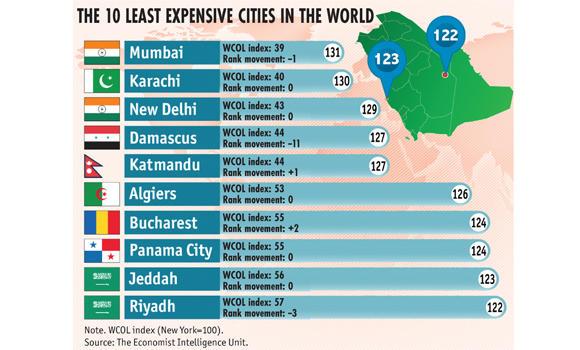
Jeddah, Mar 5: Riyadh and Jeddah are two of the least expensive cities in the world when it comes to living costs, says a new report from the Economist Intelligence Unit (EIU).

The Worldwide Cost of Living is a biannual EIU survey that compares more than 400 individual prices across 160 products and services including food, drink, clothing, household supplies, home rents, transport, utility bills, private schools, domestic help and recreational costs.

The EIU study said that Riyadh and Jeddah offer cheap cost of living in a more stable environment, with price controls on staples in Saudi Arabia continuing to guarantee low prices for many goods. Both cities were also rated as being good value for money when it came to buying other items like bread and cigarettes.

The research found that petrol prices — a key component of the index — in Saudi Arabia had actually fallen in both cities from an average $0.24 per liter 10 years ago to just $0.13 now. This compared with an average of $1.73 per liter in Singapore, ranked as the world’s most expensive city.

Singapore outstripped Tokyo as the world’s most expensive city for expatriates, with the EIU citing a strong Singaporean dollar, high price of utilities and cost of car ownership as among the factors contributing to Singapore taking the top spot.

The report said while Asia is home to some of the world’s most expensive cities, it is also home to many of the world’s cheapest cities. The best value for money is in India, Pakistan, Bangladesh, Nepal and Sri Lanka.

Mumbai is the cheapest location in the survey and three of the four cheapest cities surveyed are from Pakistan, India and Nepal.

These cities are only joined by Damascus because of the unfolding crisis in Syria and its impact on exchange rates.

Comments

Add new comment

  • Coastaldigest.com reserves the right to delete or block any comments.
  • Coastaldigset.com is not responsible for its readers’ comments.
  • Comments that are abusive, incendiary or irrelevant are strictly prohibited.
  • Please use a genuine email ID and provide your name to avoid reject.
Agencies
April 2,2020

Ankara, Apr 2: Saudi Arabia on Thursday declared a 24-hour lockdown in all parts of Makkah and Medina cities as part of measures to stem the spread of the coronavirus.

"The 24-hour curfew will be imposed in all parts of the cities of Makkah and Medina, with a ban on entry and exit from both cities," the Saudi Interior Ministry said on Twitter.

The lockdown starts from Thursday “until further notice.”

All commercial activities inside the residential neighborhoods of the two cities were also prohibited, except for pharmacies, food products stores, gas stations and banking services, the ministry said.

After first appearing in Wuhan, China last December, the virus has spread to at least 180 countries and regions, according to U.S.-based Johns Hopkins University.

Its data shows the number of confirmed cases worldwide have surpassed 962,900, with the death toll over 49,100 and more than 202,700 recoveries.

Anadolu Agency website contains only a portion of the news stories offered to subscribers in the AA News Broadcasting System (HAS), and in summarized form. Please contact us for subscription options.
Related topics

Comments

Add new comment

  • Coastaldigest.com reserves the right to delete or block any comments.
  • Coastaldigset.com is not responsible for its readers’ comments.
  • Comments that are abusive, incendiary or irrelevant are strictly prohibited.
  • Please use a genuine email ID and provide your name to avoid reject.
News Network
May 20,2020

Cairo, May 20: A senior Kuwaiti lawmaker has called for imposing a tax on expatriates’ remittances to shore up the country’s finances.

MP Khalil Al Saleh, the head of the parliament’s Human Resources Committee, has presented a draft law on the proposed tax to the legislature.

“Imposing fees on expatriates’ transfers will have a role in improving the state's revenues and diversify sources of income,” he told Al Rai newspaper.

Migrant workers transfer about 4.2 billion dinars annually from Kuwait, he added, citing figures from Kuwait’s Central Bank.

“This system is in effect in most countries of the world and in more than one Gulf country. Expats there have not objected to it. Allowing this money to exit the country is very dangerous and has a direct effect on economy,” MP Al Saleh said.

“We do not target brotherly expats because imposing symbolic fees on financial transfers will not affect their money, but will have a positive effect on the state’s sources,” he said. “This has become a necessity after the money transferred outside Kuwait has reached 4.2 billion dinars annually without the state [Kuwait] making any benefit from this.”

Foreign workers make up 3.3 million of Kuwait’s 4.6 million population.

Several Kuwaiti public figures have recently pushed for redrawing the demographic imbalance in the country, accusing expatriates of straining health facilities and increasing the Covid-19 threat.

Comments

Add new comment

  • Coastaldigest.com reserves the right to delete or block any comments.
  • Coastaldigset.com is not responsible for its readers’ comments.
  • Comments that are abusive, incendiary or irrelevant are strictly prohibited.
  • Please use a genuine email ID and provide your name to avoid reject.
News Network
May 7,2020

Dubai, May 7: Saudi Arabia will emerge as the victor of the oil price war that sent global crude markets into a spin last month, according to two experts in the energy industry.

Jason Bordoff, professor and founding director of the Center for Global Energy policy at New York’s Columbia University, said: “While 2020 will be remembered as a year of carnage for oil nations, at least one will most likely emerge from the pandemic stronger, both economically and geopolitically: Saudi Arabia.”

Writing in the American publication Foreign Policy, Bordoff said that the Kingdom’s finances can weather the storm from lower oil prices as a result of the drastically reduced demand for oil in economies under pandemic lockdowns, and that it will end up with higher oil revenues and a bigger share of the global market once it stabilizes.

Bordoff’s view was reinforced by Sir Mark Moody-Stuart, former chairman of Royal Dutch Shell and one of the longest-standing directors of Saudi Aramco. In an interview with the Gulf Intelligence energy consultancy, he said that low-cost oil producers such as Saudi Arabia would emerge from the pandemic with increased market share.

“Oil is the only commodity where the lowest-cost producers have contained their production and allowed high-cost producers to benefit. When demand recovers this year or next, we will emerge from it with the lowest-cost producers having increased their market share,” Moody-Stuart said.

Bordfoff said that it would take years for the high-cost American shale industry to recover to pre-pandemic levels of output. “Depending on how long oil demand remains depressed, US oil production is projected to decline from its pre-coronavirus peak of around 13 million barrels per day.

“Shale's heady growth in recent years (with production growing by about 1 million to 1.5 million barrels per day each year) also reflected irrational exuberance in financial markets. Many US companies struggling with uneconomical production only managed to stay afloat with infusions of cheap debt. One quarter of US shale oil production may have been uneconomic even before prices crashed,” he said.

Moody-Stuart said that recent statements about cuts to the Saudi Arabian budget as a result of falling oil revenues were “an important step to wean the population of the Kingdom off an entitlement feeling. It means that everybody is joining in it.”

The former Shell boss said that other big oil companies would follow Shell’s recent decision to cut its dividend for the first time in more than 70 years. But he added that Aramco would stick by its commitment to pay $75 billion of dividends this year.

“When a company looks at its forecasts it looks ahead for one year, so for this year it (the dividend) is fine,” he said.

Bordoff added that Saudi Arabia’s action in cutting oil production in response to the pandemic would improve its global position.

“Saudi Arabia has improved its standing in Washington. Following intense pressure from the White House and powerful senators, the Kingdom’s willingness to oblige by cutting production will reverse some of the damage done when it was blamed for the oil crash after it surged production in March,” he said.

“Only a few weeks ago, the outlook for Saudi Arabia seemed bleak. But looking out a few years, it’s difficult to see the Kingdom in anything other than a strengthened position,” Bordoff said.

Comments

Add new comment

  • Coastaldigest.com reserves the right to delete or block any comments.
  • Coastaldigset.com is not responsible for its readers’ comments.
  • Comments that are abusive, incendiary or irrelevant are strictly prohibited.
  • Please use a genuine email ID and provide your name to avoid reject.