Riyadh: NRI from Bhatkal in coma for 9 months; hospital bill 5 lakh riyals

[email protected] (CD Network)
January 20, 2017

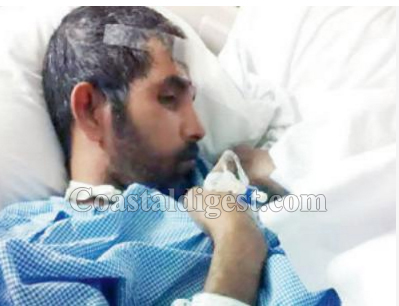
Bhatkal, Jan 20: A Kannadiga expatriate working with a courier company in Kingdom of Saudi Arabia has been lying comatose in the Prince Mohammed bin Abdulaziz Hospital, Riyadh for nine months following a road accident, even as his family's efforts to bring him back to India have been stymied by the bill for treatment of about 5 lakh Saudi riyals.

1bhatkalMakde Abubakar, 40, from Shirur, near Bhatkal in Uttara Kannada district, was hit by a speeding car while crossing the road. He was rushed to hospital and the driver fled the scene.

Since then, Abubakar has been speechless. His wife and four children, all less than 16 years, have been waiting patiently. "We have tried everything. We have to pay a huge sum of money to get him back but and we just don't have that kind of money.

His eldest son is with me in Bhatkal, my daughter keeps visiting me in anticipation of good news but I'm helpless," Abubakar's father-in-law Muhammed Ali said.

The family has been in constant touch with the Bhatkal Muslim Jamat in Riyadh, whose efforts too have been futile.

"Abubakar's sponsor was not in Riyadh when the accident happened and in Saudi Arabia, all documents of migrant workers need the sponsor's signature. In his absence, the hospital admitted him and Abu's relatives didn't understand the process," Dr Zaheer Kola, general secretary, Bhatkal Jamat, said.

He said the first three months passed with the family praying for his recovery. "Later, when they wanted to move him to India, the hospital said they had to clear bills of about 3.5 lakh riyals which they couldn't afford to pay. Now, the bill has gone up to about 5 lakh riyals," he said, adding that the hospital is just following its rules.

The Jamat gave representations to the Indian embassy . "While it received our file, there has been no action. The official first told us he would move the file on priority but even after 15 days, there's still no response," Kola said.

As a last resort, the family has got in touch with minister of external affairs Sushma Swaraj, who has promised the family the MEA would intervene and sought details of Abubakar to be provided to the embassy in Saudi. She tweeted: `Pl ensure that he gets good treatment in the hospital' and tagged the Indian embassy in Riyadh.

With Thursday being a half-day and Friday and Saturday holidays, the Jamat will resubmit Abubakar's file to the embassy on Sunday . "We hope they let him come back," Ali said.

Comments

Muhibullah Sheikji
 - 
Sunday, 22 Jan 2017

This is really a sad news. Let us pray and hope that Allah will bless Janab Abubaker and his family. Let us pray with Allah to get all the issues solved and he be shifted to his family soon. May Allah bless Janab Abubaker with recovery and good heath.... aameen

Add new comment

  • Coastaldigest.com reserves the right to delete or block any comments.
  • Coastaldigset.com is not responsible for its readers’ comments.
  • Comments that are abusive, incendiary or irrelevant are strictly prohibited.
  • Please use a genuine email ID and provide your name to avoid reject.
Agencies
June 22,2020

Bareilly, Jun 22: The All India Tanzeem Ulama-e-Islam, a religious and social organisation headed by five senior clerics, has issued a fatwa to boycott Chinese products in the country.

The clerics said the community members should stand with the army and government in this hour.

Expressing concern over India-China face-off, National general secretary of All India Tanzeem Ulama-e-Islam, Maulana Shahbuddin Rizvi expressed concern over the India-China face-off and said, "A fatwa has been passed for boycotting Chinese products on a query posted by a Bareilly-based resident. The clerics in the fatwa have condemned the conspiracy of China to encroach upon Indian land and the killing of our brave soldiers."

The panel of five clerics include national president of All India Tanzeem Ulama-e-Islam Mufti Ashfaq Hussain Qadri, Mufti Iqbal Ahmad Misbahi, Mufti Tauqir Ahmad Qadri, Mufti Hashim Raza Khan and Qari Saghir Ahmad Rizvi.

Comments

Angry Indian
 - 
Monday, 22 Jun 2020

i will purcahe more items from china...war is fought man to man not by bycotting...


we have more hindutva D#g who attack single muslim in large number...why cant they go and defend india...


our beloved soldier died in border fighting  and now in media more priority for susanth singh rajput...


who is real life hero here...soldier or film actor..

after our soldier dies not even get full compesation for our army...look what happen after pulwama...only one day they put 1000 rs flower and put crocodile tear and do some bashan..went home and slept...

no political netha son or relative die for this country...To change the system we should change our mind and heart..unite all indian irrespective of religion and cast..we can achive victory in all front

Add new comment

  • Coastaldigest.com reserves the right to delete or block any comments.
  • Coastaldigset.com is not responsible for its readers’ comments.
  • Comments that are abusive, incendiary or irrelevant are strictly prohibited.
  • Please use a genuine email ID and provide your name to avoid reject.
coastaldigst.com web desk
June 20,2020

New Delhi, Jun 20: As part of measures to check the spread of covid-19, Indian Railways is likely to stop distributing blankets and pillows in trains to AC passengers in coming days and it will make arrangements for sale at stalls on platforms.

The railways already stopped distributing blankets and pillows in 15 pair Special Rajdhani trains and 100 pair of fixed timetabled special trains, which is being operted at present. The system of not distributing blanks and pillows may continue in future once train operations normalise, said the official.

Passengers are encouraged to bring their own blankets and pillows. However same will be made available for purchase at shops so that if passengers want they can buy it, said an official.

The railways also made arrangements to sell sanitisers, masks and gloves at shops. The national transporter also said sale price should not exceed maximum retail price.

As per the Railway Board circular to zonal railways, " Amongst the items which fulfill the needs of travelling public and in keeping with the emphasis for providing safe and hygine travel facilities to passengers, it must be ensured that take away bedrolls kits/items other COVID-19 related protective items such as masks, sanitiser, gloves etc are also made available for sale through multi purpose stalls."

All items should be in good quality and will be sold only at MRP rate, circular said. The railways has also permanently removed curtains inside the AC coaches.

Comments

Add new comment

  • Coastaldigest.com reserves the right to delete or block any comments.
  • Coastaldigset.com is not responsible for its readers’ comments.
  • Comments that are abusive, incendiary or irrelevant are strictly prohibited.
  • Please use a genuine email ID and provide your name to avoid reject.
Ram Puniyani
January 14,2020

In the beginning of January 2020 two very disturbing events were reported from Pakistan. One was the attack on Nankana Sahib, the holy shrine where Sant Guru Nanak was born. While one report said that the place has been desecrated, the other stated that it was a fight between two Muslim groups. Prime Minister of Pakistan Imran Khan condemned the incident and the main accused Imran Chisti was arrested. The matter related to abduction and conversion of a Sikh girl Jagjit Kaur, daughter of Pathi (One who reads Holy Guru Granth Sahib in Gurudwara) of the Gurudwara. In another incident one Sikh youth Ravinder Singh, who was out on shopping for his marriage, was shot dead in Peshawar.

While these condemnable attacks took place on the Sikh minority in Pakistan, BJP was quick enough to jump to state that it is events like this which justify the Citizenship Amendment Act (CAA). Incidentally CAA is the Act which is discriminatory and relates to citizenship with Religion, which is not as per the norms of Indian constitution. There are constant debates and propaganda that population of Hindus has come down drastically in Pakistan and Bangla Desh. Amit Shah, the Home minister stated that in Pakistan the population of Hindus has come down from 23% at the time of partition to 3.7% at present. And in Bangla Desh it has come down from 22% to present 8%.

While not denying the fact that the religious minorities are getting a rough deal in both these countries, the figures which are presented are totally off the mark. These figures don’t take into consideration the painful migrations, which took place at the time of partition and formation of Bangla Desh later. Pakistan census figures tell a different tale. Their first census was held in 1951. As per this census the overall percentage of Non Muslim in Pakistan (East and West together) was 14.2%, of this in West Pakistan (Now Pakistan) it was 3.44 and in Eat Pakistan it was 23.2. In the census held in Pakistan 1998 it became 3.72%. As far as Bangla Desh is concerned the share of Non Muslims has gone down from 23.2 (1951) to 9.6% in 2011.

The largest minority of Pakistan is Ahmadis, (https://minorityrights.org/country/pakistan/) who are close to 4 Million and are not recognised as Muslims in Pakistan. In Bangla Desh the major migrations of Hindus from Bangla Desh took place in the backdrop of Pakistan army’s atrocities in the then East Pakistan.

As far as UN data on refugees in India it went up by 17% between 2016-2019 and largest numbers were from Tibet and Sri Lanka.  (https://www.un.org/en/development/desa/population/migration/publication…)

The state of minorities is in a way the index of strength of democracy. Most South Asian Countries have not been able to sustain democratic values properly. In Pakistan, the Republic began with Jinnah’s classic speech where secularism was to be central credo of Pakistan. This 11th August speech was in a way what the state policy should be, as per which people of all faiths are free to practice their religion. Soon enough the logic of ‘Two Nation theory” and formation of Pakistan, a separate state for Muslim took over. Army stepped in and dictatorship was to reign there intermittently. Democratic elements were suppressed and the worst came when Zia Ul Haq Islamized the state in collusion with Maulanas. The army was already a strong presence in Pakistan. The popular formulation for Pakistan was that it is ruled by three A’s, Army, America and Allah (Mullah).

Bangla Desh had a different trajectory. Its very formation was a nail in the coffin of ‘two nation theory’; that religion can be the basis of a state. Bangla Desh did begin as a secular republic but communal forces and secular forces kept struggling for their dominance and in 1988 it also became Islamic republic. At another level Myanmar, in the grip of military dictatorship, with democratic elements trying to retain their presence is also seeing a hard battle. Democracy or not, the army and Sanghas (Buddhist Sang has) are strong, in Myanmar as well. The most visible result is persecution of Rohingya Muslims.

Similar phenomenon is dominating in Sri Lanka also where Budhhist Sanghas and army have strong say in the political affairs, irrespective of which Government is ruling. Muslim and Christian minorities are a big victim there, while Tamils (Hindus, Christians etc.) suffered the biggest damage as ethnic and religious minorities. India had the best prospect of democracy, pluralism and secularism flourishing here. The secular constitution, the outcome of India’s freedom struggle, the leadership of Gandhi and Nehru did ensure the rooting of democracy and secularism in a strong way.

India so far had best democratic credentials amongst all the south Asian countries. Despite that though the population of minorities rose mainly due to poverty and illiteracy, their overall marginalisation was order of the day, it went on worsening with the rise of communal forces, with communal forces resorting to identity issues, and indulging in propaganda against minorities.

While other South Asian countries should had followed India to focus more on infrastructure and political culture of liberalism, today India is following the footsteps of Pakistan. The retrograde march of India is most visible in the issues which have dominated the political space during last few years. Issues like Ram Temple, Ghar Wapasi, Love Jihad, Beef-Cow are now finding their peak in CAA.

India’s reversal towards a polity with religion’s identity dominating the political scene was nicely presented by the late Pakistani poetess Fahmida Riaz in her poem, Tum bhi Hum Jaise Nikle (You also turned out to be like us). While trying to resist communal forces has been an arduous task, it is becoming more difficult by the day. This phenomenon has been variously called, Fundamentalism, Communalism or religious nationalism among others. Surely it has nothing to do with the religion as practiced by the great Saint and Sufi traditions of India; it resorts mainly to political mobilization by using religion as a tool.


Comments

Ashi
 - 
Tuesday, 14 Jan 2020

If Malaysia implement similar NRC/CAA, India and China are the loser.

Add new comment

  • Coastaldigest.com reserves the right to delete or block any comments.
  • Coastaldigset.com is not responsible for its readers’ comments.
  • Comments that are abusive, incendiary or irrelevant are strictly prohibited.
  • Please use a genuine email ID and provide your name to avoid reject.