



Riyadh reaffirms support for two-state solution to Israeli-Palestinian conflict

February 21, 2017

Jeddah, Feb 21: Saudia Arabia has reasserted support for a Palestinian state after US President Donald Trump said Middle East peace does not depend on a two-state solution to the Israeli-Palestinian conflict.
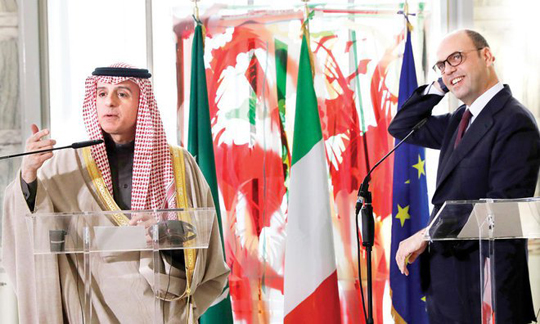
riyadh

Speaking on Monday after talks with his Italian counterpart, Saudi Foreign Minister Adel Al-Jubeir said: “You have a peace deal which essentially calls for a settlement based on two states living side by side in peace and security.”

He added: “(A) Palestinian state with East Jerusalem as its capital, and the just settlement of refugees and just sharing water resources. This is the settlement that we believe is a fair and just settlement.”

Trump said last week he could accept a two-state solution or a single-state arrangement if it is agreed upon by all sides. Administration officials later said the US absolutely supports a two-state solution.

Following talks with his Italian counterpart Angelino Alfano, Al-Jubeir pointed to the long history of Saudi-Italian relations.

Both discussed challenges to the Middle East peace process, Syria, Yemen, Iraq and Libya, in addition to the Kingdom’s Vision 2030 and the role Italy may play in this regard.

Meanwhile, Singaporean Prime Minister Lee Hsien Loong, hosting a visit by his Israeli counterpart, Benjamin Netanyahu, said his country believes in a “two-state solution.” Lee explained his stand at a joint news briefing with Netanyahu, who does not endorse the two-state approach. Lee said he realizes a two-state solution is difficult to achieve, but said it is the only way to achieve peace.

“We have consistently believed that a two-state solution between Israel and Palestine, however hard to achieve, is the only way to bring peace and security to both peoples,” Lee said.

Netanyahu did not mention tensions in the Middle East in his remarks at the news briefing, after which questions were not allowed.

But afterward, at a state dinner, he said he believes there is an opportunity to seek peace now “because I sense a great change in the Arab world, in many Arab countries, and I hope ... to be able to use that newfound attitude toward Israel to help us solve the Palestinian-Israeli conflict as well.”

Comments

Add new comment

  • Coastaldigest.com reserves the right to delete or block any comments.
  • Coastaldigset.com is not responsible for its readers’ comments.
  • Comments that are abusive, incendiary or irrelevant are strictly prohibited.
  • Please use a genuine email ID and provide your name to avoid reject.
Agencies
August 2,2020

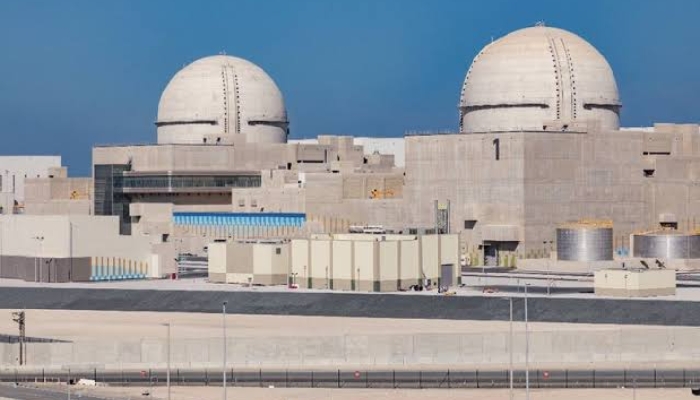
Dubai, Aug 2: The United Arab Emirates (UAE) announced on Saturday that it has started operations in the first of four reactors at the Barakah nuclear power station - the first nuclear power plant in the Arab world.

Emirates Nuclear Energy Corporation (ENEC), which is building and operating the plant with Korea Electric Power Corporation (KEPCO) said in a press release that its subsidiary Nawah Energy Company "has successfully started up Unit 1 of the Barakah Nuclear Energy Plant, located in the Al Dhafrah Region of Abu Dhabi".

That signals that Unit 1, which had fuel rods loaded in March, has achieved "criticality" - a sustained fission chain reaction.

"The start-up of Unit 1 marks the first time that the reactor safely produces heat, which is used to create steam, turning a turbine to generate electricity," said ENEC.

Barakah, which was originally scheduled to open in 2017, has been dogged by delays and is billions of dollars over budget. It has also raised myriad concerns among nuclear energy veterans who are concerned about the potential risks Barakah could visit upon the Arabian Peninsula, from an environmental catastrophe to a nuclear arms race.

Paul Dorfman, an honorary senior research fellow at the Energy Institute, University College London and founder and chair of the Nuclear Consulting Group, has criticised the Barakah reactors' "cheap and cheerful" design that he says cuts corners on safety.

Dorfman authored a report (PDF) last year detailing key safety features Barakah's reactors lack, such as a "core catcher" to literally stop the core of a reactor from breaching the containment building in the event of a meltdown. The reactors are also missing so-called Generation III Defence-In-Depth reinforcements to the containment building to shield against a radiological release resulting from a missile or fighter jet attack.

Both of these engineering features are standard on new reactors built in Europe, says Dorfman.

There have been at least 13 aerial attacks on nuclear facilities in the Middle East - more than any other region on earth.

The vulnerability of critical infrastructure in the Arabian Peninsula was further laid bare last year after Saudi Arabia's oil facilities at Abqaiq and Khurais were attacked by 18 drones and seven cruise missiles - an assault that temporarily knocked out more than half of the kingdom's oil production.

On Saturday, Dorfman reiterated his concern that there is no regional protocol in place to determine liability should an accident or incident at Barakah result in radioactive contamination spreading from the UAE to its neighbours. 

"Given Barakah has started up, because of all the well-rehearsed nuclear safety and security problems, it may be critically important that the Gulf states collectively evolve a Nuclear Accident Liability Convention, so that if anything does go wrong, victim states may have some sort of redress," Dorfman told Al Jazeera. 

The UAE has substantial oil and gas reserves, but it has made huge investments in developing alternative energy sources, including nuclear and solar.

Experts though have questioned why the UAE - which is bathed in sunlight and wind - has pushed ahead with nuclear energy - a far more expensive and riskier option than renewable energy sources.

When the UAE first announced Barakah in 2009, nuclear power was cheaper than solar and wind. But by 2012 - when the Emirates started breaking ground to build the reactors - solar and wind costs had plummeted dramatically.

Between 2009 and 2019, utility-scale average solar photovoltaic costs fell 89 percent and wind fell 43 percent, while nuclear jumped 26 percent, according to an analysis by the financial advisory and asset manager Lazard.

There are also concerns about the potential for Barakah to foment nuclear proliferation in the Middle East - a region rife with geopolitical fault lines and well-documented history of nuclear secrecy.

The UAE has sought to distance itself from the region's bad behaviour by agreeing not to enrich its own uranium or reprocess spent fuel. It has also signed up to the United Nation's nuclear watchdog's Additional Protocol, significantly enhancing inspection capabilities, and secured a 123 Agreement with the United States that allows bilateral civilian nuclear cooperation.

Comments

Add new comment

  • Coastaldigest.com reserves the right to delete or block any comments.
  • Coastaldigset.com is not responsible for its readers’ comments.
  • Comments that are abusive, incendiary or irrelevant are strictly prohibited.
  • Please use a genuine email ID and provide your name to avoid reject.
Agencies
May 22,2020

Riyadh, May 22: The family of murdered Saudi journalist Jamal Khashoggi on Friday said that they forgave his killers. Washington Post journalist Jamal Khashoggi, who had written columns critical of Saudi Arabia, was brutally killed in October 2018, allegedly at the behest of Crown Prince Mohammad bin Salman.

“In this blessed night of the blessed month [of Ramadan] we remember God’s saying: If a person forgives and makes reconciliation, his reward is due from Allah,” Jamal Khashoggi’s son Salah Khashoggi said in a tweet. “Therefore, we the sons of the Martyr Jamal Khashoggi announce that we pardon those who killed our father, seeking reward [from] God almighty.”

The legal outcome of this announcement is not yet clear. Earlier, Salah Khashoggi said he had “full confidence” in the judicial system, and that the accused were trying to exploit the case.

Jamal Khashoggi’s body was said to have been dismembered inside the Saudi consulate in Istanbul and disposed of elsewhere, but his remains were never found.

Comments

Add new comment

  • Coastaldigest.com reserves the right to delete or block any comments.
  • Coastaldigset.com is not responsible for its readers’ comments.
  • Comments that are abusive, incendiary or irrelevant are strictly prohibited.
  • Please use a genuine email ID and provide your name to avoid reject.
Agencies
February 27,2020

Riyadh, Feb 27: Saudi Arabia on Thursday halted travel to the holiest sites in Islam over fears about a new viral epidemic just months ahead of the annual hajj pilgrimage, a move coming as the Mideast has over 220 confirmed cases of the illness.

The extraordinary decision by Saudi Arabia stops foreigners from reaching the holy city of Mecca and the Kaaba, the cube-shaped structure the world's 1.8 billion Muslims pray toward five times a day. It also said travel was suspended to Prophet Muhammad's mosque in Medina.

The decision showed the worry about the outbreak potentially spreading into Saudi Arabia, whose oil-rich monarchy stakes its legitimacy on protecting Islam's holy sites. The epicenter in the Mideast's most-affected country, Iran, appears to be in the holy Shiite city of Qom, where a shrine there sees the faithful reach out to kiss and touch it in reverence.

"Saudi Arabia renews its support for all international measures to limit the spread of this virus, and urges its citizens to exercise caution before traveling to countries experiencing coronavirus outbreaks," the Saudi Foreign Ministry said in a statement announcing the decision.

"We ask God Almighty to spare all humanity from all harm." Disease outbreaks always have been a concern surrounding the hajj, required of all able-bodied Muslims once in their life, especially as pilgrims come from all over the world.

The earliest recorded outbreak came in 632 as pilgrims fought off malaria. A cholera outbreak in 1821, for instance, killed an estimated 20,000 pilgrims. Another cholera outbreak in 1865 killed 15,000 pilgrims and then spread worldwide.

More recently, Saudi Arabia faced a danger from a related coronavirus that caused Middle East respiratory syndrome, or MERS. The kingdom increased its public health measures in 2012 and 2013, though no outbreak occurred.

While millions attend the 10-day hajj, this year set for late July into early August, millions more come during the rest of the year to the holy sites in the kingdom.

"It is unprecedented, at least in recent times, but given the worldwide spread of the virus and the global nature of the umrah, it makes sense from a public health and safety point of view," said Kristian Ulrichsen, a research fellow at the James A Baker III Institute for Public Policy at Rice University. "Especially since the Iranian example illustrates how a religious crossroads can so quickly amplify the spread and reach of the virus." The virus that causes the illness named COVID-19 has infected more than 80,000 people globally, mainly in China. The hardest-hit nation in the Mideast is Iran, where Health Ministry spokesman Kianoush Jahanpour said 19 people have died among 139 confirmed cases.

Experts are concerned Iran may be underreporting cases and deaths, given the illness's rapid spread from Iran across the Persian Gulf. For example, Iran still has not confirmed any cases in Mashhad, even though a number of cases reported in Kuwait are linked to the Iranian city.

In Bahrain, which confirmed 33 cases as of Thursday morning, authorities halted all flights to Iraq and Lebanon. It separately extended a 48-hour ban overflights from Dubai and Sharjah in the United Arab Emirates, through which infected travellers reached the island kingdom off the coast of Saudi Arabia.

Iranian President Hassan Rouhani said there were no immediate plans to quarantine cities but acknowledged it may take "one, two or three weeks” to get control of the virus in Iran.

As Iran's 80 million people find themselves increasingly isolated in the region by the outbreak, the country's sanctions-battered economy saw its currency slump to its lowest level against the US dollar in a year on Wednesday.

Comments

Add new comment

  • Coastaldigest.com reserves the right to delete or block any comments.
  • Coastaldigset.com is not responsible for its readers’ comments.
  • Comments that are abusive, incendiary or irrelevant are strictly prohibited.
  • Please use a genuine email ID and provide your name to avoid reject.