


Rio De Janeiro, Aug 18: From yearning to fly in an aeroplane as a kid to clinching a bronze in the Olympics, the biggest sporting stage of all, Haryana wrestler Sakshi Malik has come a long way in her fairy tale journey to etch her name in the sporting history of the country.
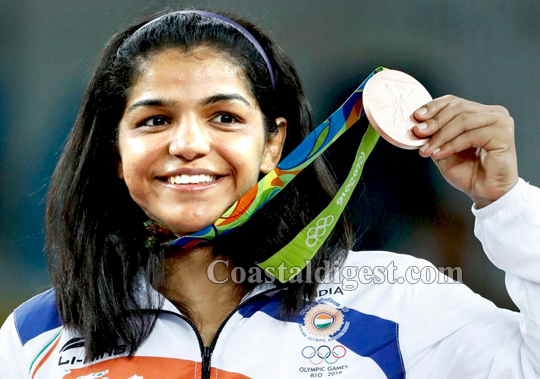
Born into a humble family at Mokhra village near Rohtak, Sakshi tried playing kabaddi and cricket in her childhood but wrestling became her favourite sport after she started "winning bouts". But, little did she and her parents knew at that time that one day she would become the first woman wrestler from the country to win an Olympic medal.
Sakshi last night ended the country's painful wait for a medal at the Rio Olympic Games by clinching the bronze medal in the 58kg category, pulling off a sensational 8-5 victory over her rival in the play-off bout.
The 23-year-old wrestler also became only the fourth woman athlete from India to win an Olympic medal as she earned the dramatic win after falling behind 0-5 in the do-or-die bout on day 12. Her bronze is the country's fifth medal overall in wrestling in the Olympics.
"I never knew what an Olympics was, I wanted to become a sportsperson to travel in an aeroplane. If you can represent India, you can board a plane, and fly," Sakshi said on the sidelines of a marathon round of interviews to hordes of elated Indian scribes late into the night at the Main Press Centre here.
Interestingly, her elder brother was named after cricket icon Sachin Tendulkar.
Sachin, who's two-years older to her, would ask Sakshi to play cricket, but she would often say 'no' and would stare at the sky with aeroplanes flying high. Her family always supported her to pursue her dream.
"Parents never forced me, they supported me well in wrestling. Now when I spoke to them briefly after winning the bronze they started crying in joy. I told them, it's time to celebrate," Sakshi said.
One defining moment for India at the Rio Games was when Sakshi was lifted by her coach Kuldeep Malik as the duo did a lap of honour before she sat bending on her knees with the tri-colour wrapped around her and a packed hall at the Carioca Arena 2 giving her a standing ovation.
"It was a dream come true for me and I had already pre-planned to celebrate this way," Sakshi said about winning the bronze medal through repechage after beating Aisuluu Tynybekova of Kyrgyzstan 8-5 in the women's 58kg freestyle.
The toughest phase for Sakshi was when she "struggled" to win a silver at theCommonwealth Games in Glasgow 2014, a lesson that had helped her in winning bronze in Rio.
"Everyone was getting medals. Such was the pressure that I thought it would be difficult to return home without a medal. I was under much less pressure here. Haar gaye toh kya ho jayega, lekin jeet gaye toh kya ho jayega... I just had a free mind. I did not fight with pressure, and it helped."
From being an underdog to winning India it's elusive medal at Rio, Sakshi acknowledged her life will change forever.
"I know my life has changed now. I'm not able to see it now but I think after I return home it will be different life altogether. Din raat ka change hone wala hai (The difference will be like between day and night)," she said.
Rohtak-to-Rio journey took 12 years of struggle and hardship for Sakshi who was often overshadowed by the Phogat sisters.
"It felt strange. Like in the camp for Bulgaria and Spain, there were all Phogats and I was the only Malik in between them. But I did not mind... It was Geeta didi who showed us the way in 2012," she says about Geeta Phogat's path-breaking Olympic qualification in London 2012.
"Geeta didi won medals for India and I got inspired and gradually I started winning," she said.
Sakshi's first international success came when she won a bronze at the 2010 Junior World Championships in the 59kg category.
Four years later, Sakshi won a gold at the Dave Schultz International Wrestling Tournament in 60kg and the biggest moment of her career came at the Glasgow Commonwealth Games in 2014 where she won a silver medal.
"When I had returned home after winning the Commonwealth Games medal, everyone was after me and I could not sleep well.
"Every time I fell sleep, my brother or mother would tell me 'get up, you've to give interviews, people are waiting'. But I enjoy it, not everyone get a chance of this type," she admits.
Two months later, Sakshi crashed out in the World Wrestling Championships quarterfinals in Tashkent finishing a poor eighth. But she again came into reckoning by winning a bronze at the Asian Championships in Doha 2015.
It was only in May this year that Sakshi qualified for the Rio Olympics after making the final of the Olympic Qualifiers in Istanbul where she lost the final to Russian Valeria Koblova.
It was only after she made the cut Sakshi was included in the Target Olympic Podium scheme as she did some training in Bulgaria and Spain.
A daily routine in Sakshi's life would be 500 sit-ups and intensive training but at the moment the training can stop and she said she would love to gorge on her favourite aloo parantha and kadhi chawal.
"It feels like I've not eaten aloo parantha, kadhi chawal for ages now. I was mostly on a liquid, carb-free diet. Now I can relax," she said.
Sakshi is not into movies or chilling out with friends. For her, it's about sleep and spend some quiet time at home, maybe watching TV.
"I just want to lead a peaceful life. I don't like to travel around or going out for movies. I want a job where I can be at peace. I've achieved all this because of my struggle for 12 years. Peace is all what I need, that's enjoyment for me."
But, this is just the beginning for Sakshi.
"I am looking forward to Tokyo 2020."
Ask her whom she would first give the prized medal after she lands in New Delhi, and Sakshi is no high-flying in her reply: "This medal is for everyone in my country. This medal belongs to you, whoever it is... I will say, see 'I've made it'."

Comments
Add new comment