



Romania: 2 Canadians survive a night at Dracula's Castle

November 2, 2016

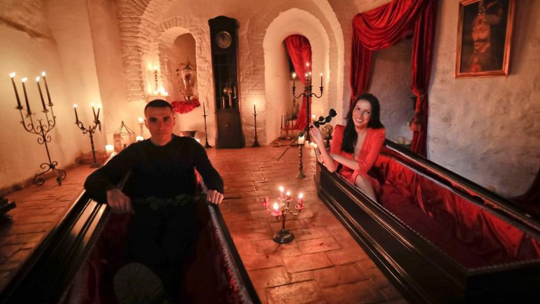
Bucharest, Nov 2: All night long, a cold wind howled around the gothic castle that inspired the Dracula legend, as a Canadian brother and sister became the first people to pass the night there in 70 years.
Romania

But it wasn't the wind that kept Robin Varma, a PhD student in political science, awake at Bran Castle in Transylvania. Rather it was the incessant chattering of his sister.

"He put the lid on his coffin so he could sleep. ... He was sick of hearing me talk," Tami Varma, an events manager from Ottawa, told The Associated Press today.

The pair outdid 88,000 people who entered a competition hosted by Airbnb to get the chance to dine and sleep at the castle in Romania, by describing how their grandfather Devendra P. Varma, a scholar of English gothic tales and an expert in vampire lore had visited the medieval fortress in 1971.

They arrived at dusk yesterday in a stagecoach, and were welcomed by Dacre Stoker the great-grandnephew of Bram Stoker who wrote the 1897 horror novel. They later dined on chicken paprikash and red wine, serenaded by a string quartet, before curling up for the night in red-velvet-lined coffins but sleep eluded them.

It wasn't just the talking, or the wind howling, though. Another mysterious sound spooked the pair.

"We have a strong feeling there were invisible guests walking along the castle corridors last night, " Tami Varma said, hinting that Count Dracula may have paid a fleeting visit. "But we did live to see sunrise."

Comments

Add new comment

  • Coastaldigest.com reserves the right to delete or block any comments.
  • Coastaldigset.com is not responsible for its readers’ comments.
  • Comments that are abusive, incendiary or irrelevant are strictly prohibited.
  • Please use a genuine email ID and provide your name to avoid reject.
Agencies
February 25,2020

Tokyo, Feb 25: Japan's Chitetsu Watanabe, recognized at 112 years as the oldest man in the world, has passed away 11 days after he received the Guinness World Record certificate, his family said on Tuesday.

Watanabe died on Sunday night, Efe news reported.

He received the official certificate on February 12 at a nursing home in Joetsu in Niigata prefecture, where he resided.

Soon after being certified as the oldest man, he began to experience a lack of appetite and respiratory problems, the wife of his eldest son told public broadcaster NHK.

Born on March 5, 1907 in a family of farmers, Watanabe moved at the age of 20 to Taiwan, where he worked at a sugar refinery for 18 years before returning to Japan after the end of World War II.

A fan of calligraphy, custard and ice cream, Watanabe told the Guinness team that the key to his long life was laughter.

He was recognized as the oldest male in the world following the deaths in 2019 of German Gustav Gerneth (in October), aged 114 years, and Japan's Masazo Nonaka (in January), at the age of 113, three months older than the German.

It remains to be seen who will be recognized after the death of Watanabe, the only male on the list drawn up by the Gerontology Research Group of the 30 oldest people in the world.

Japan has among the highest life expectancy in the world and the number of centenarians in the country has crossed 71,000, according to the latest government figures.

Since 2000, the number of centenarians censored has quintupled, raising concern for the economic outlook and future workforce of the country - where the birthrate is on a downward trend.

Out of these, 88 per cent are women.

Comments

Add new comment

  • Coastaldigest.com reserves the right to delete or block any comments.
  • Coastaldigset.com is not responsible for its readers’ comments.
  • Comments that are abusive, incendiary or irrelevant are strictly prohibited.
  • Please use a genuine email ID and provide your name to avoid reject.
Agencies
June 19,2020

Denser places, assumed by many to be more conducive to the spread of the coronavirus that causes COVID-19, are not linked to higher infection rates, say researchers.

The study, led by Johns Hopkins University, published in the Journal of the American Planning Association, also found that dense areas were associated with lower COVID-19 death rates.

"These findings suggest that urban planners should continue to practice and advocate for compact places rather than sprawling ones, due to the myriad well-established benefits of the former, including health benefits," says study lead author Shima Hamidi from Johns Hopkins Bloomberg School of Public Health in the US.

For their analysis, the researchers examined SARS-CoV-2 infection rates and COVID-19 death rates in 913 metropolitan counties in the US.

When other factors such as race and education were taken into account, the authors found that county density was not significantly associated with county infection rate.

The findings also showed that denser counties, as compared to more sprawling ones, tended to have lower death rates--possibly because they enjoyed a higher level of development including better health care systems.

On the other hand, the research found that higher coronavirus infection and COVID-19 mortality rates in counties are more related to the larger context of metropolitan size in which counties are located.

Large metropolitan areas with a higher number of counties tightly linked together through economic, social, and commuting relationships are the most vulnerable to the pandemic outbreaks.

According to the researchers, recent polls suggest that many US citizens now consider an exodus from big cities likely, possibly due to the belief that more density equals more infection risk.

Some government officials have posited that urban density is linked to the transmissibility of the virus.

"The fact that density is unrelated to confirmed virus infection rates and inversely related to confirmed COVID-19 death rates is important, unexpected, and profound," said Hamidi.

"It counters a narrative that, absent data and analysis, would challenge the foundation of modern cities and could lead to a population shift from urban centres to suburban and exurban areas," Hamidi added.

The analysis found that after controlling for factors such as metropolitan size, education, race, and age, doubling the activity density was associated with an 11.3 per cent lower death rate.

The authors said that this is possibly due to faster and more widespread adoption of social distancing practices and better quality of health care in areas of denser population.

The researchers concluded that a higher county population, a higher proportion of people age 60 and up, a lower proportion of college-educated people, and a higher proportion of African Americans were all associated with a greater infection rate and mortality rate.

Comments

Add new comment

  • Coastaldigest.com reserves the right to delete or block any comments.
  • Coastaldigset.com is not responsible for its readers’ comments.
  • Comments that are abusive, incendiary or irrelevant are strictly prohibited.
  • Please use a genuine email ID and provide your name to avoid reject.
Agencies
January 4,2020

Washington D.C: One of the greatest spectacles of modern art is still thriving in the Australian outback as confirmed by satellite imagery of NASA. The Marree Man is a massive geoglyph depicting an aboriginal hunter, that spans over 2.6 miles in the Southern Australian region.

Discovered by a pilot in 1998, its origin still remains a mystery even to this date.

The Marree Man was given a new lease of life in 2016 when a group of people from the neighboring town of Marree plowed its lines to avert its fading due to erosion.

After NASA shared the image of the art-work that was taken in June, the efforts of the good samaritans turned out to be a total success, reported CNN Travel.

The restoration team believes that the refurbished Marree Man would last longer than its original version.

According to NASA, "They [the team] created wind grooves, designed to trap water and encourage the growth of vegetation. They hope that eventually, the man will turn green."

In a previous article, CNN reported that an entrepreneur by the name of Dick Smith took upon himself to unravel the geoglyph's mystery in 2016. His team combed through all the available evidence but couldn't find anything conclusive.

In 2018 he even offered a 5,000 Australian dollar reward for anyone who knows the identity of its creator.

Nobody turned up with an answer but it was speculated that unknown artist lives in Alice Springs or even might be an American.

Comments

Add new comment

  • Coastaldigest.com reserves the right to delete or block any comments.
  • Coastaldigset.com is not responsible for its readers’ comments.
  • Comments that are abusive, incendiary or irrelevant are strictly prohibited.
  • Please use a genuine email ID and provide your name to avoid reject.