


Romania overtakes India as UK's biggest migrant population

December 1, 2016

London, Dec 1: Immigration into the UK from within the European Union (EU) has officially overtaken the rest of the world, with Romania replacing India at the top of the table in official figures released today.londonersstreet
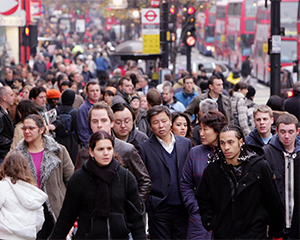
Romanians accounted for 10 per cent of all immigration in 2015 with 54,000 people coming to live in Britain – more than any other nationality, according to the Office of National Statistics (ONS).

China contributed 44,000 immigrants, followed by Poland with 38,000 tally, and India was third with 36,000.

"Immigration levels are now among the highest estimates recorded – the inflow of EU citizens is also at historically high levels and similar to the inflow of non-EU citizens," said Nicola White, ONS head of international migration statistics.

"These long-term immigration figures run up to the end of June, so it is too early to say what effect, if any, the EU referendum has had on long-term international migration," she said.

Immigration was one of the key issues that is believed to have swung the vote in favour of an exit from the EU in the June 23rd referendum.

Annual net migration to Britain in the 12 months to June 2016, or before the Brexit referendum, continued at a record level of 335,000.

This remains far from the UK government's target to reduce net migration levels to the "tens of thousands".

However, Downing Street insisted Prime Minister Theresa May remains committed to that target.

"She remains absolutely committed to bringing net immigration down to sustainable levels, which means tens of thousands, but we have made clear it will take time," a spokesperson said.

UK Immigration Minister Robert Goodwill hinted at further tightening of immigration measures for non-EU nationals, which will include India, as their hands remain tied on internal European migration until the EU's freedom of movement rules can be addressed once official Brexit negotiations kick off.

"We continue to reform non-EU immigration routes to ensure we attract the best and brightest, who benefit and contribute to this country. But there is more to do as we build an immigration system that delivers the control we need," Goodwill said.

This year's migration was largely fuelled by the highest- ever influx of EU nationals in the 12 months before June's referendum.

Europeans came to Britain for work, from countries like Austria, Belgium, Denmark, Finland, France, Germany, Greece, Italy, Luxembourg, Netherlands, Portugal, the Republic of Ireland, Spain and Sweden.

The overall 650,000 level of immigration for the year until June 2016 was made up of 284,000 EU citizens coming to live and work in Britain, 289,000 coming from outside Europe and 77,000 Britons returning to live in the UK.

Comments

Add new comment

  • Coastaldigest.com reserves the right to delete or block any comments.
  • Coastaldigset.com is not responsible for its readers’ comments.
  • Comments that are abusive, incendiary or irrelevant are strictly prohibited.
  • Please use a genuine email ID and provide your name to avoid reject.
News Network
June 9,2020

Washington, Jun 9: When epidemiologists talked about "flattening the curve," they probably didn't mean it this way: the US hit its peak coronavirus caseload in April, but since that time the graph has been on a seemingly unending plateau.

That's unlike several other hard-hit countries which have successfully pushed down their numbers of new cases, including Spain and Italy, which now have bell-shaped curves.

Experts say the prolonged nature of the US epidemic is the result of the cumulative impact of regional outbreaks, as the virus that started out primarily on the coasts and in major cities moves inward.

Layered on top of that are the effects of lifting lockdowns in parts of the country that are experiencing rising cases, as well as a lapse in compliance with social distancing guidelines because of economic hardship, and in some cases a belief that the threat is overstated.

"The US is a large country both in geography and population, and the virus is at very different stages in different parts of the country," Tom Frieden, a former director of the Centers for Disease Control and Prevention told AFP.

The US saw more than 35,000 new cases for several days in April. While that figure has declined, it has still been exceeding 20,000 regularly in recent days.

By contrast, Italy was regularly hitting more than 5,000 cases per day in March but is currently experiencing figures in the low hundreds.

"We did not act quickly and robustly enough to stop the virus spreading initially, and data indicate that it travelled from initial hotspots along major transport routes into other urban and rural areas," added Frieden, now CEO of the non-profit Resolve to Save Lives.

To wit: the East Coast states of New York, New Jersey and Massachusetts accounted for about 50 percent of all cases until about a month or so ago -- but now the geographic footprint of the US epidemic has shifted to the Midwest and southeast, including Florida.

Another key problem, said Jennifer Nuzzo, an epidemiologist at Johns Hopkins, is that the United States is still not doing enough testing, contact tracing and isolation.

After coming late to the testing party -- for reasons ranging from technical issues to regulatory hurdles -- the US has now conducted more COVID-19 tests than any other country.

It even has one of the highest per capita rates per country of 62 per 1,000 people, according to the website ourworldindata.org -- better than Germany (52 per 1,000) and South Korea (20 per 1,000).

But according to Nuzzo, these numbers are misleading, because "the amount of testing that a country should do should be scaled to the size of its epidemic.

"The United States has the largest epidemic in the world so obviously we need to do a lot more testing than any other country."

For Johns Hopkins, the more important metric is the positivity rate -- that is, out of all tests conducted, how many came back positive for COVID-19.

As of June 7, the United States had an average daily positivity rate of 14 percent, well above the World Health Organization guideline of 5 percent over two weeks before social distancing guidelines should be relaxed.

By contrast, Germany, which has tested far fewer people in relation to its population, has a positivity rate of 5 percent.

Even if testing were scaled up, carrying out tests in of itself does very little good without the next steps -- finding out who was exposed and then asking them to isolate.

Here also, too many US states are lagging woefully behind.

Texas, which is experiencing a surge in cases after relaxing its lockdown, is a case in point. The state targeted hiring a modest 4,000 tracers by June, but according to local reports is still more than a thousand shy of even that goal.

Opt-in app based efforts have also been slow to get off the ground.

Then there is the fact that some people are growing tired of lockdowns, while others don't have the economic luxury of being able to stay home for prolonged periods.

The government sent some 160 million Americans a single stimulus check of up to $1,200 back in April but it's not clear whether more will be forthcoming.

Still others, particularly in so-called red states under Republican leadership, have chafed under restrictions and mask-wearing guidelines that they see as an affront to their personal freedom.

"The US is kind of on the extreme of the individual liberty side," Sten Vermund, dean of the Yale School of Public Health, told AFP.

Part of this has to do with mixed messaging from Republican leaders, including President Donald Trump, said Nuzzo.

"We have had at the highest political level an assertion that this is a situation that's been overblown, and that maybe certain protective behaviors are not necessary," she said.

More recently, tens of thousands of people across the country have taken to the streets to protest the killing on an unarmed black man by police, risking coronavirus infection to demonstrate against the public health threat of racialized state violence.

Comments

Add new comment

  • Coastaldigest.com reserves the right to delete or block any comments.
  • Coastaldigset.com is not responsible for its readers’ comments.
  • Comments that are abusive, incendiary or irrelevant are strictly prohibited.
  • Please use a genuine email ID and provide your name to avoid reject.
News Network
February 28,2020

Tehran, Feb 28: The coronavirus epidemic in Iran has cost 26 lives, the health ministry announced Thursday, with a vice president becoming the latest top official to be infected as the spread appeared to accelerate.

Health ministry spokesman Kianoush Jahanpour told a news conference that the tally of infections had risen to 245 with 106 more cases confirmed -- the highest number for a single day since Iran announced its first infections on February 19.

The Islamic republic has the highest death toll from the virus outside China, where COVID-19 first emerged.

Among the latest coronavirus sufferers is one of Iran's seven vice presidents, Massoumeh Ebtekar, who oversees women's affairs.

Ebtekar, a former spokeswoman for students who took 52 Americans hostage at the US embassy in Tehran in 1979, is being treated at home and members of her team have been tested, state news agency IRNA reported.

Mojtaba Zolnour, head of parliament's national security and foreign affairs committee, also contracted the virus, appearing in a video posted by Fars news agency saying he was in self-quarantine.

The cleric is a deputy for the Shiite holy city of Qom in central Iran where the country's first cases were detected.

According to media reports, among the deceased in Qom on Thursday was theologian Hadi Khroroshahi, who in 1981 was named Iran's first ambassador to the Vatican.

The announcement by Zolnour comes two days after another top official, deputy health minister Iraj Harirchi, head of the government's coronavirus task force, said he too had contracted the virus.

On Wednesday, Iranian authorities announced domestic travel restrictions for people with confirmed or suspected infections.

They also placed curbs on access to major Shiite pilgrimage sites, including the Imam Reza shrine in second city Mashhad and the Fatima Masumeh shrine in Qom.

Visitors to the shrines will be allowed to visit on condition they are provided "with hand-washing liquids, proper (health) information, masks", Health Minister Saeed Namaki said.

They must "not gather together in groups but just pray and leave", he said.

In a rare move, authorities announced the cancellation of the main Friday weekly prayers in Tehran, Qom and Mashhad as well as in the capitals of 22 of Iran's 31 provinces and other infected areas.

"All of these decisions are temporary and if the situation changes, we might intensify or ease them," Namaki said.

Comments

Add new comment

  • Coastaldigest.com reserves the right to delete or block any comments.
  • Coastaldigset.com is not responsible for its readers’ comments.
  • Comments that are abusive, incendiary or irrelevant are strictly prohibited.
  • Please use a genuine email ID and provide your name to avoid reject.
Arab News
February 9,2020

London, Feb 9: A US court has rejected a Turkish attempt to dismiss civil cases brought by protesters who were violently attacked in Washington by Recep Tayyip Erdogan’s security officers.

The incident took place in May 2017 during a visit to the US by the Turkish president. About a dozen bodyguards beat-up a group demonstrating outside the Turkish ambassador’s residence in Washington.

The attack, which was caught on video, left nine people injured and further strained US relations with Turkey.

While criminal charges against the security guards were dropped within a year, around the same time Turkey released a US pastor, the victims pressed ahead with a civil case.

On Thursday, a federal court denied Turkey’s request to have the two cases thrown out on the grounds that it should have sovereign immunity from legal proceedings.

US District Judge Colleen Kollar-Kotelly said the protesters had not posed a threat and were merely gathered on a sidewalk outside the residence at Sheridan Circle when Erdogan’s security burst through a police line and attacked them.

“The Turkish security forces did not have the discretion to violently physically attack the protesters, with the degree and nature of force which was used, when the protesters were standing, protesting on a public sidewalk,” she said. “And, Turkish security forces did not have the discretion to continue violently physically attacking the protesters after the protesters had fallen to the ground or otherwise attempted to flee.”

The judge said Turkey “has not met its burden of persuasion to show that it is immune from suit in these cases.”

The ruling was welcomed by the victims of the attack, which Erdogan stopped to watch as he made his way from his car to inside the residence.

Comments

Add new comment

  • Coastaldigest.com reserves the right to delete or block any comments.
  • Coastaldigset.com is not responsible for its readers’ comments.
  • Comments that are abusive, incendiary or irrelevant are strictly prohibited.
  • Please use a genuine email ID and provide your name to avoid reject.