


Romanian government seeks loophole on corruption

February 7, 2017

Bucharest, Feb 7: Romania's government is on a high-risk mission: devise a legal and politically acceptable way to remove penalties for some types of official corruption.
Romanian

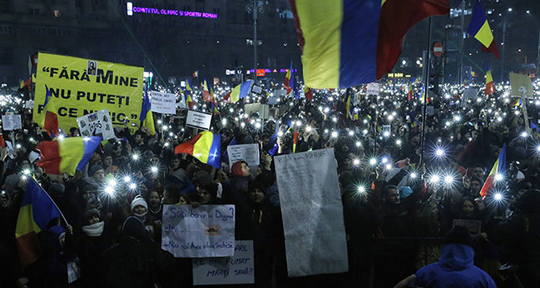
First, the government tried to effect the change by imposing an emergency decree without public debate. The move backfired badly, sparking massive demonstrations in the capital of Bucharest and other major cities that caused the government to reverse course.

The standing of the left-leaning government that assumed power two months ago has fallen so quickly that leaders found it necessary Monday to assert they would not resign even as the protests continued. The prime minister says a new proposal will be put before Parliament instead.

Is there a legal and political path for the government to accomplish its goal of easing corruption rules for public officials? Experts say Parliament can indeed pass such a law, and it could take effect if the president signs it, but the political task of winning support is trickier.

Laura Stefan, a Romanian anti-corruption specialist with the Expert Forum public policy think tank in Bucharest, said the government made a strategic blunder with the emergency decree. It would have tolerated abuse of power by officials, ranging from a mayor in a small village to a top government minister, if the amount of graft involved totaled less than about $48,500.

"It's simply un-defendable," Stefan said. "How can you explain to the people of this country, who maybe don't make $50,000 in their lifetime, that it is okay for public officials to misuse their office in order to obtain less than $50,000 from the state budget."

Public officials have not offered a specific explanation for why the law is needed, although one minister said it would bring the country in line with other European nations. The decree also would have applied retroactively to officials already convicted of corruption offenses involving less than $48,500.

The threshold figure would not have applied to case in which money was stolen, which would still be prosecuted as theft, but could apply to mismanagement of public funds, kickbacks on purchases or contracts, or other types of official misconduct. It would apply to officials who have hidden interests in companies that they set up and then make purchases from while in office.

One possible beneficiary would be Social Democratic Party leader Social Democratic Party leader Liviu Dragnea, whose path to becoming prime minister has been effectively blocked by corruption charges. His party enjoys broad support in Parliament, giving backers hope the redrafted measure will pass despite vocal opposition in the streets.

The provocative proposal could be difficult to enact even if it passes in Parliament, however, because it would still require the approval of President Klaus Iohannis, who has expressed opposition to the measure in its current form.

Transparency International, which lobbies for greater openness in government, has opposed both the way in which the emergency measure was imposed without public scrutiny and the proposal now set to be debated in Parliament.

Adam Foldes, one of the group's international lawyers at its Berlin headquarters, said the proposal does not meet international conventions set out by the United Nations and the Organization for Economic Cooperation and Development that call for corruption penalties to be "proportionate, effective, and a deterrent."

"It doesn't look good from an international perspective or a domestic legal perspective," Foldes said, adding that the original proposal cost the relatively new government a substantial amount of public support and should have been put before elected representatives all along.

Many protesters say they plan to continue nightly demonstrations until the government steps down even though the emergency ordinance was withdrawn on Sunday.

Lawyer Nicholas Hammond, who practices in Romania, said the procedure for approving emergency decrees was put in place after the country's 1989 anti-communist revolution to deal with critical situations that developed when Parliament was not in session.

However, it soon was abused by officials seeking to act without input from legislators, he said.

"They realized they could do it even when Parliament was in session," Hammond said. "This wasn't even on the agenda and it was done at 10 at night."

There were signs Monday that the government, facing nightly protests, is wavering in its commitment to press for quick adoption of the proposal in Parliament.

Justice Minister Florin Iordache said in a statement Monday that he is "not preoccupied" with drawing up a draft law and will await clarification from the Constitutional Court.

Comments

Add new comment

  • Coastaldigest.com reserves the right to delete or block any comments.
  • Coastaldigset.com is not responsible for its readers’ comments.
  • Comments that are abusive, incendiary or irrelevant are strictly prohibited.
  • Please use a genuine email ID and provide your name to avoid reject.
News Network
July 24,2020

Kathmandu, Jul 24: At least 132 people lost their lives as a result of heavy rains triggering landslides, and flash floods in Nepal.

"132 people dead, 128 injured, 53 missing and 998 families affected due to rainfall, landslides and floods in the country as of 23rd July," Nepal Disaster Risk Reduction and Management Authority Within the last two weeks, the Myagdi district of western Nepal was the worst affected with 27 reported deaths.

Search and rescue operations are being conducted continuously with officials and police personnel who are looking through the debris to find missing people.

Monsoon-induced disasters are common in Nepal owing to the country's mountainous topography. Hundreds have been displaced as landslides have swept away their homes. They ended up taking refuge in local schools and community centers.

Nepal's Meteorological Forecasting Division earlier last week had predicted heavy downpour across the country. The Division had warned of monsoon winds being near the low-pressure line in the Terai belt, which would consequently cause more rainfall.

Comments

Add new comment

  • Coastaldigest.com reserves the right to delete or block any comments.
  • Coastaldigset.com is not responsible for its readers’ comments.
  • Comments that are abusive, incendiary or irrelevant are strictly prohibited.
  • Please use a genuine email ID and provide your name to avoid reject.
News Network
March 12,2020

Geneva, Mar 12: For the global economy, virus repercussions were profound, with increasing concerns of wealth- and job-wrecking recessions. U.S. stocks wiped out more than all the gains from a huge rally a day earlier as Wall Street continued to reel.

The Dow Jones Industrial Average dropped 1,464 points, bringing it 20% below its record set last month and putting it in what Wall Street calls a “bear market.” The broader S&P 500 is just 1 percentage point away from falling into bear territory and bringing to an end one of the greatest runs in Wall Street’s history.

WHO officials said they thought long and hard about labeling the crisis a pandemic — defined as sustained outbreaks in multiple regions of the world.

The risk of employing the term, Ryan said, is “if people use it as an excuse to give up.” But the benefit is “potentially of galvanizing the world to fight.”

Underscoring the mounting challenge: soaring numbers in the U.S. and Europe’s status as the new epicenter of the pandemic. While Italy exceeds 12,000 cases and the United States has topped 1,300, China reported a record low of just 15 new cases Thursday and three-fourths of its infected patients have recovered.

China’s totals of 80,793 cases and 3,169 deaths are a shrinking portion of the world’s more than 126,000 infections and 4,600 deaths.

“If you want to be blunt, Europe is the new China,” said Robert Redfield, the head of the U.S. Centers for Disease Control and Prevention.

With 12,462 cases and 827 deaths, Italy said all shops and businesses except pharmacies and grocery stores would be closed beginning Thursday and designated billions in financial relief to cushion economic shocks in its latest efforts to adjust to the fast-evolving crisis that silenced the usually bustling heart of the Catholic faith, St. Peter’s Square.

Comments

Add new comment

  • Coastaldigest.com reserves the right to delete or block any comments.
  • Coastaldigset.com is not responsible for its readers’ comments.
  • Comments that are abusive, incendiary or irrelevant are strictly prohibited.
  • Please use a genuine email ID and provide your name to avoid reject.
Agencies
July 9,2020

The new visa regulations requiring international students in the US with an F-1 visa to take at least one in-person course or face the prospect of deportation is likely to "cause uncertainties and difficulties" for some students, the Indian Embassy has said.

"These new modifications at a time when many of the US universities and colleges are yet to announce their plans for the new academic year are likely to cause uncertainties and difficulties for some Indian students wishing to pursue their studies in the US," said a spokesperson of the Indian Embassy.

Responding to media queries, the spokesperson said the Indian government has taken up the matter with concerned US officials.

At the India US Foreign Office Consultations held on July 7, Foreign Secretary Harsh Vardhan Shringla conveyed India's concerns on the matter to Under Secretary of State for Political Affairs David Hale.

According to a recent report of Student and Exchange Visitor Program (SEVP), there were 1,94,556 Indian students enrolled in various academic institutions of the US in January this year. Of these 1,26,132 were males and 68,405 were females.

Noting that partnership in higher education is a key component of the strong people-to-people ties between India and the US, the spokesperson said in the last two decades Indian students in American universities and colleges have been the harbingers of a strong partnership between technology and innovation sectors between the two countries.

The spokesperson hoped that the US authorities would provide adequate flexibility in their visa rule, keeping in mind the extraordinary circumstances created by the COVID-19 pandemic for the Indian students community.

We continue to engage all the stakeholders in the matters, including the US administration officials, Congressional leaders, universities and colleges as well as the Indian students community in the US as we move forward towards the 2020-21 academic year to further strengthen our bilateral partnership in higher education, the spokesperson said.

Announced by the SEVP on July 6, the new rules provide temporary exemptions for nonimmigrant students on F-1 and M-1 visas taking online classes due to the COVID-19 pandemic for the fall semester of the 2020 academic year.

While these modifications do provide some flexibility for US universities and colleges to adopt a hybrid model -- that is a mixture of online and in person classes -- they also restrict international students on F-1 and M-1 visas from taking courses entirely online, the spokesperson said.

Comments

Add new comment

  • Coastaldigest.com reserves the right to delete or block any comments.
  • Coastaldigset.com is not responsible for its readers’ comments.
  • Comments that are abusive, incendiary or irrelevant are strictly prohibited.
  • Please use a genuine email ID and provide your name to avoid reject.