


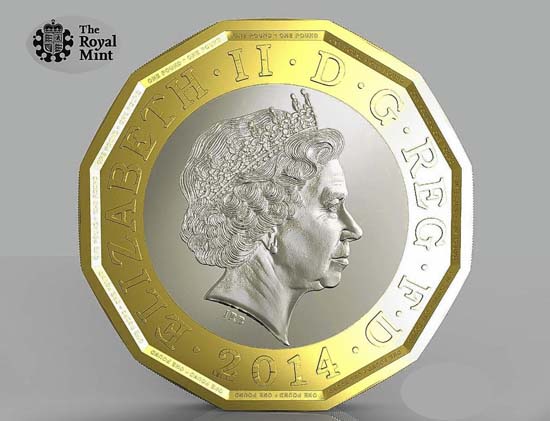
Royal Mint to cast coins from bullion from India

April 7, 2014

Britain_Royal_mintLondon, Apr 7: Britain's Royal Mint has started minting coins from Indian bullion cargo recovered from a British ship more than 70 years after it was sunk by a German U-boat.

The British ship with a cargo of 2,800 bars of silver bullion was on its way to London from Kolkata in 1941 when the ship, SS Gairsoppa, was torpedoed by a German submarine off the Irish coast.

The ship spent 70 years lost beneath the waves before being found in 2011, about 460km off the Irish coast, at a depth of three miles, half a mile deeper than the Titanic.

The deepest rescue operation in maritime history was carried out by a US company and the silver bullion was recovered from the seabed.

A portion of it was passed to the Royal Mint which began striking the coins on Friday, edged with the name SS Gairsoppa.

According to a recent report in The Telegraph, Shane Bissett, the Royal Mint's director of bullion and commemorative coin, said: "This incredible story marks yet another exciting moment in the Royal Mint's fascinating 1,000-year history.

"The traditional Britannia coin design, Philip Nathan's elegant portrayal of a windswept Britannia looking out to sea, is the perfect image for the coins struck from SS Gairsoppa's long-lost cargo.

"We are so pleased to be able to bring these coins to the market at long last, albeit more than 70 years later than expected."

According to the report, in December 1940 the Royal Mint was running dangerously low in stocks of silver due to the onset of war and called in emergency supplies from India.

The SS Gairsoppa sailed from Calcutta carrying the silver under the protection of a naval convoy.

But after battling a heavy storm it began running short of coal off the coast of Southern Ireland and was forced to break free and head for the safety of Galway Harbour.

The slow merchant ship was spotted by a German U-boat patrolling the British waters and was torpedoed at 12.08am on February 17, 1941. It sank within 20 minutes.

Three lifeboats were launched but only Second Officer Richard Ayres made it to land and survived to tell the tale.

His lifeboat started with 31 men but after spending 13 deadly days he was the only sailor to make it to dry land alive.

He was awarded an MBE in recognition of his heroic efforts to keep fellow survivors alive, as well as a War Medal for bravery at sea, and amazingly returned to sea nine months later.

Comments

Add new comment

  • Coastaldigest.com reserves the right to delete or block any comments.
  • Coastaldigset.com is not responsible for its readers’ comments.
  • Comments that are abusive, incendiary or irrelevant are strictly prohibited.
  • Please use a genuine email ID and provide your name to avoid reject.
Agencies
July 13,2020

New Delhi, Jul 13: The Income Tax Department has facilitated a new functionality for banks and post offices to ascertain TDS applicability rates on cash withdrawal of above Rs 20 lakh in case of a non-filer of the income-tax return and that of above Rs 1 crore in case of a filer of the income-tax return.

In a statement, the Central Board of Direct Taxes (CBDT) said that now banks and post offices have to only enter the PAN of the person who is withdrawing cash for ascertaining the applicable rate of TDS.

So far, more than 53,000 verification requests have been executed successfully on this facility, a statement by the CBDT said.

"CBDT today said that this functionality available as 'Verification of applicability u/s 194N' on www.incometaxindiaefiling.gov.in since 1st July 2020, is also made available to the Banks through web-services so that the entire process can be automated and be linked to the Bank's internal core banking solution," it said.

On entering PAN by the bank or the post office, a message will be instantly displayed on the departmental utility: "TDS is deductible at the rate of 2 per cent if cash withdrawal exceeds Rs 1 crore", in case the person withdrawing cash is a filer of the income-tax return.

In case the person withdrawing cash is a non-filer of income tax return, the message shown would be: "TDS is deductible at the rate of 2 per cent if cash withdrawal exceeds Rs 20 lakh and at the rate of 5 per cent if it exceeds Rs 1 crore."

The CBDT said that the data on cash withdrawal indicated that huge amount of cash is withdrawn by the persons who have never filed income-tax returns.

To ensure filing of return by these persons and to keep track on cash withdrawals by the non-filers, and to curb black money, the Finance Act, 2020 with effect from July 1, 2020 further amended IT Act to lower threshold of cash withdrawal to Rs 20 lakh for the applicability of this TDS for the non-filers and also mandated TDS at the higher rate of 5 per cent on cash withdrawal exceeding Rs 1 crore by the non-filers.

Comments

Add new comment

  • Coastaldigest.com reserves the right to delete or block any comments.
  • Coastaldigset.com is not responsible for its readers’ comments.
  • Comments that are abusive, incendiary or irrelevant are strictly prohibited.
  • Please use a genuine email ID and provide your name to avoid reject.
News Network
January 17,2020

Bengaluru, Jan 17: India’s latest communication satellite GSAT-30 was successfully launched from the Spaceport in French Guiana during the early hours on Friday.

In a press release, ISRO, has stated that the launch vehicle 'Ariane-5 VA-251' was blasted off from Kourou Launch Base, French Ginana at 0230 hours, carrying India’s GSA-30 and EUTELSAT KONNECT for Eutelasat, as per schedule.

The Ariane 5 upper stage in an elliptical Geosynchronous Transfer Orbit.

With a lift-off mass of 3,357 kg, GSAT-30 will provide continuity to operational services on some of the in-orbit satellites.

GSAT-30 derives its heritage from ISRO’s earlier INSAT/GSAT satellite series and will replace INSAT-4A in orbit.

“GSAT-30 has a unique configuration of providing flexible frequency segments and flexible coverage. The satellite will provide communication services to Indian mainland and islands through Ku-band and wide coverage covering Gulf countries, a large number of Asian countries and Australia through C-band," ISRO Chairman Dr K Sivan said.

Dr Sivan also said that “GSAT-30 will provide DTH Television Services, connectivity to VSATs for ATM, Stock-exchange, Television uplinking and teleport Services, Digital Satellite News Gathering (DSNG) and e-governance applications. The satellite will also be used for bulk data transfer for a host of emerging telecommunication applications.”

ISRO’s Master Control Facility (MCF) at Hassan in Karnataka took over the command and control of GSAT-30 immediately after its separation from the launch vehicle. Preliminary health checks of the satellite revealed its normal health.

In the days ahead, orbit-raising maneuvers will be performed to place the satellite in Geostationary Orbit (36,000 km above the equator) by using its onboard propulsion system.

During the final stages of its orbit raising operations, the two solar arrays and the antenna reflectors of GSAT-30 will be deployed. Following this, the satellite will be put in its final orbital configuration.

The satellite will be operational after the successful completion of all in-orbit tests.

Comments

Add new comment

  • Coastaldigest.com reserves the right to delete or block any comments.
  • Coastaldigset.com is not responsible for its readers’ comments.
  • Comments that are abusive, incendiary or irrelevant are strictly prohibited.
  • Please use a genuine email ID and provide your name to avoid reject.
Agencies
May 19,2020

Cybersecurity researchers on Monday warned of a Trojan malware campaign which is targeting India's co-operative banks using COVID-19 as a bait.

Seqrite, the enterprise arm of IT security firm Quick Heal Technologies, detected the new wave of Adwind Java Remote Access Trojan (RAT) campaign.

Researchers at Seqrite warned that if attackers are successful, they can take over the victim's device to steal sensitive data like SWIFT logins and customer details and move laterally to launch large scale cyberattacks and financial frauds.

According to the researchers, the Java RAT campaign starts with a spear-phishing email which claims to have originated from either the Reserve Bank of India or a nationalised bank.

The content of the email refers to COVID-19 guidelines or a financial transaction, with detailed information in an attachment, which is a zip file containing a JAR based malware.

Upon further investigation, researchers at Seqrite found that the JAR based malware is a Remote Access Trojan that can run on any machine which has Java runtime enabled and hence it can impact a variety of endpoints, irrespective of their base operating system.

Once the RAT is installed, the attacker can take over the victim's device, send commands from a remote machine, and spread laterally in the network.

In addition, this malware can also log keystrokes, capture screenshots, download additional payloads, and extract sensitive user information, Seqrite said, adding that such attack campaigns can effectively jeopardise the privacy and security of sensitive data at the co-operative banks and result in large scale attacks and financial frauds.

To prevent such attacks, users need to exercise ample caution and avoid opening attachments and clicking on web links in unsolicited emails.

Banks should also keep their operating systems updated and have a full-fledged security solution installed on all the devices, Seqrite advised.

Comments

Add new comment

  • Coastaldigest.com reserves the right to delete or block any comments.
  • Coastaldigset.com is not responsible for its readers’ comments.
  • Comments that are abusive, incendiary or irrelevant are strictly prohibited.
  • Please use a genuine email ID and provide your name to avoid reject.