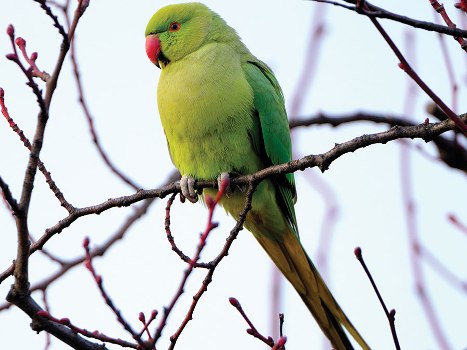
Rs 25,000 reward for mising parrot

January 30, 2017

Nawada, Jan 30: A distraught woman in Nawada district is refusing to eat and has announced a reward of Rs 25,000 for anyone who can bring back her missing parrot.

parrotBabita Devi, a resident of Thana chowk in Warsaliganj, is refusing to eat since January 3 last, the day since her parrot went missing, her family members said.

For the past eight years, the parrot used to wake her up and other members of the family early morning. The parrot was like a family member and not confined to a cage, the family members said.

Desperate to get the parrot back, she has distributed pamphlet in the locality about her missing parrot with a fervent request to help in tracing the pet.

Bachaan Pandey, Professor in S L Sinha college at Warsaliganj, who received one such pamphlet said.

The lady's three sons and relatives have also launched a campain on Whatsapp for the parrot but no success has been achieved so far.

Now, she has declared a reward of Rs 25,000 for the person bringing back her parrot.

Comments

Add new comment

  • Coastaldigest.com reserves the right to delete or block any comments.
  • Coastaldigset.com is not responsible for its readers’ comments.
  • Comments that are abusive, incendiary or irrelevant are strictly prohibited.
  • Please use a genuine email ID and provide your name to avoid reject.
Agencies
June 16,2020

Paris, Jun 16: Increasing numbers of readers are paying for online news around the world even if the level of trust in the media, in general, remains very low, according to a report published Tuesday.

Around 20 percent of Americans questioned said they subscribed to an online news provider (up to four points over the previous year) and 42 percent of Norwegians (up eight points), along with 13 percent of the Dutch (up to three points), compared with 10 percent in France and Germany.

But between a third and a half of all news subscriptions go to just a few major media organisations, such as the New York Times, according to the annual Digital News Report by the Reuters Institute.

Some readers, however, are also beginning to take out more than one subscription, paying for a local or specialist title in addition to a national news source, the study's authors said.

But a large proportion of internet users say nothing could convince them to pay for online news, around 40 percent in the United States and 50 percent in Britain.

YouGov conducted the online surveys of 40 countries for the Reuters Institute in January, with 2,000 respondents in each.

Further surveys were carried out in six countries in April to analyse the initial effects of COVID-19.

The health crisis brought a revival of interest in television news -- with the audience rising five percent on average -- establishing itself as the main source of information along with online media.

Conversely, newspaper circulation was hard-hit by coronavirus lockdown measures.

The survey found trust in the news had fallen to its lowest level since the first report in 2012, with just 38 percent saying they trusted most news most of the time.

However, confidence in the news media varied considerably by country, ranging from 56 percent in Finland and Portugal to 23 percent in France and 21 percent in South Korea.

In Hong Kong, which has been hit by months of sometimes violent street protests against an extradition law, trust in the news fell 16 points to 30 percent over the year.

Chile, which has had regular demonstrations against inequality, saw trust in the media fall 15 percent while in Britain, where society has been polarised by issues such as Brexit, it was down 12 points.

Comments

Add new comment

  • Coastaldigest.com reserves the right to delete or block any comments.
  • Coastaldigset.com is not responsible for its readers’ comments.
  • Comments that are abusive, incendiary or irrelevant are strictly prohibited.
  • Please use a genuine email ID and provide your name to avoid reject.
Agencies
May 22,2020

Kochi, May 22: During the nationwide COVID-19 lockdown, Kerala recorded the highest number of cyber attacks followed by Punjab and Tamil Nadu, a study by anti-virus software firm K7 Computing said on Thursday.

In a statement issued in Chennai, the company said its K7 Computing's Cyber Threat Report, a comprehensive analysis of cyber attacks during the lockdown has found that Kerala recorded the highest number of cyber attacks during this period. The report analyses various cyber attacks within India during the pandemic and reveals that threat actors targeted the state with COVID-themed attacks aimed at exploiting user trust.

In Kerala, regions like Kottayam, Kannur, Kollam, and Kochi saw the highest hits with 462, 374, 236, and 147 attacks respectively, while the state as a whole saw around 2,000 attacks during the period - the highest thus far in the country.

This was followed by Punjab with 207 attacks and Tamil Nadu with 184 attacks, the company said.

The sudden surge in the frequency of attacks witnessed from February 2020 to mid-April 2020 indicates that scamsters across the world were exploiting the widespread panic around coronavirus at both the individual and corporate level.

These attacks aimed to compromise computers and mobile devices to gain access to users' confidential data, banking details, and cryptocurrency accounts.

The key threats seen during this period ranged from phishing attacks to rogue apps disguised as COVID-19 information apps that targeted users' sensitive data. Phishing attacks were noticed more in Tier-II and Tier-III cities while the metros fared better. Smaller cities saw over 250 attacks being blocked per 10,000 users.

Users from Ghaziabad and Lucknow seem to have faced almost 6 and 4 times the number of attacks as Bengaluru users.

According to the statement, a majority of the recorded attacks were phishing attacks with sophisticated campaigns that could easily snare even the most educated users. These attacks were aimed at heightening users' fears and creating a sense of urgency to take action.

K7 Labs noticed phishing attacks where scamsters posed as representatives of the United States Department of Treasury, the World Health Organization (WHO), and the Centres for Disease Control and Prevention (CDC), the company said.

Users were encouraged to visit links that would automatically download malware on the host computer such as the Agent Tesla keylogger or Lokibot information-stealing malware, infamous banking Trojans such as Trickbot or Zeus Sphinx, and even disastrous ransomware.

Other attacks included infected COVID-19 Android apps like CoronaSafetyMask that scam users with promises of masks for an upfront payment; the spyware app Project Spy; and seemingly genuine apps that are infected with dangerous malware like banking Trojans such as Ginp, Anubis and Cerberus.

"Covid-19 has created an ideal situation for various threat actors to target individuals and enterprises alike. The panic caused by the stringent lockdown measures and rapid spread of this virus has left many people looking for more information on the situation," J. Kesavardhanan, Founder and CEO of K7 Computing was quoted as saying in the statement.

"Threat actors exploit this fear to their advantage and scam users into downloading malicious software and divulging sensitive information like banking codes. The need to be cyber cautious has never been greater. This is more so in the case of corporates who have adopted a work from home policy hurriedly without adequate cyber hygiene. We have seen an increase in attacks on enterprises and SME employees as well," he added.

Such attacks are expected to continue till normalcy returns. Social engineering attacks targeted at winning users' trust will gain momentum.

Healthcare institutions, well-known government offices, and international organisations will continue to be a prime target throughout the pandemic, the statement said.


Comments

Add new comment

  • Coastaldigest.com reserves the right to delete or block any comments.
  • Coastaldigset.com is not responsible for its readers’ comments.
  • Comments that are abusive, incendiary or irrelevant are strictly prohibited.
  • Please use a genuine email ID and provide your name to avoid reject.
Agencies
May 15,2020

Kolkata, May 15: Veteran Bengali author Debesh Roy, who was conferred the Sahitya Akademi award for his novel 'Teesta Parer Brittanto', died at a private hospital in Kolkata on Thursday, his family members said.

Roy was 84 and he is survived by his son. His wife had died earlier.

He was admitted to the hospital near his residence at Baguihati, in the eastern fringes of the city, on Wednesday after having symptoms like sodium potasium imbalance, sugar problem and breathing problem, his family members said.

He suffered a massive cardiac arrest and died at 10.50 PM.

A regular contributor to a number of Bengali dailies, he was a staunch critic of the attacks on liberals by in the country in recent times and attended protest meetings despite his failing health.

He was born in Pabna in present-day Bangladesh on December 17, 1936. He had five decades of career as a writer.

Besides Teesta Parer Britanta', he will be remembered for books like Borisaler Jogen Mondal , Manush Khun Kore Keno and Samay Asamayer Brittanto . His first book was Jajati.

His last rites will be performed tomorrow.

Comments

Add new comment

  • Coastaldigest.com reserves the right to delete or block any comments.
  • Coastaldigset.com is not responsible for its readers’ comments.
  • Comments that are abusive, incendiary or irrelevant are strictly prohibited.
  • Please use a genuine email ID and provide your name to avoid reject.