



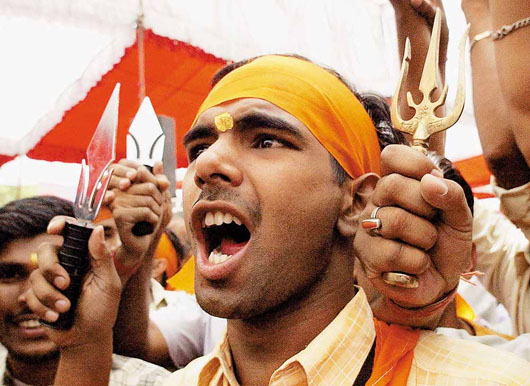
The February month cover story of the popular narrative magazine, The Caravan, published from Delhi, has already been discussed and debated a lot. Hindutva extremist Aseemanand, speaking to the magazine's journalist Ms. Leena Regunath, revealed that all the bomb blasts carried out by his team had been with the RSS leadership's knowledge and approval. Furthermore, the RSS's national leaders including its general secretary Mohan Bhagwat and national executive member Indresh Kumar had met Assemanand in person and pleaded with him to go ahead with the attacks, at the same time advising him to take care as to not link such terror acts with Sangh Parivar Organisations, especially the RSS. Aseemanand, who has been accused in five bomb blasts across the country which killed a total of 199 innocent people, also revealed that Narendra Modi, Gujarat's chief minister and BJP's prime ministerial candidate for the next general elections, was a fan and supporter of his extremist activities.
That the RSS has several wings promoting different agendas, all culminating in the aim of converting India into a 'Hindu Rashtra' is no secret today. It has also been revealed by different investigations that militant Hindutva is one of the major methods used by the RSS to achieve this goal. On several ocassions, RSS leaders have openly declared their intention tp replace the Indian Constitution with the 'Manusmriti', and to establish a social order based on caste-system and untouchability, gender discrimination, denial of basic human rights and superstitions and social evils. When BJP-led NDA had come to power at the Centre, one of the first things it did was to appoint a Commission to review the Indian Constitution. Only because the BJP lacked a simple majority in the Parliament, the country was saved from being sent back to the stone-age.
Today, Aseemanand, Pragya Singh Thakur and Col. Srikant Purohit have been identified as the kingpins of Hindutva terrorism. Aseemanand has long been considered as a stalwart of Hindutva fanaticism in Hindutva terror's biggest laboratory, Gujarat. In the interviews published by 'The Caravan', Aseemanand has stated that creating fanaticism in the minds of Hindus is the best way to stop them from converting to Christianity. He is proud of all the violence he has supervised in the name of 'stirring Hindutva' among people. He has reiterated his loyalty to militant Hindu nationalism.
Other Hindutva extremists are worse. Pragya Singh Thakur's only regret in her bombing escapades has been the low numbers of Muslim casualities. Col. Purohit used his army uniform to further the cause of Hindu extremist nationalism. He used the Bhonsala Military School in Nashik, Maharashtra, as the base of his terror operations. In 2001, this school held a 40-days training camp, in which 115 RSS and Bajrang Dal activists from different parts of the country were taught bomb making, exploding bombs and weapons training. Retired and serving army officers and retired senior IB officers were among the trainers. This was revealed in the book 'Who Killed Karkare?' by S.M. Mushrif. Media also revealed that Purohit had stolen about 60kgs of RDX from the army. Apart from using this deadly explosive to carry out bombings, some of it was also used to frame innocent Muslims in arms seizure cases. However, what is still unclear is whether all the 60 kgs stolen have been tracked down.
The RSS has always been aware of the activities of what is now called 'Abhinav Bharat'. Aseemenand and Pragya Singh Thakur were actively associated with RSS branches, and held responsible positions in the Sangh Parivar. Aseemanand was the top-most national leader of Vanavasi Kalyan Ashram (VKA), animportant Sangh Parivar wing. Pragya Singh was a national executive member of ABVP, the Sangh's students' wing. Indresh Kumar, another accused, used to be a national executive member of the RSS. Aseemanand was honoured twice by the RSS, for his 'achievements' in perpetrating violence against the minorities, especially those in Gujarat's Dangs district. Sunil Joshi, yet another accused, who was later murdered allegedly by his partners in violence, used to be a district leader of RSS in Indore. Initially, when Pragya Singh Thakur's role in terrorist activities was exposed by investigating agencies, the BJP was quick to disown her. However, this angered senior BJP leader Uma Bharti, who complained that BJP wasn't doing the right thing by disassociating itself from her. However, the BJP later ran to Pragya's help, alleging that she was being tortured in jail. They did this only after photographs emerged which established that Pragya was well connected to top-most national leaders of the RSS and BJP, including Narendra Modi. Similarly, the RSS ran to Indresh Kumar's rescue, as soon as the NIA started closing in on him. Perhaps he knew too much.
In spite of convincing evidence suggesting that the roots of these terrorists can be tracedback to the RSS, little has been done to bring this criminal organisation to book. On 24th November 2008, the Indian Express and CNN-IBN had reported that Praveen Togadia, the 'International Working President'of the Vishwa Hindu Parishad, another hate-mongering RSS outfit, was behind the funding of Abinav Bharat, which carried out all the bomb blasts in the country specifically targeting Muslims. On 18th February 2009, various media including Zee News had carried a news report which suggested that senior RSS leaders, including its general secretary Mohan Bhagwat were funded by Pakistan's ISI. This was revealed by another blast accused, Dayanand Pandey, in his confession to the police.
NDTV, on 7th June 2002, had reported about the discovery of a new extremist Hindu militant outfit which organised and carried out attacks against Masjids and Madrassas. This criminal gang was called Arya Sena, and they were based at Sharanpur district of western Uttar Pradesh. They carried out attacks using pistols and time-bombs, and had bombed 3 Masjids and a Madrassa in the initial months of operation. Further investigations had revealed that the policemen of the area had armed them with materials and motivation to carry out attacks against Muslim targets. Incidents like these suggest that there could be regional versions of Abhinav Bharat in all states with RSS presence, operating with support from sections of the administration.
Saffron terrorists operate with mafia precision and professionalism. The murder of Sunil Joshi, who used to be a prime member of the saffron terror wing, underlines this fact. The murder case chargesheet mentions that Sunil Joshi was about to surrender and confess before the authorities, when he was killed.
If the media dares to report on saffron terror, hindutva thugs are sure to wreak vengeance. Who can forget the attack on the office of the national TV channel 'Headlines Today'? On 16th July 2010, thousands of Hindutva bigots carried out the attack on HT because the channel had dared to publicize police tapes which showed the involvement of top RSS leader Indresh Kumar and others, in the planning of Ajmer bomb blast. The tapes also revealed that one of the Hindutva terrorists, Dr. R. P. Singh had planned to kill Dr. Hamid Ansari, the Vice President of the Republic of India, in a bomb blast planned to be executed during a programme in Delhi's Jamia Millia Islamia. It also showed tapes of a secret meeting discussing the need to carry out terrorist attacks against Muslim public gatherings. The fact that the channel had procured these audio and video tapes from investigating agencies, who had recovered them from Malegaon blast accused Dayanand Pandey's laptop, did not matter to the hooligans.
Irrespective of whether UPA or NDA rules at the centre, Hindutva terrorists enjoy guaranteed immunity. 'The Caravan' also revealed that even though investigative agencies had recommended banning RSS in the wake of its links with terrorist activities, the Ministry of Home Affairs paid no heed. In spite of evidence linking senior RSS leader Indresh Kumar to hindutva terrorists, he was never questioned by the NIA. Mohan Bhagwat wasn't questioned either.
As the CM of Gujarat, Modi allowed a free rein to extremists like Aseemanand. Aseemanand's activities of violence in Dangs, which though localised were high-scale in magnitude, and were aided and abetted by sections of the police and administration, who were loyal to the Hindutva agenda. These paved the way to larger and more frequent episodes of violence in Gujarat, ultimately empowering Hindutva terrorists to execute the Muslim genocide of 2002.
Aseemanand's interview in 'The Caravan' ends with his promise that the works of Hindutva extremists will continue. “It will happen. It will happen on time,” he says. This leads one to the conclusion that sleeper cells of Hindutva terrorists exist in the country, lying low to strike when the situation becomes favourable. It is evident that Hindutva terrorists long to see Modi as the next Prime Minister. This is evident from Aseemanand's younger brother Sushant's words: “Once Modiji comes to power I will put a stage in the village centre and shout from the loudspeakers all that Aseemanand has done.” Bringing Modi to power seems like a prelude to viler projects of Hindutva extremists.
When the Government of India banned the RSS after Gandhiji's assassination, it has stated the following reason:
“Undesirable and even dangerous activities have been carried out by members of the Sangh. It has been found that in several parts of the country individual members of the Rashtriya Swayamsevak Sangh have indulged in acts of violence involving arson, robbery, dacoity, and murder and have collected illicit arms and ammunitions. They have been found circulating leaflets exhorting people to resort to terrorist methods, to collect firearms, to create disaffection against the government and suborn the police and military. These activities have been carried out under the cloak of secrecy, and the government have considered from time to time how far these activities rendered it incumbent upon them to deal wth the Sangh in its corporate capacity.”
Even though the RSS-led Sangh Parivar continues to do all the above-mentioned activities even today, expecting the Union Government to ban the outfit would be asking for toomuch. Sangh Parivar national leaders like Sudarshan, Bhagwat and Togadia are still free to roam the country spewing communal venom, as several innocent Muslim youth rot away in the country's jails, for crimes they never committed.

Comments
Add new comment