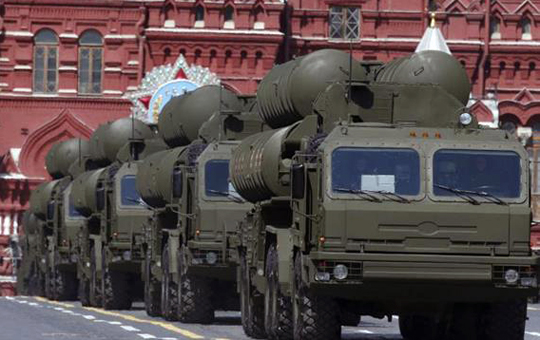
Russia preparing to supply S-400 missile systems to India

June 2, 2017

Saint Petersburg, Jun 2: Russia is preparing to supply S-400 Triumf anti-aircraft missile systems to India and both sides are discussing the terms of the sale, Russian Deputy Prime Minister Dmitry Rogozin has said.

s400

Precontract preparations underway on the supplies of the S-400 anti-aircraft missile complexes to India, Rogozin said. "Pre-contract preparations are underway on the supplies of S-400 anti-aircraft missile complexes to India," he said.

"It is difficult to say yet how much time they will take. There is an agreement between governments and now we are simply discussing the terms," Russia's official Tass News Agency quoted Rogozin as saying on the sidelines of Prime Minister Narendra Modi's ongoing visit to this Russian city.

India had announced on October 15 last year a deal on the Triumf air defence systems from Russia, worth over USD five billion, and collaborate in making four state of art frigates besides setting up a joint production facility for making Kamov helicopters.

The deals were announced following talks held between Prime Minister Modi and Russian President Putin on the sidelines of the BRICS Summit held in Goa.

In April, Sergei Chemezov, director-general of the Rostec State Corporation had said that the deal for the S-400 anti- aircraft missile systems (AAMS) to India is not yet concluded. "The contract has not yet been signed," Chemezov had said.

The S-400 Triumf long-range air defence missile system has the capability to destroy incoming hostile aircraft, missiles and even drones at ranges of up to 400 km.

India and Russia have been in talks for over a year for the purchase of at least five systems of S-400 that will be a game changer in the region. It is capable of firing three types of missiles, creating a layered defence, and simultaneously engaging 36 targets.

The S-400 Triumph is Russia's latest mobile long-range multiple anti-aircraft missile system, which came into service in 2007. It is meant for destroying aircraft as well as cruise and ballistic missiles, including medium-range missiles, and ground targets.

China was the first foreign buyer of the S-400 anti-aircraft missile systems.

Comments

Add new comment

  • Coastaldigest.com reserves the right to delete or block any comments.
  • Coastaldigset.com is not responsible for its readers’ comments.
  • Comments that are abusive, incendiary or irrelevant are strictly prohibited.
  • Please use a genuine email ID and provide your name to avoid reject.
Agencies
April 20,2020

Hong Kong, Apr 20: Oil prices collapsed to more than two-decade lows Monday as traders grow concerned that storage facilities are reaching their limits, while equities were mixed, with some support coming from signs that the coronavirus may have peaked in Europe and the United States.

US crude benchmark West Texas Intermediate briefly plunged almost 20 percent to below 15 -- its lowest since 1999 -- as stockpiles continue to build owing to a crash in demand caused by the COVID-19 pandemic.

Analysts said this month's agreement between top producers to slash output by 10 million barrels a day was having little impact on the oil crisis because of lockdowns and travel restrictions that are keeping billions of people at home.

WTI was hit particularly hard as its main US storage facilities in Cushing, Oklahoma, were filling up.

ANZ said "crude oil prices remained under pressure, as projections of weaker demand weigh on sentiment".

"Despite the OPEC+ alliance agreeing to an unprecedented cut in output, the physical market is awash with oil," it said, referring to the Organization of the Petroleum Exporting Countries and non-OPEC partners.

And AxiCorp's Stephen Innes added: "It's a dump at all cost as no one... wants delivery of oil, with Cushing storage facilities filling by the minute.

"It hasn't taken long for the market to recognise that the OPEC+ deal will not, in its present form, be enough to balance oil markets." Stock traders were in slightly more buoyant mood as governments start to consider how and when to ease lockdowns that have crippled the global economy.

Italy, Spain, France and Britain reported drops in daily death tolls and slowing infection rates.

"We are scoring points against the epidemic," said Prime Minister Edouard Philippe, while insisting "we are not out of the health crisis yet".

Meanwhile, in the US, Andrew Cuomo, governor of badly hit New York state, said the disease was "on the descent", though he cautioned it was "no time to get cocky".

Mounting evidence suggests that the lockdowns and social distancing are slowing the spread of the virus.

That has intensified planning in many countries to begin loosening curbs on movement and easing the crushing pressure on national economies.

Adding to the sense of hope was a report indicating promising research on a drug to treat coronavirus.

Hong Kong, Shanghai and Seoul were each up 0.1 percent, while Wellington added 0.4 percent.

However, Tokyo went into the break 0.9 percent lower, while Sydney and Manila dropped one percent apiece. There were also losses in Taipei, Singapore and Jakarta.

"The longer investors have to contemplate future economic issues while they wait for more countries to be on the downward slope of the pandemic curve, the more scope there is of risk assets pricing in a difficult future," Chris Iggo, of AXA Investment Managers UK, said.

Investors are keeping an eye on Washington, where Congress and the White House are working towards a 450 billion economic relief plan for small business to add to the trillions already pledged to support the economy.

Big-name companies including IBM, Netflix and Coca-Cola are due to deliver their earnings reports.

Comments

Add new comment

  • Coastaldigest.com reserves the right to delete or block any comments.
  • Coastaldigset.com is not responsible for its readers’ comments.
  • Comments that are abusive, incendiary or irrelevant are strictly prohibited.
  • Please use a genuine email ID and provide your name to avoid reject.
News Network
June 9,2020

Washington, Jun 9: The defacement of Mahatma Gandhi's statue by unknown miscreants was a "disgrace", US President Donald Trump has said, days after it was vandalised with graffiti and spray painting during the nationwide protests against the custodial killing of African-American George Floyd.

The statue, which is across the road from the Indian Embassy, was vandalised on the intervening night of June 2 and 3, prompting the Indian embassy to register a complaint with the local law enforcement agencies.

The incident happened during the week of nationwide protests against the custodial killing of Floyd in Minneapolis on May 25.

"It was a disgrace," Trump made the brief comment at the White House on Monday when asked about the incident.

The Indian Embassy here has taken up the matter with the US Department of State for early investigation into the matter, as also with the Metropolitan Police and National Park Service.

It is working with the US Department of State, Metropolitan Police and National Park Service for expeditious restoration of the statue at the park.

The US president and First Lady Melania Trump, during their visit to India in February, had spent considerable time at the Gandhi Ashram in Ahmedabad. Prime Minister Narendra Modi had personally given them a tour of the historic place.

"The First Lady and I have just had a pleasure of visiting Mahatma Gandhi's Ashram, a few miles from here, where he launched the famous Salt March," Trump had said during his address at the Namaste Trump rally at the Motera Stadium in Ahmedabad on February 24. A day later, Trump and the first lady also laid a wreath at Raj Ghat in New Delhi.

Pictures of Trump and the first lady with Gandhi's spinning wheel during their visit to the Sabarmati Ashram in Ahmedabad are seen hanging on the walls of the White House.

Last week, top US lawmakers and the Trump Campaign condemned the vandalisation of the statue.

"Very disappointing," tweeted Kimberly Guilfoyle, advisor to Donald J Trump for President Inc. and National Chair of the Trump Victory Finance Committees.

North Carolina Senator Tom Tillis said, "It's disgraceful to see the defacing of the Gandhi statue" in Washington DC.

"Gandhi was a pioneer of peaceful protesting, demonstrating the great change it can bring. Rioting, looting and vandalising do not bring us together, he said.

Senator Marco Rubio said, "more evidence that violent radicals and run of the mill crazies have hijacked legitimate protests to create anarchy or for their own purposes."

Protests against the custodial killing of Floyd turned violent in the US and prestigious monuments were damaged. In Washington DC, protestors burnt a historic church and damaged monuments like the Lincoln Memorial.

US Ambassador to India Ken Juster apologised for the incident.

"So sorry to see the desecration of the Gandhi statue in Wash, DC. Please accept our sincere apologies," he said.

"Appalled as well by the horrific death of George Floyd and the awful violence and vandalism. We stand against prejudice & discrimination of any type. We will recover and be better," he said in a tweet last week.

One of the few statues of a foreign leader on a federal land in Washington DC, the statue of Gandhi was dedicated by former prime minister Atal Bihari Vajpayee in the presence of the then US president Bill Clinton on September 16, 2000, during his state visit to the US.

Comments

Add new comment

  • Coastaldigest.com reserves the right to delete or block any comments.
  • Coastaldigset.com is not responsible for its readers’ comments.
  • Comments that are abusive, incendiary or irrelevant are strictly prohibited.
  • Please use a genuine email ID and provide your name to avoid reject.
News Network
February 2,2020

Feb 2: The Philippines on Sunday reported the first death from a new virus outside of China, where authorities delayed the opening of schools in the worst-hit province and tightened quarantine measures in a city that allow only one family member to venture out to buy supplies.

The Philippine Department of Health said a 44-year-old Chinese man from Wuhan was admitted on Jan. 25 after experiencing a fever, cough, and sore throat. He developed severe pneumonia, and in his last few days, “the patient was stable and showed signs of improvement, however, the condition of the patient deteriorated within his last 24 hours resulting in his demise.”

The man’s 38-year-old female companion, also from Wuhan, also tested positive for the virus and remains in hospital isolation in Manila.

President Rodrigo Duterte approved a temporary ban on all travelers, except Filipinos, from China and its autonomous regions. The U.S., Japan, Singapore and Australia have imposed similar restrictions despite criticism from China and an assessment from the World Health Organization that they were unnecessarily hurting trade and travel.

The death toll in China climbed by 45 to 304 and the number of cases by 2,590 to 14,380, according to the National Health Commission, well above the number of those infected in in the 2002-03 outbreak of SARS, or severe acute respiratory syndrome, which broke out in southern China and spread worldwide.

Meanwhile, six officials in the city of Huanggang, neighboring the epicenter of Wuhan in Hubei province, have been fired over “poor performance” in handling the outbreak, the official Xinhua News Agency reported.

It cited the mayor as saying the city’s “capabilities to treat the patients remained inadequate and there is a severe shortage in medical supplies such as protective suits and medical masks.”

After Huanggang, the trading center of Wenzhou in coastal Zhejiang province also confined people to homes, allowing only one family member to venture out every other day to buy necessary supplies.

With the outbreak showing little sign of abating, authorities in Hubei and elsewhere have extended the Lunar New Year holiday, due to end this week, well into February. The annual travel crunch of millions of people returning from their hometowns to the cities is thought to pose a major threat of secondary infection at a time when authorities are encouraging people to avoid public gatherings.

All Hubei schools will postpone the opening of the new semester until further notice and students from elsewhere who visited over the holiday will also be excused from classes.

Far away on China’s southeast coast, the manufacturing hub of Wenzhou put off the opening of government offices until Feb. 9, private businesses until Feb. 17 and schools until March 1.

With nearly 10 million people, Wenzhou has reported 241 confirmed cases of the virus, one of the highest levels outside Hubei. Similar measures have been announced in the provinces and cities of Heilongjiang, Shandong, Guizhou, Hebei and Hunan, while the major cities of Shanghai and Beijing were on indefinite leave pending developments.

Despite imposing drastic travel restrictions at home, China has chafed at those imposed by foreign governments, criticizing Washington’s order barring entry to most non-citizens who visited China in the past two weeks. Apart from dinging China’s international reputation, such steps could worsen a domestic economy already growing at its lowest rate in decades.

The crisis is the latest to confront Chinese leader Xi Jinping, who has been beset by months of anti-government protests in the semi-autonomous Chinese city of Hong Kong, the reelection of Taiwan’s pro-independence president and criticism over human rights violations in the traditionally Muslim northwestern territory of Xinjiang. Economically, Xi faces lagging demand and dramatically slower growth at home while the tariff war with the U.S. remains largely unresolved.

Among a growing number of airlines suspending flights to mainland China was Qatar Airways. The Doha-based carrier said on its website that its flights would stop Monday. It blamed “significant operational challenges caused by entry restrictions imposed by a number of countries” for the suspension of flights.

Oman also halted flights to China, as did Saudi Arabia’s flagship national carrier, Saudia.

Saudi Arabia’s state-run TV reported that 10 Saudi students were evacuated from Wuhan on a special flight. It said the students would be screened upon arrival, but did not say whether they would be quarantined for 14 days.

This weekend, South Korea and India flew hundreds of their citizens out of Wuhan. They went into a two-week quarantine.

On Sunday, South Korea reported three more cases for a total of 15. They include an evacuee, a Chinese relative of a man who tested positive and a man who returned from Wuhan. India reported a second case, also in southern Kerala state.

South Korea also barred foreigners who have stayed or traveled to Hubei province within the last 14 days from entering the country.

Indonesia flew back 241 nationals from Wuhan on Sunday and quarantined them on the remote Natuna Islands for two weeks. Several hundred residents protested the move, with one saying, “This is not because we do not have a sense of solidarity with fellow nationals. But because we fear they could infect us with the deadly virus from China.”

A Turkish military transport plane carrying 42 people arrived in Ankara from Wutan Saturday night. The 32 Turkish, six Azerbaijani, three Georgian nationals and an Albanian will remain under observation for 14 days, together with 20 personnel who participated in the evacuation, Health Minister Fahrettin Koca said.

Vietnam counted its seventh case, a Vietnamese-American man who had a two-hour layover in Wuhan on his way from the U.S. to Ho Chi Minh City.

The virus’ rapid spread in two months prompted the WHO on Thursday to declare it a global emergency.

That declaration “flipped the switch” from a cautious attitude to recommending governments prepare for the possibility the virus might spread, said the WHO representative in Beijing, Gauden Galea. Most cases reported so far have been people who visited China or their family members.

WHO said it was especially concerned that some cases abroad involved human-to-human transmission.

“Countries need to get ready for possible importation in order to identify cases as early as possible and in order to be ready for a domestic outbreak control, if that happens,” Galea told The Associated Press.

Both the new virus and SARS are from the coronavirus family, which also includes those that cause the common cold.

The death rate in China is falling, but the number of confirmed cases will keep growing because thousands of specimens from suspected cases have yet to be tested, Galea said.

“The case fatality ratio is settling out at a much lower level than we were reporting three, now four, weeks ago,” he said.

Although scientists expect to see limited transmission of the virus between people with family or other close contact, they are concerned about cases of infection spreading to people who might have less exposure.


Comments

Add new comment

  • Coastaldigest.com reserves the right to delete or block any comments.
  • Coastaldigset.com is not responsible for its readers’ comments.
  • Comments that are abusive, incendiary or irrelevant are strictly prohibited.
  • Please use a genuine email ID and provide your name to avoid reject.