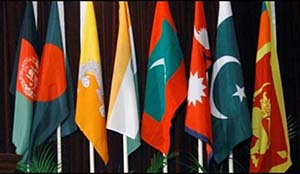
SAARC has not lived up to its potential: White House

October 13, 2016

Washington, Oct 13: SAARC has not lived up to its potential, a top White House official said and "regretted" that the regional summit has to be postponed this year after most of the member countries pulled out of it.SAARC2

"It is regrettable that the SAARC meeting could not be held this year," Peter Lavoy, Senior Director for South Asia at the National Security Council (NSC), White House told a Washington audience in response to a question at the Center for Strategic and International Studies (CSIS).

"In fact SAARC has not lived up to the potential of other regional groupings like ASEAN. That grouping has countries with similar frictions, similar boarder disputes, ethnic concerns and other problems at the time ASEAN was created," he said.

But SAARC has not been able to provide that platform, which has negative effect on the relationships, Lavoy said when asked about America's relationship between India and Pakistan.

"I think, the bottom line is we do not try to balance this relationship," he said, adding that the Obama Administration has been focused on deepening and broadening its relationship with India.

"We wish that were to be the case with Pakistan. We work very hard with Pakistan to turn that into a productive mutually beneficial relationship. I am sure the next administration would continue with these tendencies," Lavoy said.

The US he said already has a very vibrant trilateral co-operation with India and Japan.

"There is no reason why other countries can't join in on this partnership," he said.Following the attack in Uri in which 19 soldiers were killed, India decided not to participate in the SAARC Summit that was scheduled to be held in Islamabad in November.

Following India, several other South Asian countries – Bangladesh, Bhutan, Afghanistan and Sri Lanka – pulled out of the summit. This forced Pakistan to postpone the SAARC Summit for an indefinite period.

Comments

Add new comment

  • Coastaldigest.com reserves the right to delete or block any comments.
  • Coastaldigset.com is not responsible for its readers’ comments.
  • Comments that are abusive, incendiary or irrelevant are strictly prohibited.
  • Please use a genuine email ID and provide your name to avoid reject.
News Network
January 20,2020

Langkawi, Jan 20: Malaysia will not take retaliatory trade action against India over its boycott of palm oil purchases amid a political row between the two countries, Prime Minister Mahathir Mohamad said on Monday.

India, the world’s largest edible oil buyer, this month effectively halted imports from its largest supplier and the world’s second-biggest producer in response to comments from Mahathir attacking India’s domestic policies.

“We are too small to take retaliatory action,” Mahathir told reporters in Langkawi, a resort island off the western coast of Malaysia. “We have to find ways and means to overcome that,” he added.

The 94-year-old premier of Muslim-majority Malaysia has criticised New Delhi’s new religion-based citizenship law and also accused India of invading the disputed region of Kashmir.

Mahathir again criticised India’s citizenship law on Monday, saying he believed it was “grossly unfair”.

India has been Malaysia’s largest palm oil market for the past five years, presenting the Southeast Asian country with a major challenge in finding new buyers for its palm oil.

Benchmark Malaysian palm futures fell nearly 10% last week, their biggest weekly decline in more than 11 years.

New Delhi is also unhappy with Malaysia’s refusal to revoke permanent resident status for controversial Indian Islamic preacher Zakir Naik, who has lived in Malaysia for about three years and faces charges of money laundering and hate speech in India.

Mahathir said even if the Indian government guarantees a fair trial, Naik faces the real threat of vigilante action and that Malaysia will only relocate the preacher if it can find a third country where he would be safe.

“If we can find a place for him, we will send him out.”

Comments

Add new comment

  • Coastaldigest.com reserves the right to delete or block any comments.
  • Coastaldigset.com is not responsible for its readers’ comments.
  • Comments that are abusive, incendiary or irrelevant are strictly prohibited.
  • Please use a genuine email ID and provide your name to avoid reject.
News Network
May 30,2020

May 30: Warning of the tightrope walk ahead as governments battle the coronavirus crisis, Nobel laureate Peter Charles Doherty has expressed concern about densely populated countries such as India relaxing lockdown norms while also describing a complete shutdown as “an economic and social impossibility”.

The Australian immunologist, who cautioned that the number of COVID-19 cases will rise in the coming days, said the earliest time frame for an effective vaccine “going into large numbers of people” is nine to 12 months.

"If all goes well with testing, we could know if some of the candidate vaccines are both safe and effective as early as September/October. Then, rolling a vaccine out will depend on the type of product and how quickly it can be made, put in vials and so forth," Doherty told PTI in an email interview from Melbourne.

The novel coronavirus, he added, does not change fast like influenza and, from what is known so far, “the same vaccine should work everywhere”.

Doherty, who is with the Department of Microbiology and Immunology at the Doherty Institute, University of Melbourne, won the Nobel Prize for Medicine in 1996 for his discovery of how the body’s immune system distinguishes virus-infected cells from normal ones.

Discussing the lockdown, he said, "If it was purely a matter of hard science, everywhere should stay locked down. But that’s pretty much an economic and social impossibility.”

The expectation, he said, is the numbers will rise and limiting spread will depend on people acting responsibly and the capacity for rapid response and extensive contact testing.

“And in a densely populated country like India I think that it will be very difficult," the scientist said.

Several countries, including India, began relaxing lockdown norms in mid-May despite the WHO’s warning about a second wave. India’s lockdown began on March 25 and has since been extended. The fourth phase ends on Sunday.

Asked whether there are any alternatives to a lockdown, the 79-year-old said, "There is no other option other than closing borders. South Korea, for example, conducted massive, intensive testing and contact tracing in a wealthy country with a very disciplined population. Otherwise, not till we have effective vaccines."

He added that he personally doesn’t see the point of closing borders for people coming in if there’s already a high incidence of disease in the community, “unless it’s to avoid the need to care for them and use scarce hospital beds".

According to Doherty, the coronavirus "is a new virus which has come straight out of nature".

“It (the virus) has moved so rapidly across the world because of people travelling on international planes as well as tourist ships," he added.

The immunologist also warned against the use of hydroxychloroquine to treat COVID-19, and said current and planned trials of the anti-malaria drug should be stopped.

“My understanding is that the use of the drug in severe disease is definitely contra-indicated, but it’s not yet clear whether, if taken under medical supervision, it could have some useful effect if taken early on, or as a preventive. Those trials just haven’t been done properly," Doherty noted.

The Indian Council of Medical Research (ICMR) has backed the use of hydroxychloroquine as a preventive against COVID-19 even after the WHO suspended clinical trials of the drug citing safety concerns.

Asked whether plasma therapy can be an effective treatment for COVID-19, Doherty said, "We lack good properly controlled trials but, especially if the plasma has been tested for antibody levels and there’s evidence of good activity, it could be helpful. If I had the disease and was offered plasma therapy I would certainly accept, but I would not take hydroxychloroquine."

Doherty is also very optimistic about herd immunity developing against the SARS-CoV-2 infection.

"We think that (herd immunity) will cut in and have an obvious effect when, say, 60 per cent of people have been infected. Best hope is to boost herd immunity with a vaccine," he stated.

Herd immunity is a form of indirect protection from infectious disease that occurs when a large percentage of a population has become immune to an infection, whether through vaccination or previous infections.

The number of COVID-19 cases have crossed 5.9 million and the fatalities 3,65,000, according to the Johns Hopkins University on Saturday. 

In India, the death toll has risen to 4,971 and the number of cases to 1,73,763, according to the Union Health Ministry on Saturday.

Several states, including Bihar, Uttar Pradesh, Madhya Pradesh, Jharkhand and Chhattisgarh, have reported a rise in number since lockdown norms were relaxed in early May and migrant workers reached home.

In Uttar Pradesh, for instance, the number of infections rose from around 3,000 on May 4 to 6,532 on May 26. Similarly, Bihar’s numbers increased from around 500 to over 2,700 in the period.


Comments

Add new comment

  • Coastaldigest.com reserves the right to delete or block any comments.
  • Coastaldigset.com is not responsible for its readers’ comments.
  • Comments that are abusive, incendiary or irrelevant are strictly prohibited.
  • Please use a genuine email ID and provide your name to avoid reject.
Agencies
May 8,2020

United Nations, May 8: UN Secretary-General Antonio Guterres said Friday the coronavirus pandemic keeps unleashing a tsunami of hate and xenophobia, scapegoating and scare-mongering. 

The UN chief said anti-foreigner sentiment has surged online and in the streets, anti-Semitic conspiracy theories have spread, and COVID-19-related anti-Muslim attacks have occurred. 

Guterres said migrants and refugees have been vilified as a source of the virus -- and then denied access to medical treatment. 

With older persons among the most vulnerable, contemptible memes have emerged suggesting they are also the most expendable, he said. 

And journalists, whistleblowers, health professionals, aid workers and human rights defenders are being targeted simply for doing their jobs. 

Guterres appealed for an all-out effort to end hate speech globally. The secretary-general called on political leaders to show solidarity with all people, on educational institutions to focus on digital literacy at a time when extremists are seeking to prey on captive and potentially despairing audiences. 

He called on the media, especially social media, to remove racist, misogynist and other harmful content, on civil society to strengthen their outreach to vulnerable people, and on religious figures to serve as models of mutual respect. 

And I ask everyone, everywhere, to stand up against hate, treat each other with dignity and take every opportunity to spread kindness, Guterres said.

The secretary-general stressed that COVID-19 does not care who we are, where we live, what we believe or about any other distinction. His global appeal to address and counter COVID-19-related hate speech follows his April 23 message calling the coronarivus pandemic a human crisis that is fast becoming a human rights crisis. 

Guterres said then that the pandemic has seen disproportionate effects on certain communities, the rise of hate speech, the targeting of vulnerable groups, and the risks of heavy-handed security responses undermining the health response. 

With rising ethno-nationalism, populism, authoritarianism and a push back against human rights in some countries, the crisis can provide a pretext to adopt repressive measures for purposes unrelated to the pandemic, he warned.

In February, Guterres issued a call to action to countries, businesses and people to help renew and revive human rights across the globe, laying out a seven-point plan amid concerns about climate change, conflict and repression.

Comments

Add new comment

  • Coastaldigest.com reserves the right to delete or block any comments.
  • Coastaldigset.com is not responsible for its readers’ comments.
  • Comments that are abusive, incendiary or irrelevant are strictly prohibited.
  • Please use a genuine email ID and provide your name to avoid reject.