



Sangh Parivar's Population Bomb

November 19, 2013

twocirclesnet

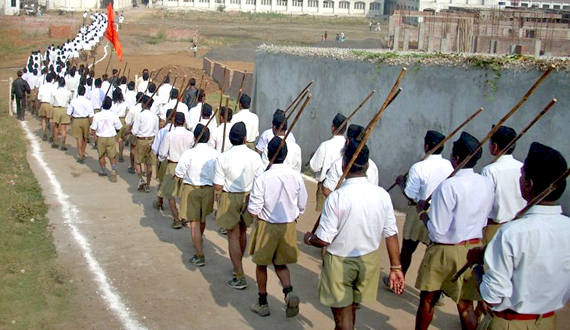
Once again the Rashtriya Swayamsewak Sangh [RSS] has urged Hindus that more children should be produced, in order to check the demographic imbalance. Did anyone call it fatwa or a diktat? How many TV channels found RSS joint secretary Dattatreya Hosbale's comments as controversial? Has there been strong criticism on editorial pages in mainstream newspapers? This is not the first time that RSS leaders have said that Hindus need to produce more kids. For them, Hindus are the 'victim'.

The bogey of 'Muslim population rise' or 'Ham Panch-Hamare Pachchis' are used by RSS to portray Muslims in bad light. Not only that the statement aims at driving wedge among religious communities, the fact is that it is truly regressive in nature.

Shouldn't RSS turn itself into a forward looking organisation?

The reason is that if RSS been a forward looking organisation, it would stop looking at things from the Hindu vs. Muslim. In that case it should have urged middle-class Indians [mostly Hindus] to stop female foeticide [and infanticide] to control the fascination for 'baby boy'.

It is this gender imbalance that is really threatening Hinduism [and India]. There are vast regions where there are less than 800 girls for 1,000 boys. Even the upper class and middle-class want the 'baby boy'. If the first child is a girl, many go for second, in the hope to have a boy.

This 'sickness' needs to be fought. Strangely, RSS leaders never tell their followers how Hinduism has been growing much faster over the last century in the world. While Islam has grown fast after 1900, overall population of Hindus in the world, has also gone up significantly, even as Christianity and other religions have now lost the pace.

As far as rise in Muslim population in India is concerned, it is not a very unusual phenomenon. The minority [Muslim] rate of growth is quite close to Dalits. Clearly, economic reasons and social backwardness are the cause behind the high birthrate.

Muslim growth rate in Kerala, Tamil Nadu much less than in UP, Bihar

In states like Tamil Nadu and Kerala, Muslims have a growth rate of much less than 20% per decade, which is less than the growth rate of Hindu population in India in many other states of North India. UP and Bihar have overall bigger families. No wonder, fertility rates are higher among Muslims in these states.

Secondly, there is no open opposition to family planning among Muslims, and they have adopted it widely. As Muslims go up on socio-economic indicators, they also tend to have smaller families, just like rest of the Indians.

As per 2001 census, the overall population grew by 21.5% in India in the previous decade. Muslim decadal population grew by a mere 13.7% in Tamil Nadu and 15.8% in Kerala [from 1991 to 2001]. These states have a higher Muslim literacy rate and here Muslims are financially better-off. In contrast, Hindu population increased by 28.7% in Punjab, 24.7% in Karnataka and 23.4% in Bihar.

How do you explain that? Now there will be critics who would say that if Muslims grew by 13.7% in Tamil Nadu in the decade, the decennial Hindu growth was just 11%.

The problem is that when the Hindu growth rate is seen, they don't take into account the growth rate of backwards and Dalits, whose population growth is comparable to Muslims.

For example, you can't expect to compare Iyers or Iyengars' decadal rise in population with Dalits or even Vanniyars. If you have to at all compare then do it with the socially upward Muslims. Else, consider Muslims also as a social group and then look at them with their growth rate.

The right comparison would be Muslim population rise vis-a-vis increase in population of social groups that have similar earning, living conditions and socio-economic backwardness. Statistics clearly reveal that Muslim population rate is falling in India and would stabilise in a few decades.

The difference of population growth rates is narrowing down fast. Far from becoming majority or even 25%, it will take centuries before they even reach the figure of 20% in India.

Perpetuating old myths: Fact is that Muslims are least polygamous in India

For decades, right-wing groups have made similar claims. Take for example, the charge of polygamy. Census clearly reveals that the practice of polygamy was highest among Adivasis, Jains, Buddhists and Hindus. Muslims came last as far as prevalence of the practice was concerned.

See this link. This is despite the fact that polygamy is legal for Muslims and unlawful for Hindus. But this is not highlighted or even mentioned. Tell a lie a thousand times and people tend to believe it. Senior RSS and BJP leaders often make attacks on Muslims about being more polygamous.

In December 2005, the then RSS chief [sarsanghchalak] KS Sudharshan had also urged the majority community in a similar manner. He said that 3-4 children per couple would keep the 'changing religious demography' in control. Just imagine had any other religious community [like a Muslim cleric from Nadwatul Ulema or Deoband] made such a statement, what would have happened?

There would have been wide condemnation, politicians and activists gunning for him and effigies burnt. TV channels would have continued debates for days. But in the case of RSS, it was simply ignored even though the 'cultural organisation' has huge impact and has a cadre strength of tens of lakhs.

If the RSS leaders take up real issues that affect the nation, they would be taken more seriously. It may also strike chord with the young generation. However, they remain stuck in regressive rhetoric.

Comments

Add new comment

  • Coastaldigest.com reserves the right to delete or block any comments.
  • Coastaldigset.com is not responsible for its readers’ comments.
  • Comments that are abusive, incendiary or irrelevant are strictly prohibited.
  • Please use a genuine email ID and provide your name to avoid reject.
Agencies
January 10,2020

Indian enterprises were flooded with a whopping 14.6 crore malware threats in 2019 - a growth of 48 per cent (year-on-year) compared to 2018, a new report said on Friday.

Manufacturing, BFSI (banking, financial services and insurance), education, healthcare, IT/ITES, and the government were the most at-risk industries in the country, said the report from Seqrite, the enterprise arm of Pune-based IT security firm Quick Heal Technologies.

Interestingly, almost a quarter (23 per cent) of the threats were identified through 'Signatureless behaviour-based' detection by Seqrite, indicating how a growing number of cybercriminals were deploying new or previously unknown threat vectors to compromise enterprise security.

"With the latest Seqrite annual threat report, we want to empower CIOs, CISOs, business leaders and all key public stakeholders with the insights they need to combat the growing complexity of the threat landscape," said Sanjay Katkar, Joint Managing Director and CTO, Quick Heal Technologies.

The most prominent trend was the drastic increase in the volume, intensity, and sophistication of cyber-attack campaigns targeting Indian enterprises in 2019.

The rapid integration of IoT devices, BYOD (bring your own device), and third-party APIs into enterprise networks has created newer security vulnerabilities that might go unnoticed until a major breach occurs.

Threat researchers at Seqrite observed several large-scale advanced persistent threats (APT) attacks deployed against organisations in the government sector.

"The entry of nation-states and organised cybercrime cells into the fray is expected to add more complication to this situation and will require Indian government bodies and corporate enterprises to shore up their cyber defence strategies in 2020 and beyond," the report noted.

More alarming, however, was the continued lack of security awareness amongst enterprises and government organisations.

"Unsecured Remote Desktop Protocol (RDP) and Server Message Block (SMB) protocols continued to be targeted through brute-force attacks," said the report.

Spear phishing attack campaigns leveraging Office exploits and infected macros were also used extensively by cybercriminals to gain access to enterprise networks and steal critical data.

"India's digital journey depends on ensuring robust cybersecurity for all stakeholders within the enterprise ecosystem," said Katkar.

The sharp spike should be a cause of concern for CIOs and CISOs in the country, especially given the growing digital penetration within their enterprise networks.

"With network vulnerabilities and potential entry points increasing at a rapid pace, threat actors are expected to leverage artificial intelligence (AI) capabilities to power their malware campaigns in the future to capitalise on newer attack vectors," the report added.

Comments

Add new comment

  • Coastaldigest.com reserves the right to delete or block any comments.
  • Coastaldigset.com is not responsible for its readers’ comments.
  • Comments that are abusive, incendiary or irrelevant are strictly prohibited.
  • Please use a genuine email ID and provide your name to avoid reject.
Agencies
July 25,2020

In a study conducted in 117 countries, researchers have found that the world is experiencing the most dramatic reduction in the seismic noise (the hum of vibrations in the planet's crust) in recorded history due to global COVID-19 lockdowns.

Measured by instruments called seismometers, seismic noise is caused by vibrations within the Earth, which travel like waves and the waves can be triggered by earthquakes, volcanoes, and bombs - but also by daily human activity like travel and industry.

This quiet period was likely caused by the total global effect of social distancing measures, closure of services and industry, and drops in tourism and travel, the study published in the journal Science, reported.

The new research, led by the Royal Observatory of Belgium and five other institutions around the world including Imperial College London (ICL), showed that the dampening of 'seismic noise' caused by humans was more pronounced in more densely populated areas.

"Our study uniquely highlights just how much human activities impact the solid Earth, and could let us see more clearly than ever what differentiates human and natural noise," said study co-author Stephen Hicks from ICL in the UK.

For the findings, the research team looked at seismic data from a global network of 268 seismic stations in 117 countries and found significant noise reductions compared to before any lockdown at 185 of those stations.

Researchers tracked the 'wave' of quietening between March and May as worldwide lockdown measures took hold.

The largest drops in vibrations were seen in the most densely populated areas, like Singapore and New York City, but drops were also seen in remote areas like Germany's the Black Forest and Rundu in Namibia.

Citizen-owned seismometers, which tend to measure more localised noise, noted large drops around universities and schools around Cornwall, UK and Boston, US - a drop in noise 20 per cent larger than seen during school holidays.

The findings showed that countries like Barbados, where lockdown coincided with the tourist season, saw a 50 per cent decrease in noise.

"The changes have also given us the opportunity to listen in to the Earth's natural vibrations without the distortions of human input," the study authors wrote.

Earlier in April, a study published in the journal Nature, reported at least a 30 per cent reduction in that amount of ambient human noise since lockdown began in Belgium.

Comments

Add new comment

  • Coastaldigest.com reserves the right to delete or block any comments.
  • Coastaldigset.com is not responsible for its readers’ comments.
  • Comments that are abusive, incendiary or irrelevant are strictly prohibited.
  • Please use a genuine email ID and provide your name to avoid reject.
Agencies
May 10,2020

In the wake of the gas leak at a factory in Visakhapatnam, the National Disaster Management Authority (NDMA) has issued detailed guidelines for restarting industries after the lockdown and the precautions to be taken for the safety of the plants as well as the workers.

In a communication to all states and union territories, the NDMA said due to several weeks of lockdown and the closure of industrial units, it is possible that some of the operators might not have followed the established standard operating procedures.

As a result, some of the manufacturing facilities, pipelines, valves may have residual chemicals, which may pose risk. The same is true for the storage facilities with hazardous chemicals and flammable materials, it said.

The NDMA guidelines said while restarting a unit, the first week should be considered as the trial or test run period after ensuring all safety protocols.

Companies should not try to achieve high production targets. There should be 24-hour sanitisation of the factory premises, it said.

The factories need to maintain a sanitisation routine every two-three hours especially in the common areas that include lunch rooms and common tables which will have to be wiped clean with disinfectants after every single use, it added.

For accommodation, the NDMA said, sanitisation needs to be performed regularly to ensure worker safety and reduce the spread of contamination.

To minimise the risk, it is important that employees who work on specific equipment are sensitised and made aware of the need to identify abnormalities like strange sounds or smell, exposed wires, vibrations, leaks, smoke, abnormal wobbling, irregular grinding or other potentially hazardous signs which indicate the need for immediate maintenance or if required shutdown, it said.

At least 11 people lost their lives and about 1,000 others were exposed to a gas leak at a factory in Andhra Pradesh''s Visakhapatnam on May 7.

The incident took place after it restarted operations when the government allowed industrial activities in certain sectors following several weeks of lockdown.

The lockdown was first announced by Prime Minister Narendra Modi on March 24 for 21 days in a bid to combat the coronavirus threat. The lockdown was then extended till May 3 and again till May 17.

Comments

Add new comment

  • Coastaldigest.com reserves the right to delete or block any comments.
  • Coastaldigset.com is not responsible for its readers’ comments.
  • Comments that are abusive, incendiary or irrelevant are strictly prohibited.
  • Please use a genuine email ID and provide your name to avoid reject.