


Sangh Parivar's Population Bomb

November 19, 2013

twocirclesnet

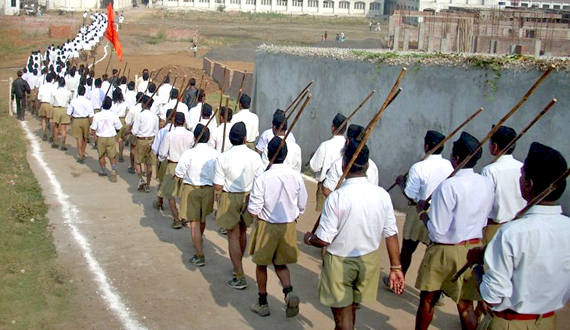
Once again the Rashtriya Swayamsewak Sangh [RSS] has urged Hindus that more children should be produced, in order to check the demographic imbalance. Did anyone call it fatwa or a diktat? How many TV channels found RSS joint secretary Dattatreya Hosbale's comments as controversial? Has there been strong criticism on editorial pages in mainstream newspapers? This is not the first time that RSS leaders have said that Hindus need to produce more kids. For them, Hindus are the 'victim'.

The bogey of 'Muslim population rise' or 'Ham Panch-Hamare Pachchis' are used by RSS to portray Muslims in bad light. Not only that the statement aims at driving wedge among religious communities, the fact is that it is truly regressive in nature.

Shouldn't RSS turn itself into a forward looking organisation?

The reason is that if RSS been a forward looking organisation, it would stop looking at things from the Hindu vs. Muslim. In that case it should have urged middle-class Indians [mostly Hindus] to stop female foeticide [and infanticide] to control the fascination for 'baby boy'.

It is this gender imbalance that is really threatening Hinduism [and India]. There are vast regions where there are less than 800 girls for 1,000 boys. Even the upper class and middle-class want the 'baby boy'. If the first child is a girl, many go for second, in the hope to have a boy.

This 'sickness' needs to be fought. Strangely, RSS leaders never tell their followers how Hinduism has been growing much faster over the last century in the world. While Islam has grown fast after 1900, overall population of Hindus in the world, has also gone up significantly, even as Christianity and other religions have now lost the pace.

As far as rise in Muslim population in India is concerned, it is not a very unusual phenomenon. The minority [Muslim] rate of growth is quite close to Dalits. Clearly, economic reasons and social backwardness are the cause behind the high birthrate.

Muslim growth rate in Kerala, Tamil Nadu much less than in UP, Bihar

In states like Tamil Nadu and Kerala, Muslims have a growth rate of much less than 20% per decade, which is less than the growth rate of Hindu population in India in many other states of North India. UP and Bihar have overall bigger families. No wonder, fertility rates are higher among Muslims in these states.

Secondly, there is no open opposition to family planning among Muslims, and they have adopted it widely. As Muslims go up on socio-economic indicators, they also tend to have smaller families, just like rest of the Indians.

As per 2001 census, the overall population grew by 21.5% in India in the previous decade. Muslim decadal population grew by a mere 13.7% in Tamil Nadu and 15.8% in Kerala [from 1991 to 2001]. These states have a higher Muslim literacy rate and here Muslims are financially better-off. In contrast, Hindu population increased by 28.7% in Punjab, 24.7% in Karnataka and 23.4% in Bihar.

How do you explain that? Now there will be critics who would say that if Muslims grew by 13.7% in Tamil Nadu in the decade, the decennial Hindu growth was just 11%.

The problem is that when the Hindu growth rate is seen, they don't take into account the growth rate of backwards and Dalits, whose population growth is comparable to Muslims.

For example, you can't expect to compare Iyers or Iyengars' decadal rise in population with Dalits or even Vanniyars. If you have to at all compare then do it with the socially upward Muslims. Else, consider Muslims also as a social group and then look at them with their growth rate.

The right comparison would be Muslim population rise vis-a-vis increase in population of social groups that have similar earning, living conditions and socio-economic backwardness. Statistics clearly reveal that Muslim population rate is falling in India and would stabilise in a few decades.

The difference of population growth rates is narrowing down fast. Far from becoming majority or even 25%, it will take centuries before they even reach the figure of 20% in India.

Perpetuating old myths: Fact is that Muslims are least polygamous in India

For decades, right-wing groups have made similar claims. Take for example, the charge of polygamy. Census clearly reveals that the practice of polygamy was highest among Adivasis, Jains, Buddhists and Hindus. Muslims came last as far as prevalence of the practice was concerned.

See this link. This is despite the fact that polygamy is legal for Muslims and unlawful for Hindus. But this is not highlighted or even mentioned. Tell a lie a thousand times and people tend to believe it. Senior RSS and BJP leaders often make attacks on Muslims about being more polygamous.

In December 2005, the then RSS chief [sarsanghchalak] KS Sudharshan had also urged the majority community in a similar manner. He said that 3-4 children per couple would keep the 'changing religious demography' in control. Just imagine had any other religious community [like a Muslim cleric from Nadwatul Ulema or Deoband] made such a statement, what would have happened?

There would have been wide condemnation, politicians and activists gunning for him and effigies burnt. TV channels would have continued debates for days. But in the case of RSS, it was simply ignored even though the 'cultural organisation' has huge impact and has a cadre strength of tens of lakhs.

If the RSS leaders take up real issues that affect the nation, they would be taken more seriously. It may also strike chord with the young generation. However, they remain stuck in regressive rhetoric.

Comments

Add new comment

  • Coastaldigest.com reserves the right to delete or block any comments.
  • Coastaldigset.com is not responsible for its readers’ comments.
  • Comments that are abusive, incendiary or irrelevant are strictly prohibited.
  • Please use a genuine email ID and provide your name to avoid reject.
Agencies
February 27,2020

Feb 27: With the window to submit comments on India's proposed personal data protection law closing on Tuesday, a period of anxious wait for final version of the Bill started for social media firms.

This comes even as global Internet companies have called on the government for improved transparency related to intermediary Guidelines (Amendment) Rules and allay fears about the prospect of increased surveillance and prompting a fragmentation of the Internet in India that would harm users.

As per the proposed amendments, an intermediary having over 50 lakh users in the country will have to be incorporated in India with a permanent registered office and address.

When required by lawful order, the intermediary shall, within 72 hours of communication, provide such information or assistance as asked for by any government agency or assistance concerning security of the state or cybersecurity.

This means that the government could pull down information provided by platforms such as Wikipedia, potentially hampering its functioning in India.

In the open letter to IT Minister Ravi Shankar Prasad, leading browser and software development platform like Mozilla, Microsoft-owned GitHub and Cloudflare earlier called for improved transparency by allowing the public an opportunity to see a final version of these amendments prior to their enactment.

According to a Business Insider report, Indian users may lose access to Wikipedia if the new intermediary rules for internet and social media companies are approved.

Since the rules would require the website to take down content deemed illegal by the government, it would require Wikipedia to show different content for different countries.

Anusha Alikhan, senior communications director for Wikimedia told Business Insider that the platform is built though languages and not geographies. Therefore, removing content from one country, while it is still visible to other country users may not work for the company’s model.

India is one of Wikipedia’s largest markets. Over 771 million Indian users accessed the site in just November 2019.

Also read: Explained: What is the Personal Data Protection Bill and why you should care

The Personal Data Protection Bill, 2019, which was introduced in Lok Sabha in the winter session last year, was referred to a Joint Parliamentary Committee (JPC) of both the Houses.

The government last month decided to seek views and suggestions on the Bill from individuals and associations and bodies concerned and the last date for submitting the comments was on Tuesday.

Prasad, while introducing the Personal Data Protection Bill, 2019, in the Lok Sabha on December 11, announced that the draft Bill empowers the government to ask companies including Facebook, Google and others for anonymised personal data and non-personal data.

There was a buzz when the Bill's latest version was introduced in the Lok Sabha, especially the provision seeking to allow the use of personal and non-personal data of users in some cases, especially when national security is involved.

Several legal experts red-flagged the issue and said the provision will give the government unaccounted access to personal data of users in the country.

In their submission to the JPC, several organisations also flagged that the power to collect non-personal and anonymised data by the government without notice and consent should not form part of the Bill because of issues regarding effective anonymisation and potential abuse.

"Clauses 35 and 36 of the Bill provide unbridled access to personal data to the Central Government by giving it powers to exempt its agencies from the application of the Bill on the basis of various broad worded grounds," SFLC.in, a New Delhi-based not-for-profit legal services organisation, commented.

The Software Alliance, also known as BSA, a trade group which includes tech giants such as Microsoft, IBM and Adobe, among others said that the current version of the privacy bill pose substantial challenges, including the sweeping new powers for the government to acquire non-personal data, restrictions on data transfers, and local storage requirements.

"We urge the Joint Parliamentary Committee, as it considers revisions to the Bill, to eliminate provisions concerning non-personal data from the Personal Data Protection Bill and to remove the data localisation requirements and restrictions on international data flows," said Venkatesh Krishnamoorthy, Country Manager-India, BSA.

The Personal Data Protection (PDP) Bill, 2019 draws its origins from the Justice B.N. Srikrishna Committee on data privacy, which produced a draft of legislation that was made public in 2018 ("the Srikrishna Bill").

The mandatory requirement for storing a mirror copy of all personal data in India as per Section 40 of the Srikrishna Bill has been done away with in the PDP Bill, 2019, meaning that companies like Facebook and Twitter would be able to store data of Indian users abroad if they so wish.

But the bill prohibits processing of sensitive personal data and critical personal data outside India.

What is more, what constitutes critical data has not been clearly defined.

As per the proposals, social media companies will have to modify their application as they are required to have a system in place by which a user can verify themselves.

So legal experts believe that some system to upload identification documents should be there and something like the Twitter blue tick mark should be there to identify verified accounts.

"The 2019 Bill introduces a new category of data fiduciaries called social media intermediaries ('SMIs'). SMIs are a subcategory of significant data fiduciaries ('SDFs') and will be notified by the Central government after due consultation with the DPA, or the Data Protection Authority. Clause 26(4) of the Bill defines SMIs as intermediaries who primarily or solely enable online interaction between two or more users," SFLC.in said.

"On a plain reading of the definition, online platforms like Facebook, Twitter, YouTube, TikTok, ShareChat and WhatsApp are likely to be notified as SMIs under the Bill," it added.

Comments

Add new comment

  • Coastaldigest.com reserves the right to delete or block any comments.
  • Coastaldigset.com is not responsible for its readers’ comments.
  • Comments that are abusive, incendiary or irrelevant are strictly prohibited.
  • Please use a genuine email ID and provide your name to avoid reject.
Agencies
March 13,2020

Amid the rapid spread of the novel coronavirus (COVID-19), which has infected 73 people in India and killed more than 4,500 individuals globally, doctors have advised that in addition to regularly washing hands, one should also disinfect their smartphone every 90 minutes with alcohol-based hand sanitizer.

Ravi Shekhar Jha, Head of Department at Fortis Escorts Hospital in Faridabad said the best method to disinfect your smartphone is to use regular doctor spirit or the alcohol-based hand sanitizer at least every 90 minutes.

"Avoid touching your eyes, mouth, or nose. The best option is to use a phone cover or a Bluetooth device and try to touch your phone as less as possible. We would also recommend cleaning your phone at least twice a day," Jha told IANS.

According to research, published in 2018 by Insurance2Go, a gadget insurance provider, revealed that smartphone screens have three times more germs than a toilet seat.

One in 20 smartphone users was found to clean their phones less than every six months, said the study.

"In the time of fear of coronavirus, smartphones should also be disinfected with alcohol-based sanitizer rub. Pour few drops of sanitizer on a tiny clean cotton pad and rub it safely on your entire phone," said Jyoti Mutta, Senior Consultant, Microbiology, Sri Balaji Action Medical Institute in New Delhi.

"You can repeat this process every evening coming back home after an entire day out at work and once in the morning before going out," Mutta added.

"Maintain basic cleanliness, and try to avoid using other's phones especially if suffering from respiratory illness or flu-like symptoms as there is no other way to disinfect these regular gadgets," she stressed.

Another study from the University of Surrey in the UK, also found that the home button on your smartphone may be harbouring millions of bacteria - some even harmful.

The World Health Organisation (WHO) declared the novel coronavirus as a global pandemic on Wednesday. The death toll of COVID-19 has crossed the 4,500 marks and confirmed cases globally have touched one lakh as per the reports.

According to Suranjeet Chatterjee, Senior Consultant in Internal Medicine Department of Indraprastha Apollo Hospitals in New Delhi, "We should frequently wash our hands, cover our coughs and it is important to adapt to other good hygiene habits that are most important in such a situation."

"Coronavirus and other germs can live on surfaces like glass, metal or plastics and phones are bacteria-ridden. It is necessary that we sanitize our hands frequently and make sure that our hands are clean all the time," Chatterjee told IANS.

"The emphasis should be laid on sanitising our hands rather than sanitizing the phone - once in a while the phone can be sanitized under the guidance of the makers of the phone," Chatterjee stressed.

According to the global health agency, the most effective way to protect yourself against coronavirus is by frequently cleaning of your hands with alcohol-based hand rub or washing them with soap and water.

The WHO's report showed the virus infects people of all ages, among which older people and those with underlying medical conditions are at a higher risk of getting infected.

People should eat only well-cooked food, avoid spitting in public, and avoid close contact, the WHO said, adding that it is important for people to seek medical care at the earliest if they become sick.

Comments

Add new comment

  • Coastaldigest.com reserves the right to delete or block any comments.
  • Coastaldigset.com is not responsible for its readers’ comments.
  • Comments that are abusive, incendiary or irrelevant are strictly prohibited.
  • Please use a genuine email ID and provide your name to avoid reject.
Agencies
July 13,2020

New Delhi, Jul 13: The Income Tax Department has facilitated a new functionality for banks and post offices to ascertain TDS applicability rates on cash withdrawal of above Rs 20 lakh in case of a non-filer of the income-tax return and that of above Rs 1 crore in case of a filer of the income-tax return.

In a statement, the Central Board of Direct Taxes (CBDT) said that now banks and post offices have to only enter the PAN of the person who is withdrawing cash for ascertaining the applicable rate of TDS.

So far, more than 53,000 verification requests have been executed successfully on this facility, a statement by the CBDT said.

"CBDT today said that this functionality available as 'Verification of applicability u/s 194N' on www.incometaxindiaefiling.gov.in since 1st July 2020, is also made available to the Banks through web-services so that the entire process can be automated and be linked to the Bank's internal core banking solution," it said.

On entering PAN by the bank or the post office, a message will be instantly displayed on the departmental utility: "TDS is deductible at the rate of 2 per cent if cash withdrawal exceeds Rs 1 crore", in case the person withdrawing cash is a filer of the income-tax return.

In case the person withdrawing cash is a non-filer of income tax return, the message shown would be: "TDS is deductible at the rate of 2 per cent if cash withdrawal exceeds Rs 20 lakh and at the rate of 5 per cent if it exceeds Rs 1 crore."

The CBDT said that the data on cash withdrawal indicated that huge amount of cash is withdrawn by the persons who have never filed income-tax returns.

To ensure filing of return by these persons and to keep track on cash withdrawals by the non-filers, and to curb black money, the Finance Act, 2020 with effect from July 1, 2020 further amended IT Act to lower threshold of cash withdrawal to Rs 20 lakh for the applicability of this TDS for the non-filers and also mandated TDS at the higher rate of 5 per cent on cash withdrawal exceeding Rs 1 crore by the non-filers.

Comments

Add new comment

  • Coastaldigest.com reserves the right to delete or block any comments.
  • Coastaldigset.com is not responsible for its readers’ comments.
  • Comments that are abusive, incendiary or irrelevant are strictly prohibited.
  • Please use a genuine email ID and provide your name to avoid reject.