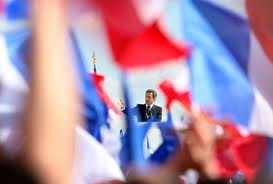
Sarkozy stages own rally to woo far-right

May 2, 2012

sarz


Paris, May 2: Nicolas Sarkozy staged a huge election rally on Tuesday to rival France's traditional May Day show of force by the left, as Marine Le Pen scornfully rejected his bid to woo her far-right supporters.

Five days before Sarkozy was to face Socialist frontrunner Francois Hollande in the second-round run-off of the French presidential election, he addressed a cheering crowd in Paris in front of the Eiffel Tower at Trocadero.

His campaign claimed 2,00,000 had turned out in bright spring sunshine to hear him attempt to don the nationalist mantle of General Charles de Gaulle and, while this figure was impossible to verify, the crowd was packed tight.

At the same moment, the French left and trade union movements, which are backing Hollande, were marching through Left Bank Paris towards another huge rally at the revolutionary venue of the Place de la Bastille.

“I say this to the unions. Put down the red flag and serve France!” the right-wing incumbent declared, as supporters waved France's tricolour banner.

Having spent the week since the first-round vote attempting to recruit far-right sympathisers from Le Pen's anti-immigrant, anti-EU camp, Sarkozy rounded on the left, accusing the unions of failing ordinary workers.

He tried to silence critics of his bid to hijack what is traditionally a labour festival by recalling that De Gaulle had often addressed France on May Day, and urged France to turn its back on Socialism.

“We have decided to gather under the Tricolour. I will never accept being lectured to by those who brandish the red flag, symbol of so many tyrannies,” he said, while four kilometres away the unions marched.


Comments

Add new comment

  • Coastaldigest.com reserves the right to delete or block any comments.
  • Coastaldigset.com is not responsible for its readers’ comments.
  • Comments that are abusive, incendiary or irrelevant are strictly prohibited.
  • Please use a genuine email ID and provide your name to avoid reject.
News Network
July 4,2020

Geneva, Jul 4: The World Health Organization has updated its account of the early stages of the COVID crisis to say it was alerted by its own office in China, and not by China itself, to the first pneumonia cases in Wuhan.

The UN health body has been accused by US President Donald Trump of failing to provide the information needed to stem the pandemic and of being complacent towards Beijing, charges it denies.

On April 9, WHO published an initial timeline of its communications, partly in response to criticism of its early response to the outbreak that has now claimed more than 521,000 lives worldwide.

In that chronology, WHO had said only that the Wuhan municipal health commission in the province of Hubei had on December 31 reported cases of pneumonia. The UN health agency did not however specify who had notified it.

WHO director Tedros Adhanom Ghebreyesus told a press conference on April 20 the first report had come from China, without specifying whether the report had been sent by Chinese authorities or another source.

But a new chronology, published this week by the Geneva-based institution, offers a more detailed version of events.

It indicates that it was the WHO office in China that on December 31 notified its regional point of contact of a case of "viral pneumonia" after having found a declaration for the media on a Wuhan health commission website on the issue.

The same day, WHO's epidemic information service picked up another news report transmitted by the international epidemiological surveillance network ProMed -- based in the United States -- about the same group of cases of pneumonia from unknown causes in Wuhan.

After which, WHO asked the Chinese authorities on two occasions, on January 1 and January 2, for information about these cases, which they provided on January 3.

WHO emergencies director Michael Ryan told a press conference on Friday that countries have 24-48 hours to officially verify an event and provide the agency with additional information about the nature or cause of an event.

Ryan added that the Chinese authorities immediately contacted WHO's as soon as the agency asked to verify the report.

US President Donald Trump has announced that his country, the main financial contributor to WHO, will cut its bridges with the institution, which he accuses of being too close to China and of having poorly managed the pandemic.

The WHO denies any complacency toward China.

Comments

Add new comment

  • Coastaldigest.com reserves the right to delete or block any comments.
  • Coastaldigset.com is not responsible for its readers’ comments.
  • Comments that are abusive, incendiary or irrelevant are strictly prohibited.
  • Please use a genuine email ID and provide your name to avoid reject.
News Network
March 3,2020

Mar 3: Just hours after the ending of a week-long “reduction” in violence that was crucial for Donald Trump’s peace deal in Afghanistan, the Taliban struck again: On Monday, they killed three people and injured about a dozen at a football match in Khost province. This resumption of violence will not surprise anyone actually invested in peace for that troubled country. The point of the U.S.-Taliban deal was never peace. It was to try and cover up an ignominious exit for the U.S., driven by an election-bound president who feels no responsibility toward that country or to the broader region.

Seen from South Asia, every point we know about in the agreement is a concession by Trump to the Taliban. Most importantly, it completes a long-term effort by the U.S. to delegitimize the elected government in Kabul — and, by extension, Afghanistan’s constitution. Afghanistan’s president is already balking at releasing 5,000 Taliban prisoners before intra-Afghan talks can begin — a provision that his government did not approve.

One particularly cringe-worthy aspect: The agreement refers to the Taliban throughout  as “the Islamic Emirate of Afghanistan that is not recognized by the United States as a state and is known as the Taliban.” This unwieldy nomenclature validates the Taliban’s claim to be a government equivalent to the one in Kabul, just not the one recognised at the moment by the U.S. When read together with the second part of the agreement, which binds the U.S. to not “intervene in [Afghanistan’s] domestic affairs,” the point is obvious: The Taliban is not interested in peace, but in ensuring that support for its rivals is forbidden, and its path to Kabul is cleared.

All that the U.S. has effectively gotten in return is the Taliban’s assurance that it will not allow the soil of Afghanistan to be used against the “U.S. and its allies.” True, the U.S. under Trump has shown a disturbing willingness to trust solemn assurances from autocrats; but its apparent belief in promises made by a murderous theocratic movement is even more ridiculous. Especially as the Taliban made much the same promise to an Assistant Secretary of State about Osama bin Laden while he was in the country plotting 9/11.

Nobody in the region is pleased with this agreement except for the Taliban and their backers in the Pakistani military. India has consistently held that the legitimate government in Kabul must be the basic anchor of any peace plan. Ordinary Afghans, unsurprisingly, long for peace — but they are, by all accounts, deeply skeptical about how this deal will get them there. The brave activists of the Afghan Women’s Network are worried that intra-Afghan talks will take place without adequate representation of the country’s women — who have, after all, the most to lose from a return to Taliban rule.

But the Pakistani military establishment is not hiding its glee. One retired general tweeted: “Big victory for Afghan Taliban as historic accord signed… Forced Americans to negotiate an accord from the position of parity. Setback for India.” Pakistan’s army, the Taliban’s biggest backer, longs to re-install a friendly Islamist regime in Kabul — and it has correctly estimated that, after being abandoned by Trump, the Afghan government will have sharply reduced bargaining power in any intra-Afghan peace talks. A deal with the Taliban that fails also to include its backers in the Pakistani military is meaningless.

India, meanwhile, will not see this deal as a positive for regional peace or its relationship with the U.S. It comes barely a week after Trump’s India visit, which made it painfully clear that shared strategic concerns are the only thing keeping the countries together. New Delhi remembers that India is not, on paper, a U.S. “ally.” In that respect, an intensification of terrorism targeting India, as happened the last time the U.S. withdrew from the region, would not even be a violation of Trump’s agreement. One possible outcome: Over time the government in New Delhi, which has resolutely sought to keep its ties with Kabul primarily political, may have to step up security cooperation. Nobody knows where that would lead.

The irresponsible concessions made by the U.S. in this agreement will likely disrupt South Asia for years to come, and endanger its own relationship with India going forward. But worst of all, this deal abandons those in Afghanistan who, under the shadow of war, tried to develop, for the first time, institutions that work for all Afghans. No amount of sanctimony about “ending America’s longest war” should obscure the danger and immorality of this sort of exit.

Comments

Add new comment

  • Coastaldigest.com reserves the right to delete or block any comments.
  • Coastaldigset.com is not responsible for its readers’ comments.
  • Comments that are abusive, incendiary or irrelevant are strictly prohibited.
  • Please use a genuine email ID and provide your name to avoid reject.
News Network
February 14,2020

London, Feb 14: Five years ago Britain’s new finance minister Rishi Sunak wasn’t even a member of parliament and now he is running the world's fifth largest economy.

The 39-year-old former Goldman Sachs banker was appointed in dramatic fashion on Thursday when incumbent Sajid Javid unexpectedly quit — in a row over advisers — during what Downing Street had cast as a routine ministerial reshuffle.

Sunak is married to the daughter of Infosys co-founder NR Narayana Murthy, and was hand-picked to take over an ultra-safe seat in northern England, previously represented by former Conservative Party leader William Hague. The Murthy family was not reachable for comment.

In July, when he was promoted chief secretary to the Treasury, Murthy had said: “Our advice to our children, including Rishi, has been to work hard, be honest, and do good for society…We wish him well.”

After Thursday’s announcement, Sunak said: “Delighted to be appointed... Lots to get on with.”

Tipped for Promotion

As Boris Johnson moves to increase control of the finance ministry, one of the youngest chancellors in history will face a prime minister who wants to increase government spending on everything from infrastructure and police to health and education.

Sunak, seen as a rising star in the ruling Conservative Party since he entered Parliament in 2015, had been tipped for promotion to a senior post in the ministerial rejig as Johnson put together his post-Brexit cabinet.

But, despite an already rapid ascent through the ranks of government, few expected the Oxford University Politics, Philosophy and Economics graduate to ascend to one of the highest offices in the land.

Sunak had been serving as Javid’s deputy in the finance ministry since Johnson promoted him upon taking office in July 2019. Prior to that he had served as a junior housing minister.

“From working in my mum’s tiny chemist shop to my experience building large businesses, I have seen first-hand how politicians should support free enterprise and innovation to ensure our future prosperity,” Sunak says on his website.

Smooth and loyal

Seen as a smooth media performer and ultra-loyal member of the Conservative Party, Sunak has been used by the government to present and defend their policies in television interviews — a sign of trust from Johnson, who has a fraught relationship with Britain’s media.

Sunak takes control at a critical juncture for Britain’s $2.7 trillion economy. He will have to steer the economy through the turbulence of leaving the European Union and the forging of new trade links that will define Britain’s new relationship with the world.

However, the power struggle that forced his predecessor Javid to quit hints at a more diminished role for what is the second most powerful position in the government — with Johnson’s office wanting to centralise control and minimise dissent.

Sunak is one of the three ministers of Indian origin in Johnson’s cabinet, the other two being Priti Patel and Alok Sharma. Patel remains the interior minister after the cabinet reshuffle while Sharma, a former minister for international development, was appointed the new minister for business. Sunak’s father was a doctor and his mother ran a chemist shop. Before entering politics he worked for Goldman Sachs and a hedge fund, then co-founded an investment firm. He also has an MBA from Stanford University.


Comments

Add new comment

  • Coastaldigest.com reserves the right to delete or block any comments.
  • Coastaldigset.com is not responsible for its readers’ comments.
  • Comments that are abusive, incendiary or irrelevant are strictly prohibited.
  • Please use a genuine email ID and provide your name to avoid reject.