



Saudi Arabia: 459 illegal foreigners arrested in crackdown

October 16, 2014

Riyadh, Oct 16: In a major operation on Sunday, the police arrested 459 expatriates of various nationalities, including 36 women, who violated the country's labor regulations.illegal foriegners
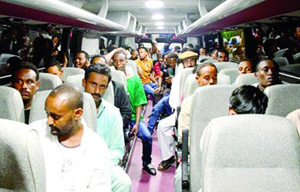
Among those arrested were two Yemeni beggars, who were carrying fake Saudi identity cards.

The police raids were conducted on the orders of Riyadh Gov. Prince Turki bin Abdullah. The authorities here also hope their actions will reduce crime in the region including theft, sorcery, cupping therapy and brewing liquor.

The operations were carried out in the district of Manfouha. The police combed construction sites, abandoned buildings, market places, malls and streets for child beggars and people staying illegally in the Kingdom. The raids were carried out over 24 hours from dawn on Sunday.

According to a police official, most of those arrested were people who overstayed their Haj or Umrah visas and were trafficked into the capital from Jeddah.

In a separate operation at the weekend in Riyadh, the police also arrested 400 violators including 59 beggars who were operating near traffic lights. Most of the beggars were foreign nationals and included children, women and men.

Begging increases in the Kingdom during the Haj season and holy month of Ramadan when it is customary to give charity. The government deports expatriates and sends citizens to rehabilitation programs run by the Ministry of Social Affairs.

Comments

Add new comment

  • Coastaldigest.com reserves the right to delete or block any comments.
  • Coastaldigset.com is not responsible for its readers’ comments.
  • Comments that are abusive, incendiary or irrelevant are strictly prohibited.
  • Please use a genuine email ID and provide your name to avoid reject.
News Network
May 3,2020

Jeddah, May 3: Saudis and expats who spread rumors on social media could be jailed for up to five years and fined SR3 million ($800,000) under measures to counter false information regarding the coronavirus pandemic.

The move follows warnings by Saudi Arabia’s Ministry of Health, Ministry of Interior, General Presidency of the Two Holy Mosques and other government entities that people should rely on trusted news sources and not third parties for information on the Kingdom’s handling of the COVID-19 outbreak.

The Saudi Public Prosecutor warned that legal action will be taken against individuals who spread misinformation and rumors.

On Saturday, media spokesman for the Riyadh region police, Col. Shakir Al-Tuwaijri, highlighted a video circulating on social media in which a person spreads rumors about steps taken to curb the spread of the coronavirus.

Other false claims include a planned change in curfew hours, warnings of food shortages, and a suggestion that health authorities are deliberately concealing the number of cases in the Kingdom.

In a recent case, a Riyadh resident claimed to know when worshippers will be allowed to return to the Grand Mosque.

All suspects have been arrested and face legal action, police said.

Dimah Al-Sharif, a Saudi legal counsel and member of the International Association of Lawyers, urged people to be responsible regarding content they access on social media.

“Receivers should not save such content or share it with others, and should delete it if possible since they, too, will be liable,” she said.

“Under Saudi laws to counter cyber-crime, we are not allowed to produce, prepare, send or save any unauthorized content or rumors.”

Individuals who breach regulations can be jailed for up to five years and face fines of SR3 million, as well as confiscation of the device(s) used in the crime, she said.

In addition, the judicial ruling will be published in newspapers at the offender’s expense.

The Kingdom’s Public Prosecution Office took to social media to warn users about the consequences of spreading rumors and misinformation.

@bip_ksa tweeted: “Receiving information from its official sources is a moral obligation and commitment, and legal responsibility. Do not fall victim to malicious rumors and news from anonymous sources that violate the procedures and effort, and cause terror regarding the Coronavirus, in order to avoid strict criminal accountability in this regard.”

Comments

Add new comment

  • Coastaldigest.com reserves the right to delete or block any comments.
  • Coastaldigset.com is not responsible for its readers’ comments.
  • Comments that are abusive, incendiary or irrelevant are strictly prohibited.
  • Please use a genuine email ID and provide your name to avoid reject.
News Network
May 7,2020

Dubai, May 7: The holy month of Ramadan is expected to be a 30-day month this year, said Ibrahim Al Jarwan, member of the Arab Union for Astronomy and Space Sciences.

According to Arabic daily Emarat Al Youm, he said that Sunday, May 24, will mark the end of the holy month of Ramadan and the beginning of Shawwal.

Additionally, he said that the crescent of Shawwal will occur on Friday, May 22, at 9.39pm, after sunset, and will be visible on Sunday, May 24, the beginning of Shawal, which makes Ramadan a 30-day month this year.

He added that the next Ramadan is expected to start on April 13, 2021, and the one after that on April 2, 2022.

Comments

Add new comment

  • Coastaldigest.com reserves the right to delete or block any comments.
  • Coastaldigset.com is not responsible for its readers’ comments.
  • Comments that are abusive, incendiary or irrelevant are strictly prohibited.
  • Please use a genuine email ID and provide your name to avoid reject.
News Network
May 21,2020

Dubai, May 21: Around 10,000 Iranian health workers have been infected with the new coronavirus, the semi-official ILNA news agency quoted a deputy health minister as saying on Thursday.

Health services are stretched thin in Iran, the Middle East country hardest hit by the respiratory pandemic, with 7,249 deaths and a total of 129,341 infections. The Health Ministry said in April that over 100 health workers had died of COVID-19.

No more details on infections among health workers were immediately available.

Earlier on Thursday, Health Minister Saeed Namaki appealed to Iranians to avoid travelling during the Eid al-Fitr religious holiday later this month to avoid the risk of a new surge of coronavirus infections, state TV reported.

Iranians often travel to different cities around the country to mark the end of the Muslim holy fasting month of Ramadan, something Namaki said could lead to a disregard of social distancing rules and a fresh outbreak of COVID-19.

"I am urging you not to travel during the Eid. Definitely, such trips mean new cases of infection...People should not travel to and from those high-risk red areas," Namaki was quoted by state television as saying.

"Some 90% of the population in many areas has not yet contracted the disease. In the case of a new outbreak, it will be very difficult for me and my colleagues to control it."

A report by parliament's research centre suggested that the actual tally of infections and deaths in Iran might be almost twice that announced by the health ministry.

However, worried that measures to limit public activities could wreck an economy which has already been battered by U.S. sanctions, the government has been easing most restrictions on normal life in late April.

Infected cases have been on a rising trajectory for the past two weeks. However, President Hassan Rouhani said on Wednesday that Iran was close to curbing the outbreak.

Comments

Add new comment

  • Coastaldigest.com reserves the right to delete or block any comments.
  • Coastaldigset.com is not responsible for its readers’ comments.
  • Comments that are abusive, incendiary or irrelevant are strictly prohibited.
  • Please use a genuine email ID and provide your name to avoid reject.