


Saudi Arabia has zero tolerance for all forms of terrorism

September 21, 2016

Jeddah, Sep 21: The Kingdom takes a firm stance against all forms of terrorism whether at the local or international level. It takes significant concrete steps in the fight against the dangerous phenomenon and its devastating consequences. In addition to its leadership at conferences and meetings, Saudi Arabia was the first country to sign a treaty against international terrorism at the OIC in May of 2000.
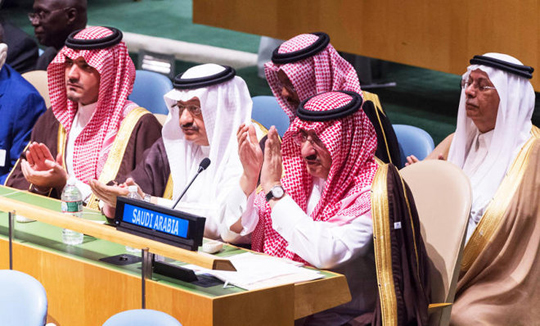
Saudi

The clear efforts carried out by the Kingdom have earned it accolades, most recently two days ago at the 71st Session of the United Nations General Assembly.

UN Secretary-General Ban Ki-moon expressed his appreciation for the Kingdom’s efforts and contributions to the fight against terrorism in a statement by deputy spokesman Farhan Haq.

“I emphasize the appreciation of the secretary-general for the contributions made by the Kingdom to the fight against terrorism, including its funding for the Counterterrorism Center,” he said. The Kingdom has provided more than $110 million in funding for the center established in 2011.

On the local level, the Kingdom has fought terrorism by increasing and improving preventative security measures as well as through the actions of security personnel in security confrontations with terrorists.

Saudi security personnel have achieved remarkable results in dealing with such criminals without endangering the lives of citizens living in neighborhoods where the terrorists hide. A remarkable 95 percent of terrorist operations have been thwarted, thanks to a comprehensive security strategy put in place by security authorities. Authorities have also been able to weaken the means of funding and support for the terrorists who also present a danger similar to those carrying out operations on the ground.

The Kingdom has made significant efforts in fighting money laundering by amending its anti-money laundering regulations issued in Royal Order No. M/31 on 11/5/1433 to include many additional and applicable local and international requirements. The Kingdom also hosted a number of conferences, seminars, and training which dealt with money laundering, such as the 15th meeting of the Financial Action Task Force for the Middle East and North Africa in April 2012 in Jeddah.

Through other measures, the Kingdom has improved the means to organize and monitor the entry and exit of funds in order to ensure that funds are documented and bankers keep records of buyers and sellers. Inspections and supervision of money exchange companies are a regular occurrence.

Through its Standing Committee on Anti-Money Laundering, chaired by the Saudi Arabian Monetary Ageny (SAMA) governor, the Kingdom has also formed four working teams concerned with risk, applicants, mutual assessments, and statistics, in order to be aware of developments related to these issues and take practical steps to apply recommendations.

On the international level, the Kingdom has worked to stop the flow of resources of to terrorism and has fought Daesh as part of an international coalition to combat terrorist groups. The Kingdom has monitored for years the actions of such groups in surrounding countries, and has taken steps to close down organizations that fund these organizations under the cover of charity. Additional laws have been passed criminalyzing the funding of terrorism. The Islamic Coalition of 40 states committed to the fight against terrorism recently selected Riyadh to host its meeting to address bilateral efforts in this regard.

The Kingdom also played a prominent role in recent years in helping uncover terror plots and the infiltration of terrorist elements into European cities. In October 2015, British Prime Minister David Cameron revealed his country had received information from the Kingdom about a suicide bombing in London; in 2010, information from the Kingdom uncovered a terrorist attack using bombs on a ship from Yemen to the United States. At the time, President Obama thanked the Kingdom for its role in preventing the planned operation. Security officials from the Kingdom also met with their German counterparts to exchange information and about a terrorist attack that occurred in Germany when the perpetrator had used a Saudi telephone line to contact a Daesh member.

Comments

Add new comment

  • Coastaldigest.com reserves the right to delete or block any comments.
  • Coastaldigset.com is not responsible for its readers’ comments.
  • Comments that are abusive, incendiary or irrelevant are strictly prohibited.
  • Please use a genuine email ID and provide your name to avoid reject.
KT
April 13,2020

Dubai, Apr 13: The UAE Ministry of Health and Prevention (MoHAP) on Monday announced 172 new recoveries in the country, taking the total recoveries to 852 cases.

"With today's 172 cases, the total number of fully recovered Covid-19 patients has become 852, while three residents of different nationalities were declared dead, taking the total number of deaths to 25," Dr Farida Al Hosani, spokeswoman for the ministry, said.

"We have also carried out up to 23,380 new tests on Monday all over the country."

Also read: UAE residency, visit visas valid until end-2020

Dr Hosani said His Highness Sheikh Mohamed bin Zayed Al Nahyan, Crown Prince of Abu Dhabi and Deputy Supreme Commander of the UAE Armed Forces, has launched the national home-based testing programme for determined people, be they nationals or residents.

"The program, targeting this important segment of the society who have difficulty doing tests outdoors, is part of the national drive-through testing national program."

Addressing some baseless rumours that are viral on social media, Dr Al Hosani confirmed that no one can fix a date for the peak of infected cases.

"So many studies have affirmed that physical distancing is so critical in reducing not only the number of Cobid-19 new cases but also the infection curve."

Dr Al Hosani advised the public to wear gloves whenever they go out. "However, do not touch your personal stuff when wearing gloves, particularly when using your phone, and safely dispose of them."

It is still so critical to clean your hands with water and soap on a regular basis, she underlined. "Cleaning and washing our hands are much better and safer than wearing gloves."

Wearing one-time disposable surgical gloves is highly advisable, she said. "If not available, hand-made cloth masks can be used but need to be cleaned regularly with water and soap."

Masks should be worn properly covering the nose, mouth and the chin, she pointed out. "Do not touch the internal or external parts of the face masks, while the blue colour side must be always outward."

Priority in drive-through tests are given for those with respiratory issues, senior people, and pregnant women, she said in answer to a question raised by media people.

"If you are developing no Covid-19 infection symptoms and just wish to make sure you are sound, you need to book an appointment, be aware that it will cost you Dh370."

"If developing minor symptoms, the public is urged to stay home and call any of these toll-free numbers for help: (800011111), (8001717), (800342)."

Comments

Add new comment

  • Coastaldigest.com reserves the right to delete or block any comments.
  • Coastaldigset.com is not responsible for its readers’ comments.
  • Comments that are abusive, incendiary or irrelevant are strictly prohibited.
  • Please use a genuine email ID and provide your name to avoid reject.
News Network
April 20,2020

Sharjah, Apr 20: Air Arabia announced on Monday it will operate new repatriation flights from four cities in India to Sharjah carrying UAE nationals back home.

The special flights will operate from Mumbai and Delhi to Sharjah International Airport on April 20 while special flights will operate from Kochi and Hyderabad to Sharjah International Airport on April 22.

Air Arabia remains committed to bring stranded citizens back home as well as supporting requests to operate repatriation flights and is working closely with UAE authorities in this regard, the airline said.

Air Arabia announced earlier that it’s operating a mix of repatriation flights as well as cargo flights during the month of April to multiple destinations.

Further information about the repatriation and cargo flights is available on the website or can be obtained by contacting the Air Arabia call centre on 06 5580000 or respective travel agent.

Comments

Add new comment

  • Coastaldigest.com reserves the right to delete or block any comments.
  • Coastaldigset.com is not responsible for its readers’ comments.
  • Comments that are abusive, incendiary or irrelevant are strictly prohibited.
  • Please use a genuine email ID and provide your name to avoid reject.
Agencies
August 2,2020

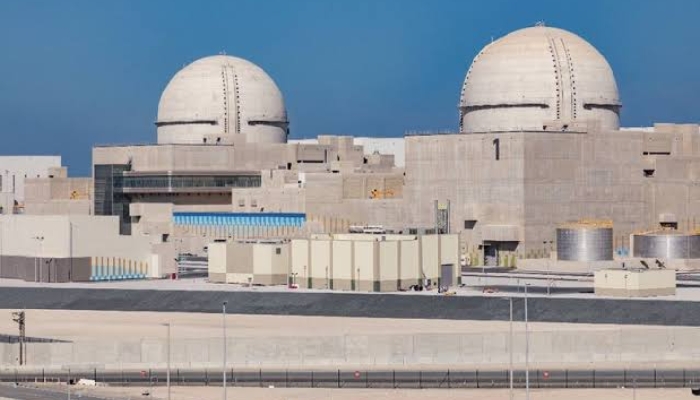
Dubai, Aug 2: The United Arab Emirates (UAE) announced on Saturday that it has started operations in the first of four reactors at the Barakah nuclear power station - the first nuclear power plant in the Arab world.

Emirates Nuclear Energy Corporation (ENEC), which is building and operating the plant with Korea Electric Power Corporation (KEPCO) said in a press release that its subsidiary Nawah Energy Company "has successfully started up Unit 1 of the Barakah Nuclear Energy Plant, located in the Al Dhafrah Region of Abu Dhabi".

That signals that Unit 1, which had fuel rods loaded in March, has achieved "criticality" - a sustained fission chain reaction.

"The start-up of Unit 1 marks the first time that the reactor safely produces heat, which is used to create steam, turning a turbine to generate electricity," said ENEC.

Barakah, which was originally scheduled to open in 2017, has been dogged by delays and is billions of dollars over budget. It has also raised myriad concerns among nuclear energy veterans who are concerned about the potential risks Barakah could visit upon the Arabian Peninsula, from an environmental catastrophe to a nuclear arms race.

Paul Dorfman, an honorary senior research fellow at the Energy Institute, University College London and founder and chair of the Nuclear Consulting Group, has criticised the Barakah reactors' "cheap and cheerful" design that he says cuts corners on safety.

Dorfman authored a report (PDF) last year detailing key safety features Barakah's reactors lack, such as a "core catcher" to literally stop the core of a reactor from breaching the containment building in the event of a meltdown. The reactors are also missing so-called Generation III Defence-In-Depth reinforcements to the containment building to shield against a radiological release resulting from a missile or fighter jet attack.

Both of these engineering features are standard on new reactors built in Europe, says Dorfman.

There have been at least 13 aerial attacks on nuclear facilities in the Middle East - more than any other region on earth.

The vulnerability of critical infrastructure in the Arabian Peninsula was further laid bare last year after Saudi Arabia's oil facilities at Abqaiq and Khurais were attacked by 18 drones and seven cruise missiles - an assault that temporarily knocked out more than half of the kingdom's oil production.

On Saturday, Dorfman reiterated his concern that there is no regional protocol in place to determine liability should an accident or incident at Barakah result in radioactive contamination spreading from the UAE to its neighbours. 

"Given Barakah has started up, because of all the well-rehearsed nuclear safety and security problems, it may be critically important that the Gulf states collectively evolve a Nuclear Accident Liability Convention, so that if anything does go wrong, victim states may have some sort of redress," Dorfman told Al Jazeera. 

The UAE has substantial oil and gas reserves, but it has made huge investments in developing alternative energy sources, including nuclear and solar.

Experts though have questioned why the UAE - which is bathed in sunlight and wind - has pushed ahead with nuclear energy - a far more expensive and riskier option than renewable energy sources.

When the UAE first announced Barakah in 2009, nuclear power was cheaper than solar and wind. But by 2012 - when the Emirates started breaking ground to build the reactors - solar and wind costs had plummeted dramatically.

Between 2009 and 2019, utility-scale average solar photovoltaic costs fell 89 percent and wind fell 43 percent, while nuclear jumped 26 percent, according to an analysis by the financial advisory and asset manager Lazard.

There are also concerns about the potential for Barakah to foment nuclear proliferation in the Middle East - a region rife with geopolitical fault lines and well-documented history of nuclear secrecy.

The UAE has sought to distance itself from the region's bad behaviour by agreeing not to enrich its own uranium or reprocess spent fuel. It has also signed up to the United Nation's nuclear watchdog's Additional Protocol, significantly enhancing inspection capabilities, and secured a 123 Agreement with the United States that allows bilateral civilian nuclear cooperation.

Comments

Add new comment

  • Coastaldigest.com reserves the right to delete or block any comments.
  • Coastaldigset.com is not responsible for its readers’ comments.
  • Comments that are abusive, incendiary or irrelevant are strictly prohibited.
  • Please use a genuine email ID and provide your name to avoid reject.