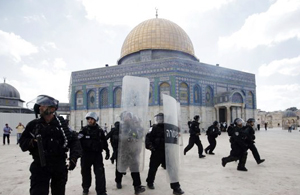
Saudi Arabia warns Israel: Hands off Al-Aqsa

September 18, 2015

Jeddah, Sep 18: Custodian of the Two Holy Mosques King Salman has condemned Israel for its blatant attacks on worshippers at Al-Aqsa Mosque.al Aqsa

The king has spoken on phone with US President Barack Obama, Russian President Vladimir Putin, British Prime Minister David Cameron, French President Francois Hollande and UN Secretary-General Ban Ki-moon to express his concerns over Israel’s actions.

He called on the UN Security Council to take urgent measures to stop the violations at Al-Aqsa Mosque, protect the Palestine people and holy sites, and ensure Israel grants Palestinians sovereignty, according to the SPA.

He said the attacks violate the sanctity of religions, and contribute to extremism and violence in the world. The Saudi government would hold the Israelis fully responsible for the aggression, the report stated.

Saudi officials warned that Israel’s actions violate the sanctity of the third holiest site in Islam, and are incompatible with the principles of international law.

One official warned that the Zionist regime’s actions would escalate the conflict in the region. He also slammed the Israelis for trying to divide Al-Aqsa.

King Salman had informed Palestinian President Mahmoud Abbas that he had been in contact with world leaders regarding the mosque and had asked Foreign Minister Adel Al-Jubeir to take measures to protect Al-Aqsa, according to reports.

The Israeli police entered the compound to disperse protesters this week, in a move that sparked condemnation across the Arab world and concern that the tensions could spiral out of control, according to reports.

Comments

Add new comment

  • Coastaldigest.com reserves the right to delete or block any comments.
  • Coastaldigset.com is not responsible for its readers’ comments.
  • Comments that are abusive, incendiary or irrelevant are strictly prohibited.
  • Please use a genuine email ID and provide your name to avoid reject.
News Network
May 1,2020

Dubai, May 1: Saudi Arabia has reported 1,344 new coronavirus cases in the last 24 hours, bringing the total number of infections in the country to 24,097, the Ministry of Health announced on Friday.

The ministry also announced 7 more deaths and 392 new recoveries, raising the total number of fatalities and recoveries to 169 and 3,55 respectively.

Out of the 1,344 new cases reported today, 282 were confirmed in Riyadh, 237 in Madinah, 207 in Makkah, 171 in Jubail and 124 in Jeddah in addition to 114 infections in Dammam.

Authorities continue to urge people to stay at home unless necessary despite having relaxed some restrictions and curfews at the start of Ramadan.

Citizens and residents are allowed to go out for necessary needs between 9 a.m. and 5 p.m. but must adhere to precautionary measures such as wearing a face mask and maintaining social distancing practices.

Comments

Add new comment

  • Coastaldigest.com reserves the right to delete or block any comments.
  • Coastaldigset.com is not responsible for its readers’ comments.
  • Comments that are abusive, incendiary or irrelevant are strictly prohibited.
  • Please use a genuine email ID and provide your name to avoid reject.
News Network
March 18,2020

Riyadh, Mar 18: Private-sector businesses in Saudi Arabia on Wednesday were ordered to introduce enforced remote working for all employees for 15 days in an attempt to prevent the spread of the coronavirus.

Businesses that require staff to be physically present to ensure they continue to operate — including those in vital or sensitive sectors such as electricity, water and communications — must reduce the number of workers in their offices to the bare minimum. This can be no more than 40 percent of the total number of staff.

In such cases precautionary measures set by the Ministry of Health must be followed. At offices, and staff accommodation, with more than 50 workers, an area at the entrance must be provided where temperatures can be taken and symptoms checked.

Employers must also set up a mechanism for workers to report any symptoms, such as high temperature, coughing or shortness of breath, or contact they have had with infected individuals or people who recently returned from other countries without following proper Ministry of Health quarantine procedures.

Inside offices, a safe amount of space between employees must be maintained at all times. In addition, all health clubs and nurseries provided by employers must close.

Pregnant women and new mothers, people suffering from respiratory diseases, those with immune-system problems or chronic conditions, cancer patients and employees above the age of 55 are to be given 14 days compulsory paid leave, which will not be deducted from their annual entitlement.

Businesses that are excluded from the new measures include pharmacies and supermarkets, and their suppliers. Private-sector organizations that provide services to government agencies must contact them before suspending workplace attendance. Any other business that considers it impossible to operate with only 40 percent of staff in the workplace must submit an exemption request to the authority that supervises it.

Comments

Add new comment

  • Coastaldigest.com reserves the right to delete or block any comments.
  • Coastaldigset.com is not responsible for its readers’ comments.
  • Comments that are abusive, incendiary or irrelevant are strictly prohibited.
  • Please use a genuine email ID and provide your name to avoid reject.
News Network
July 1,2020

Riyadh, Jul 1: Saudis braced Wednesday for a tripling in value added tax, another unpopular austerity measure after the twin shocks of coronavirus and an oil price slump triggered the kingdom's worst economic decline in decades.

Retailers in the country reported a sharp uptick in sales this week of everything from gold and electronics to cars and building materials, as shoppers sought to stock up before VAT is raised to 15 percent.

The hike could stir public resentment as it weighs on household incomes, pushing up inflation and depressing consumer spending as the kingdom emerges from a three-month coronavirus lockdown.

"Cuts, cuts, cuts everywhere," a Saudi teacher in Riyadh told AFP, bemoaning vanishing subsidies as salaries remain stagnant.

"Air conditioner, television, electronic items," he said, rattling off a list of items he bought last week ahead of the VAT hike.

"I can't afford these things from Wednesday."

With its vast oil wealth funding the Arab world's biggest economy, the kingdom had for decades been able to fund massive spending with no taxes at all.

It only introduced VAT in 2018, as part of a push to reduce its dependence on crude revenues.

Then, seeking to shore up state finances battered by sliding oil prices and the coronavirus crisis, it announced in May that it would triple VAT and halt a cost-of-living monthly allowance to citizens.

The austerity push underscores how Saudi Arabia's once-lavish spending is becoming a thing of the past, with the erosion of the welfare system leaving a mostly young population to cope with reduced incomes and a lifestyle downgrade.

That could pile strain on a decades-old social contract whereby citizens were given generous subsidies and handouts in exchange for loyalty to the absolute monarchy.

The rising cost of living may prompt many to ask why state funds are being lavished on multi-billion-dollar projects and overseas assets, including the proposed purchase of English football club Newcastle United.

Shopping malls in the kingdom have drawn large crowds in recent days as retailers offered "pre-VAT sales" and discounts before the hike kicks in.

A gold shop in Riyadh told AFP it saw a 70 percent jump in sales in recent weeks, while a car dealership saw them tick up by 15 percent.

Once the new rate is in place, businesses are predicting depressed sales of everything from cars to cosmetics and home appliances.

Capital Economics forecast inflation will jump up to six percent year-on-year in July, from 1.1 percent in May, as a result.

"The government ended the country's lockdown (in June) and there are signs that economic activity has started to recover," Capital Economics said in a report.

"Nonetheless, we expect the recovery to be slow-going as fiscal austerity measures bite."

The kingdom also risks losing its edge against other Gulf states, including its principal ally the United Arab Emirates, which introduced VAT at the same time but has so far refrained from raising it beyond five percent.

"Saudi Arabia is taking massive risks with contractionary fiscal policies," said Tarek Fadlallah, chief executive officer of the Middle East unit of Nomura Asset Management.

But the kingdom has few choices as oil revenue declines.

Its finances have taken another blow as authorities massively scaled back this year's hajj pilgrimage, from 2.5 million pilgrims last year to around a thousand already inside the country, and suspended the lesser umrah because of coronavirus.

Together the rites rake in some $12 billion annually.

The International Monetary Fund warned the kingdom's GDP will shrink by 6.8 percent this year -- its worst performance since the 1980s oil glut.

The austerity drive would boost state coffers by 100 billion riyals ($26.6 billion), according to state media.

But the measures are unlikely to plug the kingdom's huge budget deficit.

The Saudi Jadwa Investment group forecasts the shortfall will rise to a record $112 billion this year.


Comments

Add new comment

  • Coastaldigest.com reserves the right to delete or block any comments.
  • Coastaldigset.com is not responsible for its readers’ comments.
  • Comments that are abusive, incendiary or irrelevant are strictly prohibited.
  • Please use a genuine email ID and provide your name to avoid reject.