


Saudi Arabia’s ‘look-east’ policy pays off

March 17, 2017

Beijing, Mar 17: Chinese foreign affairs analysts say that a series of agreements signed by Saudi Arabia and China is a “win-win” situation for both countries.
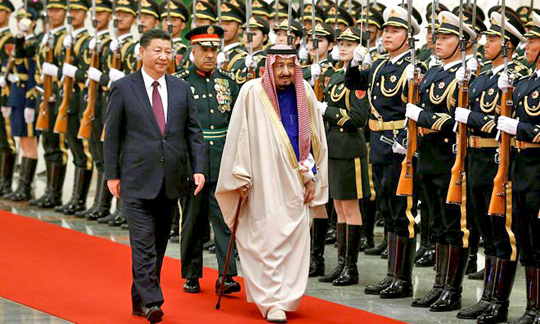
Saudi3

Saudi Arabia’s King Salman oversaw the signing of deals worth potentially $65 billion on the first day of a visit to Beijing on Thursday, as the world’s largest oil exporter looks to cement ties with China.

Dr. Zeng Ji, chair of the Department of International Affairs at Sun Yat-sen University, China, told Arab News the deals consist of 35 projects that include covering productive capacity, trade, space industry, new energy and education.

“So far, I have noticed that little is mentioned about oil deals,” Zeng said. “It suggests that Sino-Saudi economic cooperation becomes more pluralistic nowadays, compared with China’s traditional reliance on Saudi oil. For China, the Middle East, including Saudi Arabia ... is not only a provider of energy. The paramount need for China is to export its over-abundant productive capacity.”

Zeng added the Middle East would accelerate China’s ambitious initiative aimed at tighter economic links with countries extending to Europe and Africa through the Middle East.

He also said the “deals suggest a win-win situation in the eyes of both countries.”

Dr. Degang Sun of the Institute of Shanghai International Studies University said China and Saudi Arabia are a perfect match in potential trade and investments.

“The two sides’ economies are supplementary to each other,” Degang told Arab News.

“In recent years, China put forward the ‘One Belt and One Road Initiative’ and the Saudi government put forward Vision 2030 in 2016. The two sides’ development strategies are compatible with each other. China perceives Saudi Arabia as the pivotal state in implementing its ‘One Belt and One Road,’ and China’s investment in and trade with Saudi Arabia will enhance the diversification and industrialization of the Saudi economy in the next decade.”

He said Saudi Arabia “looking east” and China “looking west” will enhance their strategic partnership.

Few other details were given about the 14 memoranda of understanding (MoU) that were signed on Thursday.

Besides the MoUs agreed between the two governments, Saudi and Chinese companies signed 21 deals, ranging from exploring investments in oil and petrochemical plants to e-commerce and co-operating in renewable energy markets.

Comments

Add new comment

  • Coastaldigest.com reserves the right to delete or block any comments.
  • Coastaldigset.com is not responsible for its readers’ comments.
  • Comments that are abusive, incendiary or irrelevant are strictly prohibited.
  • Please use a genuine email ID and provide your name to avoid reject.
News Network
May 7,2020

Dubai, May 7: As India begins the world’s largest evacuation mission by repatriating its overseas citizens stranded due to COVID-19, as many as 354 of them from the UAE will fly into their home country in the first two flights to Kerala today.

An Air India Express flight, which is scheduled to take off from Abu Dhabi to Kochi at 4.15 pm is the first flight, which will be followed by a Dubai-Kozhikode flight of the same airline at 5.10pm. The Indian missions in the UAE finalised the list of passengers, who were chosen based on the compelling reasons they submitted while registering their names.

Selection criteria

These include pregnant women and their accompanying family members in some instances, people with medical emergencies, workers and housemaids in distress, families with cancelled visas, bereaved family members who couldn’t attend funerals back home, a few students and stranded visitors and tourists including two brothers who got stranded in Dubai International Airport for 50 days, the missions said.

Short-listing the first passengers from among a database of more than 200,000 applicants, who include around 6,500 pregnant women, has been a mammoth task which posed several challenges for the missions, Neeraj Agrawal, Consul Press, Information and Culture at the Indian Consulate in Dubai told Gulf News.

He said the consulate set up an operations room in a tie-up with community volunteers from Kerala Muslim Cultural Centre, Indian Association Ajman, AKCAF Task Force, the BAPS Mandir, Indian People’s Forum, and Tamil Ladies’ Sangam.

 “We are trying to accommodate as many deserving people as possible. We expect the understanding of the people. It has been very difficult to sort out everyone’s urgency.”

“We cannot do a lottery system in this and we had to make sub- categories to ensure there is a mix of people with different types of urgencies.”

“Though we want to give priority to pregnant women, it is practically not possible and not good for the health and safety of the applicants to allot a lot of them on the same flight.”

He said 11 pregnant women have been issued tickets on the Dubai-Kozhikode flight.

“That is the threshold we can allow on a flight.”

Volunteer support

The consul appreciated the support of the volunteers in finalising the flight manifest.

“But our response ratio was very less. Many people whose names came up on top of the list were not willing to go on the first flights.”

Due to various constraints like this and sometimes the details of accompanying persons not readily being available, he said the mission was not able to quickly reach out to who might be really in need.

“However, we have given due consideration to people who got in touch with us with their emergency needs. At the time of issuing tickets, we had about 20 such cases.”

He said the Consul General of India in Dubai Vipul led the entire operation and Pankaj Bodkhe, consul, education, was in charge of the Dubai flight.

A big challenge

“It has been a big challenge. Our only concern is that despite our best efforts, sometimes people with more compelling reasons might have got left out on the first flights because of the volume of people who have reached out to us.”

Since there is a chance that some passengers with tickets might not be allowed to fly if they fail the medical screening including blood tests to check antibodies for COVID-19, he said some applicants in the waiting list have been asked to be on standby at the airport.

People with emergencies wishing to fly to other destinations also could not be included, he pointed out.

“We had to ask them to wait. We are unable to send them to other destinations. We can see their desperation. We feel sorry and desperate.”

He said the government is trying to add more flights to un-chartered destinations and a new flight from Dubai to Kannur has been added on May 12.

Passengers of today’s flights have been urged to reach the airport four to five hours prior to departure to facilitate the medical screening.

Comments

Add new comment

  • Coastaldigest.com reserves the right to delete or block any comments.
  • Coastaldigset.com is not responsible for its readers’ comments.
  • Comments that are abusive, incendiary or irrelevant are strictly prohibited.
  • Please use a genuine email ID and provide your name to avoid reject.
News Network
March 11,2020

Mar 11: Energy giant Saudi Aramco on Wednesday said it plans to raise its crude production capacity by one million barrels per day to 13 million bpd as a price war with Russia intensifies.

"Saudi Aramco announces that it received a directive from the ministry of energy to increase its maximum sustainable capacity from 12 million bpd to 13 million bpd," the company said in a statement to the Saudi Stock Exchange.

The decision comes a day after the world's top exporter, Saudi Arabia, decided to hike production by at least 2.5 million bpd to a record 12.3 million from April.

The Saudi moves come after the collapse of an oil production reduction agreement between OPEC and non-OPEC producers, including Russia.

The deal proposed by Saudi Arabia called for additional output cuts of 1.5 million bpd to cope with the severe economic impact of the coronavirus which has sharply reduced world demand for crude.

Boosting production capacity normally takes a long time and requires billions of dollars of investment.

Several years ago, the kingdom had shelved plans to boost its crude production capacity beyond 12 million bpd after demand for OPEC oil declined in the face of stiff competition from North American shale oil and other sources.

Russia on Tuesday said it was open to renewing cooperation with the OPEC cartel even as its kingpin Saudi Arabia escalated a price war with Moscow by announcing it would flood markets with new supplies.

The oil price war broke out after OPEC and a group of non-member countries dominated by Russia -- the world's second largest producer -- on Friday failed to agree on production cuts.

Saudi Arabia responded by announcing unilateral price cuts. This prompted the oil price to plummet and fuelled huge falls on stock markets around the world on Monday.

Comments

Add new comment

  • Coastaldigest.com reserves the right to delete or block any comments.
  • Coastaldigset.com is not responsible for its readers’ comments.
  • Comments that are abusive, incendiary or irrelevant are strictly prohibited.
  • Please use a genuine email ID and provide your name to avoid reject.
News Network
April 20,2020

Apr 20: Eight Indians, including two engineers, have died due to the novel coronavirus in Saudi Arabia, according to a media report on Sunday.

Mohammed Aslam Khan, an electrical engineer in Makkah, and Azmatullah Khan, an engineer at the Makkah Haram power station, have died due to the COVID-19, Saudi Gazette reported.

Aslam Khan, aged 51, who hailed from Meerut in Uttar Pradesh, was admitted to King Faisal Hospital, Makkah on April 3, following worsening of his condition after being infected with fever and throat pain.

He had been on ventilator for more than two weeks and breathed his last on Saturday night, the paper said.

Khan is survived by wife and a daughter and a son. His wife and children are under self-imposed home quarantine.

Azmatullah Khan, from Telangana, died of coronavirus on Friday.

Mujeeb Pukkottoor, a prominent Indian social worker and general secretary of Makkah chapter of Kerala Muslim Cultural Center, told the paper that the body of Khan was buried in Makkah on Sunday.

Khan, aged 65, had been working with Saudi Binladin Group for the last 32 years.

Fakre Alam, an employee at the Haram Project of Saudi Binladin Group in Makkah, died on Sunday due to infection, the paper said.

Barkt Ali Abdullatif Fakir, an electrical technician working in Medina, also died of coronavirus, it said.

According to the Saudi Ministry of Health’s daily report published on April 14, the number of coronavirus infected cases among workers of Saudi Binladin Group in various parts of the Kingdom stood at 117, and these included 70 cases in Makkah.

The first two Indian fatalities were reported from Medina and Riyadh earlier this month with the death of Shebnaz Pala Kandiyil (29) and Safvan Nadamal (41), both from Kerala.

Mohammed Sadiq, from Hyderabad, working in Jeddah and Suleman Sayyid Junaid (Maharashtra) are other Indians who died due to COVID-19 in the Gulf kingdom, the paper said.

Shebnaz from Panoor in Kannoor district died on April 3 and his body was buried in Medina on April 7. He came back to the Kingdom March 3 after his marriage in January.

Safvan, a taxi driver from Chemmad in Malappuram district, died on April 2 and was buried in Riyadh on April 8.

Comments

Add new comment

  • Coastaldigest.com reserves the right to delete or block any comments.
  • Coastaldigset.com is not responsible for its readers’ comments.
  • Comments that are abusive, incendiary or irrelevant are strictly prohibited.
  • Please use a genuine email ID and provide your name to avoid reject.