Saudi Arabia's withdrawal stuns UN Security Council

October 18, 2013
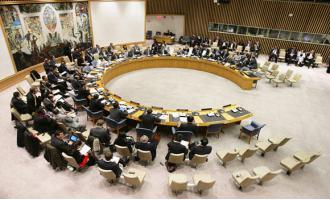
United Nations (United States), Oct 18: Saudi Arabia's angry rejection of a Security Council seat one day after winning it is a United Nations first that stunned members of the body on Friday.

UN

But diplomats said there had been no official notice from Riyadh of its refusal to take up the seat on January 1. It was possible the conservative kingdom could change its mind, they added.

"This is totally unexpected. We all had to look into the council history for a precedent and there is not one," said a Security Council diplomat, speaking on condition of anonymity.

"Campaigning and securing a seat normally takes years of preparation which makes the announcement even more surprising."

Saudi Arabia was one of five nations elected by the UN general assembly to start a two-year term on the 15-member Security Council. The others included Chad, Chile, Lithuania and Nigeria. All had stood unopposed.

"There was nothing controversial about the election. But the government has made it clear in recent weeks that it is concerned about Syria and the Palestine issue," said a second UN diplomat.

"They will have to write to set out their official position and then the UN will have to decide the next step," the envoy added.

"There could be a new election, but it is possible that Saudi Arabia can be persuaded to change its stance."

The United Nations secretariat and UN general assembly president had no immediate comment.

Saudi Arabia won a seat for the first time in Thursday's election.

"Work mechanisms and double-standards on the security council prevent it from carrying out its duties and assuming its responsibilities in keeping world peace," the Saudi foreign ministry said in a statement explaining its move.

"Therefore Saudi Arabia... has no other option but to turn down Security Council membership until it is reformed and given the means to accomplish its duties and assume its responsiblities in preserving the world's peace and security," it added.

Comments

Add new comment

  • Coastaldigest.com reserves the right to delete or block any comments.
  • Coastaldigset.com is not responsible for its readers’ comments.
  • Comments that are abusive, incendiary or irrelevant are strictly prohibited.
  • Please use a genuine email ID and provide your name to avoid reject.
Agencies
May 7,2020

Dubai, May 7: Indians in the UAE have voiced scepticism about a "massive" operation announced by New Delhi to bring home some of the hundreds of thousands of nationals stranded by coronavirus restrictions.

"It is just propaganda," said Ishan, an Indian expatriate in Dubai, one of seven emirates in the UAE and long a magnet for foreign workers.

He was reacting to his government's announcement this week that it would deploy passenger jets and naval ships to bring home citizens stuck in a host of countries.

India's consulate in Dubai said it received about 200,000 requests from nationals seeking repatriation -- mostly workers who have lost their jobs in the pandemic.

One vessel was heading to the UAE, India's government said, while two flights were scheduled to depart the UAE for India on Thursday.

But the plans drew scorn from Ishan, who was a manager at a luxury services company before he was made redundant last month.

"It's like throwing a dog a bone," the 35-year-old complained on Wednesday, dismissing the Indian government's efforts as a drop in the ocean.

"Let's say they repatriate 400 people on the first day, and about 5,000 people in 10 days, what difference has it made?"

India banned all incoming commercial flights in late March as it imposed one of the world's strictest lockdowns to tackle the spread of coronavirus.

The UAE is home to a 3.3-million-strong Indian community, who make up around 30 per cent of the Gulf state's population.

To the anger of some Indian expatriates, the evacuees will have to pay for their passage home and spend two weeks in quarantine on arrival.

"We are upset over the failure of our government," Ishan said. "What about the people with no money? How are you helping them?"

The Indian consulate could not be reached for comment.

Ibrahim Khalil, head of the Kerala Muslim Cultural Center in Dubai, said the consulate had asked him to select 100 Indian nationals for repatriation.

"We are planning to pay for the tickets of those who cannot afford it," he said, adding that the elderly, pregnant and those suffering from illnesses were a priority.

But one Indian woman, eight months pregnant in the neighbouring emirate of Sharjah, was not one of the lucky ones chosen to go back home in one of Thursday's planned departures.

"We called them but nobody would pick up," the 26-year-old, who requested anonymity, told AFP.

She arrived in the UAE a few months ago to visit her husband, who lives in a shared apartment with another family to save money.

"We have no insurance here and the medical expenses are too costly," said the woman, who was anxious to leave to give birth at home.

"I just hope that I am chosen to go back to India. I don't know why I haven't been considered."

Comments

Add new comment

  • Coastaldigest.com reserves the right to delete or block any comments.
  • Coastaldigset.com is not responsible for its readers’ comments.
  • Comments that are abusive, incendiary or irrelevant are strictly prohibited.
  • Please use a genuine email ID and provide your name to avoid reject.
Agencies
June 22,2020

Riyadh, Jun 22: The Ministry of Municipal and Rural Affairs (MMRA) in Saudi Arabia has announced the continuation of the ban on providing Shisha (hubble-bubble), and the closure of children's play areas in restaurants as a precautionary measure for protecting the health of citizens and residents from the novel coronavirus COVID-19 infection.

The new stage, in which the Kingdom is beginning to coexist with the virus, focuses on the concept of "social distancing" that has emerged since the start of the coronavirus crisis throughout the world,

It stipulates leaving at least 2 meters between one person and the other in public places to prevent the transmission of infection, in addition to covering the mouth and nose by wearing a facemask.

It also specifies complying with the preventive protocols in workplaces, stores, shops, mosques and tourist attractions, with human gatherings not to exceed 50 people, as a maximum.

Comments

Add new comment

  • Coastaldigest.com reserves the right to delete or block any comments.
  • Coastaldigset.com is not responsible for its readers’ comments.
  • Comments that are abusive, incendiary or irrelevant are strictly prohibited.
  • Please use a genuine email ID and provide your name to avoid reject.
Agencies
August 2,2020

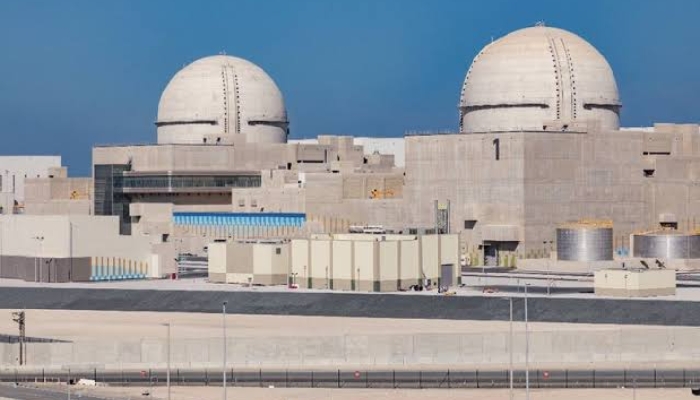
Dubai, Aug 2: The United Arab Emirates (UAE) announced on Saturday that it has started operations in the first of four reactors at the Barakah nuclear power station - the first nuclear power plant in the Arab world.

Emirates Nuclear Energy Corporation (ENEC), which is building and operating the plant with Korea Electric Power Corporation (KEPCO) said in a press release that its subsidiary Nawah Energy Company "has successfully started up Unit 1 of the Barakah Nuclear Energy Plant, located in the Al Dhafrah Region of Abu Dhabi".

That signals that Unit 1, which had fuel rods loaded in March, has achieved "criticality" - a sustained fission chain reaction.

"The start-up of Unit 1 marks the first time that the reactor safely produces heat, which is used to create steam, turning a turbine to generate electricity," said ENEC.

Barakah, which was originally scheduled to open in 2017, has been dogged by delays and is billions of dollars over budget. It has also raised myriad concerns among nuclear energy veterans who are concerned about the potential risks Barakah could visit upon the Arabian Peninsula, from an environmental catastrophe to a nuclear arms race.

Paul Dorfman, an honorary senior research fellow at the Energy Institute, University College London and founder and chair of the Nuclear Consulting Group, has criticised the Barakah reactors' "cheap and cheerful" design that he says cuts corners on safety.

Dorfman authored a report (PDF) last year detailing key safety features Barakah's reactors lack, such as a "core catcher" to literally stop the core of a reactor from breaching the containment building in the event of a meltdown. The reactors are also missing so-called Generation III Defence-In-Depth reinforcements to the containment building to shield against a radiological release resulting from a missile or fighter jet attack.

Both of these engineering features are standard on new reactors built in Europe, says Dorfman.

There have been at least 13 aerial attacks on nuclear facilities in the Middle East - more than any other region on earth.

The vulnerability of critical infrastructure in the Arabian Peninsula was further laid bare last year after Saudi Arabia's oil facilities at Abqaiq and Khurais were attacked by 18 drones and seven cruise missiles - an assault that temporarily knocked out more than half of the kingdom's oil production.

On Saturday, Dorfman reiterated his concern that there is no regional protocol in place to determine liability should an accident or incident at Barakah result in radioactive contamination spreading from the UAE to its neighbours. 

"Given Barakah has started up, because of all the well-rehearsed nuclear safety and security problems, it may be critically important that the Gulf states collectively evolve a Nuclear Accident Liability Convention, so that if anything does go wrong, victim states may have some sort of redress," Dorfman told Al Jazeera. 

The UAE has substantial oil and gas reserves, but it has made huge investments in developing alternative energy sources, including nuclear and solar.

Experts though have questioned why the UAE - which is bathed in sunlight and wind - has pushed ahead with nuclear energy - a far more expensive and riskier option than renewable energy sources.

When the UAE first announced Barakah in 2009, nuclear power was cheaper than solar and wind. But by 2012 - when the Emirates started breaking ground to build the reactors - solar and wind costs had plummeted dramatically.

Between 2009 and 2019, utility-scale average solar photovoltaic costs fell 89 percent and wind fell 43 percent, while nuclear jumped 26 percent, according to an analysis by the financial advisory and asset manager Lazard.

There are also concerns about the potential for Barakah to foment nuclear proliferation in the Middle East - a region rife with geopolitical fault lines and well-documented history of nuclear secrecy.

The UAE has sought to distance itself from the region's bad behaviour by agreeing not to enrich its own uranium or reprocess spent fuel. It has also signed up to the United Nation's nuclear watchdog's Additional Protocol, significantly enhancing inspection capabilities, and secured a 123 Agreement with the United States that allows bilateral civilian nuclear cooperation.


Comments

Add new comment

  • Coastaldigest.com reserves the right to delete or block any comments.
  • Coastaldigset.com is not responsible for its readers’ comments.
  • Comments that are abusive, incendiary or irrelevant are strictly prohibited.
  • Please use a genuine email ID and provide your name to avoid reject.