


Saudi Cabinet deplores brutal attacks on civilians, hospitals

November 22, 2016

Riyadh, Nov 22: The Council of Ministers, chaired by Custodian of the Two Holy Mosques King Salman, met in Riyadh on Monday and denounced the brutal shelling and heinous attacks on the Syrian people in Aleppo and its surroundings.
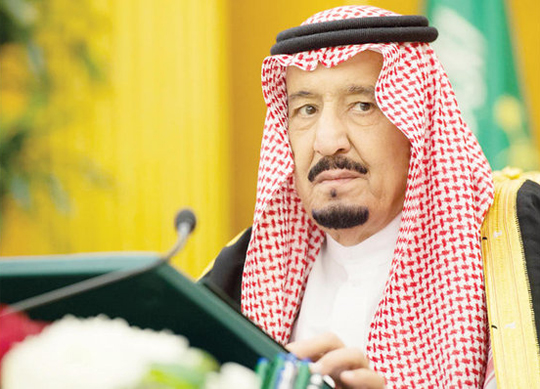
king salman

The Cabinet deplored the severe damage caused to people and property, particularly hospitals and schools.

The attacks resulted in the demolition of buildings and civilians being deprived of relief assistance.

The ministers noted that such attacks are contrary to the principles, values and essence of international law and humane principles in general.

The ministers reaffirmed the decisions of the emergency meeting of the foreign ministers of the Organization of the Islamic Cooperation (OIC) that the Kingdom would defend the Two Holy Mosques and enforce a strict call for putting an end to the practices of the Houthi militias and their supporters and their persistence in launching ballistic missiles at Makkah. These were unpredictable threats to Islamic sanctity and hurt the feelings of Muslims.

At the beginning of the meeting, the Custodian of the Two Holy Mosques briefed the ministers on the contents of messages he had received from Algerian President Abdulaziz Bouteflika and the outcome of his meetings and talks with Algerian Premier Abdulmalik Al-Sallal, Ethiopian Prime Minister Hailemariam Desalegn, Arab League Secretary-General Ahmed Abulghait, GCC Secretary-General Abdullatif Al-Zayani and Italian Interior Minister Engelo Alfano.

On reading the 52nd annual report of Saudi Arabian Monetary Agency (SAMA) for the fiscal year 2015, King Salman lauded the Kingdom’s vibrant financial situation which is attributed to strong security and stability in the country.

He also expressed his appreciation for SAMA’s efforts in the service of the country’s economy.

The Cabinet also hoped for a bright future in the forward march in accordance with the objectives of the Kingdom’s Vision 2030 and the national transformation program, (NTP) which will make a tangible economic impact through its diversification of national economic resources.

The Cabinet highlighted the statement made by Crown Prince Mohammed bin Naif, deputy premier and minister of interior, on the importance of protecting children from the threats of human society that harm their innocence and breach their dignity and honor.

The Kingdom’s hosting of the National Forum for Preventing Children’s Sexual Abuse on the Internet reflects its interest and care for human rights in general and children’s rights in particular based on the teachings of Islam.

The Cabinet was also briefed on the points raised by Deputy Crown Prince Mohammed bin Salman, second deputy premier and minister of defense, about his chairing of the 15th meeting of the GCC defense ministers, citing that everybody is looking forward to seeing the GCC move onward, particularly in the defense field amid the current challenges engulfing the countries in the region which necessitate more coordination and work and the taking of prompt action.

It was also briefed on the Kingdom’s stand at the UN Framework Convention’s 22nd Conference on Climate Change held in Marrakech.

It said that it would remain committed to its firm role in facing the problem of climate change and meeting the world’s oil energy needs and also providing support for a gradual transformation toward a more sustainable environmental future.

The Cabinet lauded the outcome of the conference.

Also highlighted was the Kingdom’s assertion at the Africa Labor summit that the GCC seeks fruitful cooperation at the Arab-African level for consolidating partnerships in order to achieve the objectives of UN sustainable development which was approved in New York in 2015.

The Cabinet also lauded the outcome of the 33rd GCC ministers of labor and social affairs held in Riyadh.

It cited the initiatives and programs envisaged to contribute effectively to a number of issues pertaining to the labor and social development fields, including the GCC joint common market.

The Cabinet praised the results of the first Arab Gulf Security exercise held in Bahrain where the Kingdom took part upon instructions of the Custodian of the Two Holy Mosques.

Later, the Cabinet approved the following decisions:

Firstly, the Cabinet authorized the crown prince or his delegated authority to discuss with the Zambians a draft cooperation agreement between the governments of Saudi Arabia and Zambia on the fight against terrorism, organized crimes and illegal trafficking in drugs and psychotropic items and their smuggling.

Secondly on the privatization of sports clubs in the Kingdom, based on recommendations of the Council of Economic Affairs and Development.

The Cabinet approved the following: privatization of sports clubs joining the Saudi championship for Premier Football League clubs.

The General Authority for Sports will, in coordination with the ministers of commerce and investment and economy and planning, stipulate regulations and conditions whereby the sports companies will carry out their activities.

Formation of a committee to supervise the completion of the club privatization stages to be headed by the president of the General Authority for Sports and members composed of the deputy minister of economy and planning, commerce undersecretary for systems and regulations in addition to representatives of the Finance Ministry, Saudi Football Association, and the Professional League Association.

Thirdly, the Cabinet approved a memorandum of understanding between the Saudi Ministry of Islamic Affairs, Call and Guidance and the Ministry of Islamic Affairs in Maldives in the field of Islamic affairs and endowments.

Fourthly, the Cabinet authorized the Minister of Islamic Affairs, Call and Guidance, or whomever he authorizes, to discuss with Djibouti a draft memo of understanding between the Saudi Ministry of Islamic Affairs, Call and Guidance and the Ministry of Islamic Affairs, Culture and Endowments in Djibouti in the area of Islamic affairs.

Fifth, the Cabinet authorized the Minister of Foreign Affairs, or whomever he authorizes, to discuss with the Independent Permanent Commission on Human Rights at the Organization of Islamic Cooperation (OIC) a draft head office agreement between the Saudi government and the Independent Permanent Commission on Human Rights at the OIC.

Sixth, the Cabinet approved the establishment of diplomatic relations between Saudi Arabia and the Republic of Central Africa at the level of “non-resident ambassador”.

The Cabinet also approved an agreement on the employment of domestic workers between the Saudi Ministry of Labor and Social Development and the Ministry of Public Office in Chad.

Finally, the Cabinet approved the establishment of a national program to maximize the benefits of government incentives in the energy and water sectors aimed at reducing consumption of energy and water in order to ensure economic efficiency in the productive sectors.

Comments

Add new comment

  • Coastaldigest.com reserves the right to delete or block any comments.
  • Coastaldigset.com is not responsible for its readers’ comments.
  • Comments that are abusive, incendiary or irrelevant are strictly prohibited.
  • Please use a genuine email ID and provide your name to avoid reject.
News Network
January 6,2020

Riyadh, Jan 6: Saudi Arabia was not consulted by its ally Washington over a US drone strike that killed a top Iranian general, an official said Sunday, as the kingdom sought to defuse soaring regional tensions.

Saudi Arabia is vulnerable to possible Iranian reprisals after Tehran vowed "revenge" following the strike on Friday that killed powerful commander Qasem Soleimani in Baghdad.

"The kingdom of Saudi Arabia was not consulted regarding the US strike," a Saudi official told AFP, requesting anonymity.

"In light of the rapid developments, the kingdom stresses the importance of exercising restraint to guard against all acts that may lead to escalation, with severe consequences," the official added.

Saudi Arabia's foreign ministry made a similar call for restraint at the weekend and King Salman emphasised the need for measures to defuse tensions in a phone call on Saturday with Iraqi President Barham Saleh.

In a separate phone call with Iraq's Prime Minister Adel Abdel Mahdi, Saudi Crown Prince Mohammed bin Salman stressed "the need to make efforts to calm the situation and de-escalate tensions", the official Saudi Press Agency reported.

The crown prince has instructed Prince Khalid bin Salman, his younger brother and deputy defence minister, to travel to Washington and London in the next few days to urge restraint, the pan-Arab Asharq al-Awsat newspaper reported.

Prince Khalid will meet White House and US defence officials, the paper said, citing unnamed sources.

The killing of Soleimani, seen as the second most powerful man in Iran, is the most dramatic escalation yet in spiralling tensions between Washington and Tehran and has prompted fears of a major conflagration in the Middle East.

US President Donald Trump, who ordered the drone strike, has warned that Washington will hit Iran "very fast and very hard" if the Islamic republic attacks American personnel or assets.

The American embassy in Riyadh on Sunday warned its citizens living close to military bases and oil and gas installations in the kingdom of a "heightened risk of missile and drone attacks".

A string of attacks blamed on Iran has caused anxiety in recent months, as Riyadh and Washington deliberated over how to react.

In particular, devastating strikes against Saudi oil installations last September led Riyadh and Abu Dhabi to adopt a more conciliatory approach aimed at avoiding confrontation with Tehran.

Analysts warn that pro-Iran groups have the capacity to carry out attacks on US bases in Gulf states as well as against shipping in the Strait of Hormuz -- the strategic waterway that Tehran could close at will.

"Expect Iranian reprisals (directly or through partner groups in Iraq, Lebanon or elsewhere) to target US partners in the region including Saudi Arabia," said Thomas Juneau, an assistant professor at the University of Ottawa.

"Given the climate in the US, where support for Saudi in the media and Congress is at an all time low, it will be difficult for Trump to commit significant resources to come to its aid."

Yemen's pro-Iran Huthi rebels, locked in a five-year conflict with a Saudi-led military coalition, have also called for swift reprisals for Soleimani's killing.

"The aggression... will not go without a response," said Huthi political council member Mohammed Al-Bukhaiti.

"How the response is going to be, when and where will be determined by Iraq and Iran, and we will stand with them as a hub for the resistance."

It was unclear if the Huthi warning was directed in part at Saudi Arabia, which has stepped up efforts to end Yemen's conflict amid a lull in Huthi attacks on the kingdom.

Saudi Arabian military commanders recently met with counterparts from "friendly countries" to formulate a new strategy to tackle the Yemeni rebels, particularly those "opposing" a political solution, according to Asharq al-Awsat.

Riyadh has said it will host a separate meeting of foreign ministers of Arab and African coastal states on Monday.

Comments

Add new comment

  • Coastaldigest.com reserves the right to delete or block any comments.
  • Coastaldigset.com is not responsible for its readers’ comments.
  • Comments that are abusive, incendiary or irrelevant are strictly prohibited.
  • Please use a genuine email ID and provide your name to avoid reject.
News Network
January 16,2020

Abu Dhabi, Jan 16: The number of people being killed by terrorism activities worldwide has decreased significantly over the recent years, according to the latest Global Terrorism Index.

The 2019 Global Terrorism Index, which was presented at a forum in Abu Dhabi on Wednesday also showed that the UAE improved its ranking in the index by coming down to 130th rank among the 163 countries. The terrorism impact in the UAE is categorised as 'very low'. In the UAE, only two terrorism incidents were reported over the past decade - one in 2010 and another in 2014 - and there were no casualties.

Commenting on the report, Mansour Al Mansouri, director of the UAE National Media Council (NMC) said: "These findings rightly show the UAE as one of the safest countries in the world in terms of terror threat."

The index showed that the total number of deaths from terrorism declined for the fourth consecutive year in 2018, falling by 15.2 per cent to 15,952 deaths. This represents a 53 per cent reduction since its peak in 2014 when 33,555 people were killed in terrorist attacks.

The index published for the seventh year in a row, ranks 163 countries across the globe according to the relative impact of terrorism. This takes into account the number of terrorist incidents, deaths caused by terror and total value of property damage.

The latest results saw three Middle East countries - Iraq, Syria and Yemen - continue in the top 10 positions of the index.

The findings also showed Taleban overtaking Daesh as the deadliest terrorist group in the world, accounting for 38 per cent of all terrorist deaths. This is an increase of 71 per cent. Afghanistan is the country most affected by terrorism in 2018 followed by Iraq, Nigeria, Syria and Pakistan, according to the report. The least impacted nations were Belarus, Guinea-Bissau, Oman, The Gambia and North Korea.

During his presentation of the key findings of the index at the Foreign Correspondent's Club of the UAE (FCC), Serge Stroobants, director of Europe and Mena at the Institute of Economics and Peace, said lesser people were now being killed in terrorism activities.

"There have been long-term trends in global terrorism, with deaths caused by terror down by 52 per cent compared to high point of 2014, which saw Daesh and Boko Haram at their peak," said Stroobants attributing the decrease in the deaths to the increase in security measures and cooperation among nations in the fight against terrorism.

In contrast to this, there has been a 320 per cent increase in far-right terrorist incidents in the West, with political ideology being the driving force behind an increased proportion of terror motivation.

"There has been an increase in far-right terrorism in Western Europe, North America and Oceania for the third consecutive year," said Stroobants.

Terrorism still remains a global security threat, according the index, with 71 countries recording more than one death - the second highest number of countries since 2002.

Stroobants said conflicts remain the main cause of terrorism with 90 per cent of terrorist incidents occurring in places where there are conflicts or insurgencies.

The report said the global economic impact of terrorism was $33 billion in 2018, a substantial decrease of 38 per cent from the previous year.

Boko Haram was responsible for 80 per cent of all female suicide attacks, said the terrorism index.

Global Terrorism Index: Most affected countries

>Afghanistan (7379 deaths)

>Iraq (1,054 deaths)

>Nigeria (2,040 deaths)

>Syria (662 deaths)

>Pakistan (537 deaths)

>Somalia (646 deaths)

>India (350 deaths)

>Yemen (301 deaths)

>The Philippines (297 deaths)

>Democratic Republic of the Congo (410 deaths)

Comments

Add new comment

  • Coastaldigest.com reserves the right to delete or block any comments.
  • Coastaldigset.com is not responsible for its readers’ comments.
  • Comments that are abusive, incendiary or irrelevant are strictly prohibited.
  • Please use a genuine email ID and provide your name to avoid reject.
Agencies
July 19,2020

Occupied Jerusalem, Jul 19: Israeli Prime Minister Benjamin Netanyahu’s corruption trial resumed on Sunday.

Netanyahu is charged with fraud, breach of trust and accepting bribes in a series of scandals in which he is alleged to have received lavish gifts from billionaire friends and exchanged regulatory favors with media moguls for more agreeable coverage of himself and his family.

Netanyahu denies wrongdoing, painting the accusations as a media-orchestrated witchhunt pursued by a biased law enforcement system.

The trial opened in May. Just before appearing in front of the judges, Netanyahu took to a podium inside the courthouse and flanked by his party members bashed the country’s legal institutions in an angry tirade.

Netanyahu was not expected to appear at Sunday’s hearing, which is taking place at an occupied Jerusalem court and is mostly a procedural deliberation.

The trial resumes as Netanyahu faces widespread anger over his government’s handling of the coronavirus crisis.

While the country appeared to have tamped down a first wave of infections, what’s emerged as a hasty and erratic reopening sent infections soaring. Yet even amid the rise in new cases Netanyahu and his emergency government — formed with the goal of dealing with the crisis — appeared to neglect the numbers and moved forward with other policy priorities and its reopening plans.

It has since paused them and even re-impose restrictions, including a weekend only lockdown set to begin later this week.

Netanyahu’s government has been criticized for a baffling, halting response to the new wave, which has seen daily cases rise to nearly 2,000. It has been slammed for its handling of the economic fallout of the crisis.

His trial thus comes at inopportune timing. Netanyahu had hoped to ride on the goodwill he gained from overcoming the first wave of infections going into his corruption trial, but the increasingly souring mood has affected his approval rating and may deny him the public backing he had hoped for. The anger has sparked protests over the past few weeks that have culminated in violent clashes with police.

Comments

Add new comment

  • Coastaldigest.com reserves the right to delete or block any comments.
  • Coastaldigset.com is not responsible for its readers’ comments.
  • Comments that are abusive, incendiary or irrelevant are strictly prohibited.
  • Please use a genuine email ID and provide your name to avoid reject.