


Saudi Cabinet slams chemical attack in Syria, expresses support for US military strike

April 11, 2017

Riyadh, Apr 11: The Saudi Cabinet on Monday condemned the use of the chemical attack on Khan Sheikhun in Syria, which resulted in many deaths including children and women, committed by the Syrian regime and, expressing full support to the recent US military operation against selected targets in Syria was articulated.
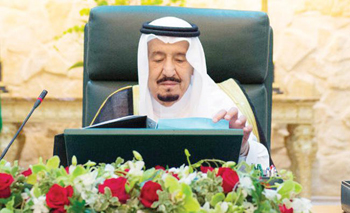
kingThe Kingdom’s long-standing rejection of terrorism in all forms and manifestations was stressed upon. They condemned the two explosions in Egypt and similar terrorist attacks in St. Petersburg, Russia, and Stockholm, Sweden, which resulted in several deaths and injuries.

The Cabinet also lauded the Arab Coalition forces’ support for restoration of peace and stability in Yemen as well as the Kingdom’s humanitarian efforts through King Salman Center for Humanitarian and Relief Aids, and stressed what the deputy crown prince highlighted earlier during his meeting with key Yemeni tribal chiefs that the Kingdom sees Yemen as strategic depth for the Arab and GCC countries as well as the Kingdom; and it is a duty to stand by the Yemeni people against Houthi aggression.

The Kingdom’s keenness to contribute to Arab joint action which was embodied in the Memorandum of Understanding (MoU) was also highlighted; it was for the establishment of a common Arab market for electricity, within 14 countries, during the 12th Arab ministerial council for electricity in Cairo.

The Cabinet also appreciated the king’s efforts to unify Arab and Muslim ranks in facing the difficult conditions experienced by Arab and Islamic countries.

He was praised for awarding Prince Naif, the Order of Arab Security at the conclusion of the 34th Arab Interior Ministers meeting in Tunis, for his leading role in supporting Arab and Islamic causes, and his efforts in preserving international peace and security.

The Cabinet noted recommendations and decisions issued at the Arab Interior Ministers meeting including Arab strategies on combating illegal use of drugs, terrorism, traffic safety and intellectual security.

On a local level, the Cabinet welcomed the announcement made by Deputy Crown Prince Mohammed bin Salman on launching the largest cultural, sports and entertainment city in southwest Riyadh in support of Vision 2030, and diversifying the sources of national income.

Later, the Cabinet approved a series of decisions.

They authorized the minister of foreign affairs to hold political consultations (and sign an MoU) between the Saudi and Filipino foreign ministries.

They authorized the minister of environment, water and agriculture to cooperate in the area of agriculture and fisheries between the governments of Saudi Arabia and South Africa, and sign an MoU.

The Cabinet approved an MoU for joint cooperation in the area of housing between the Saudi Ministry of Housing and the South Korean Ministry of Land, Transport and Infrastructure.

The Cabinet also approved a similar MoU for joint cooperation in the area of housing between the governments of Saudi Arabia and People’s Republic of China.

They authorized the minister of education to discuss scientific and educational cooperation between the Saudi and UAE ministries of education, and sign an MoU.

The Cabinet authorized the president of the National Anti-Corruption Commission (Nazaha) to discuss an MoU with the United Nations Office on Drugs and Crime.

They approved that the General Authority for Sports be structurally linked to President of the Council of Economic Affairs.

The Cabinet approved Saudi Arabia’s accession to the international convention for the control and management of ships’ ballast water and sediments for 2004.

The Cabinet approved that state budget will bear the entry visa fee for seasonal workers on the sacrificial meat project.

Comments

Add new comment

  • Coastaldigest.com reserves the right to delete or block any comments.
  • Coastaldigset.com is not responsible for its readers’ comments.
  • Comments that are abusive, incendiary or irrelevant are strictly prohibited.
  • Please use a genuine email ID and provide your name to avoid reject.
Agencies
May 18,2020

Jeddah, May 18: Saudi Arabia’s Grand Mufti and head of the Council of Senior Scholars and the Department of Scientific Research and Ifta Sheikh Abdul Aziz Al Asheikh ruled that it is permissible to perform Eid Al-Fitr prayer at home under exceptional circumstances similar to the current pandemic situation. The prayer consists of two rakats with reciting more numbers of takbeer and without a sermon.

Speaking to Okaz/Saudi Gazette, he said that Zakat Al-Fitr could be distributed through charitable societies if they are reliable ones, with the condition that it should be distributed before the day of Eid. The Grand Mufti urged parents to bring joy and happiness to their children and their families by spending more on them.

Meanwhile, Sheikh Abdul Salam Abdullah Al-Sulaiman, member of the Council of Senior Scholars and the Standing Committee of Fatwa, said that Eid prayer could be performed individually or in congregation.

Speaking to Okaz/Saudi Gazette, he said that the worshiper will recite takbeer to start salat and then follow it with six more takbeer in the first rakat before reciting Fatiha loudly and then it is ideal to recite Surah Al-Qaf.

In the second rakat, there will be five takbeer after the takbeer at the start of the rakat before starting to recite Surah Fatiha and then Surah Al-Qamar, following the example of the Prophet (peace be upon him). It is also ideal to recite Surah Al-A’la and Al-Ghashiya instead of Al-Qaf and Al-Qamar in each rakat respectively.

Sheikh Al-Sulaiman also cited the example of Anas Bin Malik, a prominent companion of the Prophet (pbuh). When Anas (May Allah be pleased with him), was at his home in Zawiya, a place near Basra, he did not find any Eid congregation prayer and therefore he performed prayer along with his family members and his aide Abdullah Bin Abi Otba.

The scholar said that the time for Eid prayer begins after sunrise and the best time is after the sun rises by the height of one or two spears as agreed by most scholars. This means 15 or 30 minutes after sunrise and its time continues until the end of the time of the Duha prayer; that is before the Zuhr prayer begins.

The prayer is forbidden at the moment when the sun rises, and the majority of jurists, including the schools of thought of Shafi, Maliki, and Hanbali opposed prayer at sunrise and favored to perform the prayer only after the sun rises by the height of one or two spears in the sky.

Regarding the recitation of takbeer on the occasion of Eid Al-Fitr, Sheikh Al-Suleiman said that it should begin during the night of the Eid and continue until the beginning of the Eid prayer.

Comments

Add new comment

  • Coastaldigest.com reserves the right to delete or block any comments.
  • Coastaldigset.com is not responsible for its readers’ comments.
  • Comments that are abusive, incendiary or irrelevant are strictly prohibited.
  • Please use a genuine email ID and provide your name to avoid reject.
News Network
April 5,2020

Beirut, Apr 5: The novel coronavirus has put global trade on hold, placed half of the world population in confinement and has the potential to topple governments and reshape diplomatic relations.

The United Nations has appealed for ceasefires in all the major conflicts rocking the planet, with its chief Antonio Guterres on Friday warning "the worst is yet to come". But it remains unclear what the pandemic's impact will be on the multiple wars roiling the Middle East.

Here is an overview of the impact so far on the conflicts in Syria, Yemen, Libya and Iraq:

The COVID-19 outbreak turned into a pandemic just as a ceasefire reached by the two main foreign power brokers in Syria's nine-year-old war -- Russia and Turkey -- was taking effect.

The three million people living in the ceasefire zone, in the country's northwestern region of Idlib, had little hope the deal would hold.

Yet fears the coronavirus could spread like wildfire across the devastated country appear to have given the truce an extended lease of life.

According to the Syrian Observatory for Human Rights, the month of March saw the lowest civilian death toll since the conflict started in 2011, with 103 deaths.

The ability of the multiple administrations in Syria -- the Damascus government, the autonomous Kurdish administration in the northeast and the jihadist-led alliance that runs Idlib -- to manage the coronavirus threat is key to their credibility.

"This epidemic is a way for Damascus to show that the Syrian state is efficient and all territories should be returned under its governance," analyst Fabrice Balanche said.

However the pandemic and the global mobilisation it requires could precipitate the departure of US-led troops from Syria and neighbouring Iraq.

This in turn could create a vacuum in which the Islamic State jihadist group, still reeling from the demise of its "caliphate" a year ago, could seek to step up its attacks.

The Yemeni government and the Huthi rebels initially responded positively to the UN appeal for a ceasefire, as did neighbouring Saudi Arabia, which leads a military coalition in support of the government.

That rare glimmer of hope in the five-year-old conflict was short-lived however and last week Saudi air defences intercepted ballistic missiles over Riyadh and a border city fired by the Iran-backed rebels.

The Saudi-led coalition retaliated by striking Huthi targets in the rebel-held capital Sanaa on Monday.

Talks have repeatedly faltered but the UN envoy Martin Griffiths is holding daily consultations in a bid to clinch a nationwide ceasefire.

More flare-ups in Yemen could compound a humanitarian crisis often described as the worst in the world and invite a coronavirus outbreak of catastrophic proportions.

In a country where the health infrastructure has collapsed, where water is a rare commodity and where 24 million people require humanitarian assistance, the population fears being wiped out if a ceasefire doesn't allow for adequate aid.

"People will end up dying on the streets, bodies will be rotting in the open," said Mohammed Omar, a taxi driver in the Red Sea port city of Hodeida.

Much like Yemen, the main protagonists in the Libyan conflict initially welcomed the UN ceasefire call but swiftly resumed hostilities.

Fierce fighting has rocked the south of the capital Tripoli in recent days, suggesting the risk of a major coronavirus outbreak is not enough to make guns fall silent.

Turkey has recently played a key role in the conflict, throwing its weight behind the UN-recognised Government of National Accord.

Fabrice Balanche predicted that accelerated Western disengagement from Middle East conflicts could limit Turkish support to the GNA.

That could eventually favour forces loyal to eastern-based strongman Khalifa Haftar, who launched an assault on Tripoli one year ago and has the backing of Russia, Egypt and the United Arab Emirates.

Western countries have been hit hardest by the pandemic, which could prompt them to divert both military resources and peace-brokering capacity from foreign conflicts.

A report by the International Crisis Group said European officials had reported that efforts to secure a ceasefire in Libya were no longer receiving high-level attention due to the pandemic.

Iraq is no longer gripped by fully-fledged conflict but it remains vulnerable to an IS resurgence in some regions and its two main foreign backers are at each other's throats.

Iran and the United States are two of the countries most affected by the coronavirus but there has been no sign of any let-up in their battle for influence that has largely played out on Iraqi soil.

With most non-US troops in the coalition now gone and some bases evacuated, American personnel are now regrouped in a handful of locations in Iraq.

Washington has deployed Patriot air defence missiles, prompting fears of a fresh escalation with Tehran, whose proxies it blames for a spate of rocket attacks on bases housing US troops.

Comments

Add new comment

  • Coastaldigest.com reserves the right to delete or block any comments.
  • Coastaldigset.com is not responsible for its readers’ comments.
  • Comments that are abusive, incendiary or irrelevant are strictly prohibited.
  • Please use a genuine email ID and provide your name to avoid reject.
Agencies
August 8,2020

Beirut, Aug 7: A devastating explosion that destroyed much of Beirut might have been the result of a missile attack or bomb, Lebanese President Michel Aoun said, as the death toll from the blast rose to 154.

More than 2,700 tons of ammonium nitrate had been sitting in a port warehouse for six years, but there have been conflicting accounts about why Lebanese authorities decided to empty the shipment of explosive material. The vessel carrying the flammable cargo was heading from Georgia to Mozambique when it stopped in the Lebanese port to load up on iron, according to the ship’s captain.

By Friday, 19 suspects had been arrested and Lebanon’s former director general of customs Chafic Merhy had been questioned by military police.

Comments

Add new comment

  • Coastaldigest.com reserves the right to delete or block any comments.
  • Coastaldigset.com is not responsible for its readers’ comments.
  • Comments that are abusive, incendiary or irrelevant are strictly prohibited.
  • Please use a genuine email ID and provide your name to avoid reject.