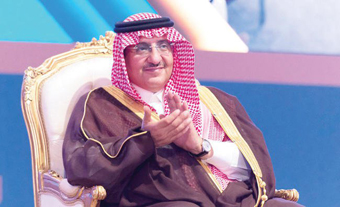
Saudi Crown prince inaugurates 17th Scientific Forum for Haj, Umrah and Visit Research

May 12, 2017

Madinah, May 12: The 17th Scientific Forum for Haj, Umrah and Visit Research was inaugurated Wednesday at Taibah University in Madinah by Crown Prince Mohammed bin Naif, chairman of the Higher Supervisory Committee of the Custodian of the Two Holy Mosques Institute for Haj and Umrah Research.

UmrahThe institute, at Umm Al-Qura University, “is proud to take on the task of developing and improving the Haj, Umrah and visitor environment by refining the services provided to the guests through scientific research and specialized studies,” said Sami Barhamain, dean of the Custodian of the Two Holy Mosques Institute for Haj and Umrah Research.

The theme of the forum involved studies of management, economics and jurisprudence, health and environment studies, as well as awareness and information centers, architectural and engineering studies, and information technology.

More than 200 researchers and participants are presenting their experiences via 46 research papers pertaining to their relevant fields, all of which have been made available on the forum’s scientific register.

Also present were Prince Faisal bin Salman, governor of Madinah and chairman of the Haj Committee in the region; Mohammed Saleh Benten, minister of Haj and Umrah and acting minister of education; Bakri bin Maatouq Assas, director of Umm Al-Qura University and general supervisor of the Custodian of the Two Holy Mosques Institute for Haj and Umrah Research; and Abdulaziz Al-Sarani, director of Taibah University.

The participants and audience then viewed a presentation on the achievements of the institute, as well as research partnerships with concerned parties.

The participants urged the media to convey the true endeavors to offer services and secure the safety of pilgrims.

During their second scientific meeting called “Awareness and Media,” held under the chairmanship of the director of Taibah University, Abdulaziz Al-Sarani, participants also called for countering malicious campaigns targeting the Kingdom and discussed several issues related to the media.

Abdullah Al-Wazzan from the Northern Border University presented the paper titled “The role of Twitter in raising environmental awareness among Saudi university youth,” stressing that “there is an urgent need to enhance environmental awareness and help the youth get acquainted with issues pertaining to it, particularly those that pose a danger to humans” and how important it is that “university students acquire awareness of the environment.”

He called on Twitter users to publish material — news, comments, photos and videos — pertaining to the environment.

Eman Fathi Abdel Mohsen, from the college of Social Sciences at Umm Al-Qura University, presented a scientific paper on the effectiveness of designing an application on smartphones to raise the awareness of visitors to the Prophet’s Mosque about religious tourism in Madinah, stressing that there is consensus on the need to design an electronic guide application in this regard.

“Al-Baqi was one of the religious tourism sites most visited, according to a study conducted in Madinah, followed by Jabal Uhod, and the Green Dome Mosque came third,” she said.

In their paper, Wajdi Helmi Abdul Zaher and Mohammed Ali Gharib, from the college of Social Sciences, Umm Al-Qura University, also highlighted the important role the media play in promoting the image of the Kingdom of Saudi Arabia to those who perform Haj and Umrah, and the need to conduct media campaigns abroad.

They pointed to “the need to monitor the interactive relationship between the Saudi security media and the degree of satisfaction of pilgrims, which strengthens the religious message,” and the importance of monitoring and addressing media messages aimed at distorting the image of the Kingdom.

Another working paper titled “Studying the most effective guidance forms and symbols in the Prophet’s Mosque” concluded that there is a need to unify the guiding signs and highlight the identity and importance of Madinah.

Comments

Add new comment

  • Coastaldigest.com reserves the right to delete or block any comments.
  • Coastaldigset.com is not responsible for its readers’ comments.
  • Comments that are abusive, incendiary or irrelevant are strictly prohibited.
  • Please use a genuine email ID and provide your name to avoid reject.
News Network
June 5,2020

New Delhi, Jun 5: As part of global efforts to combat COVID-19, the UAE has provided more than 708 tonnes of medical aid, personal protection kits and supplies to 62 countries, including India, with direct beneficiaries exceeding 708,000 health workers, a UAE Embassy statement said.

The UAE is regarded as the main lifeline for the logistic operations of the international organizations' strategic warehouses in Dubai's International Humanitarian City (IHC) where the UAE is the first responder to the global crises, especially in providing assistance in relation to the current COVID-19 pandemic, it said.

Dubai's IHC has dispatched more than 132 shipments to 98 countries around the world so far since the beginning of this year, and is working as a central hub to distribute the personal protection kits, the statement said.

While the UAE continues its constant work of supporting the global efforts aimed at curbing the spread of the COVID-19 disease, it has provided more than 708 tons of medical aid, personal protection kits and supplies to 62 countries worldwide to date, with direct beneficiaries exceeding 708,000 health workers, it said.

In addition, 65 million indirect beneficiaries profited from the UAE's global efforts in combating the spread of the virus, the statement said.

Meanwhile, Etihad Airways, effective June 10, said it will link 20 cities in Europe, Asia and Australia via Abu Dhabi.

The new transfer services will make it possible for those travelling on the airline's current network of special flights to connect easily through the UAE capital onwards to key global destinations.

Etihad recently launched links from Melbourne and Sydney to London Heathrow, allowing direct transfer connections to and from the UK capital via Abu Dhabi.

Easy transfer connections via Abu Dhabi will now be available from Jakarta, Karachi, Kuala Lumpur, Manila, Melbourne, Seoul, Singapore, Sydney, and Tokyo to major cities across Europe including Amsterdam, Barcelona, Brussels, Dublin, Frankfurt, Geneva, London Heathrow, Madrid, Milan, Paris Charles de Gaulle, and Zurich, the airline said.

Comments

Add new comment

  • Coastaldigest.com reserves the right to delete or block any comments.
  • Coastaldigset.com is not responsible for its readers’ comments.
  • Comments that are abusive, incendiary or irrelevant are strictly prohibited.
  • Please use a genuine email ID and provide your name to avoid reject.
News Network
April 5,2020

Beirut, Apr 5: The novel coronavirus has put global trade on hold, placed half of the world population in confinement and has the potential to topple governments and reshape diplomatic relations.

The United Nations has appealed for ceasefires in all the major conflicts rocking the planet, with its chief Antonio Guterres on Friday warning "the worst is yet to come". But it remains unclear what the pandemic's impact will be on the multiple wars roiling the Middle East.

Here is an overview of the impact so far on the conflicts in Syria, Yemen, Libya and Iraq:

The COVID-19 outbreak turned into a pandemic just as a ceasefire reached by the two main foreign power brokers in Syria's nine-year-old war -- Russia and Turkey -- was taking effect.

The three million people living in the ceasefire zone, in the country's northwestern region of Idlib, had little hope the deal would hold.

Yet fears the coronavirus could spread like wildfire across the devastated country appear to have given the truce an extended lease of life.

According to the Syrian Observatory for Human Rights, the month of March saw the lowest civilian death toll since the conflict started in 2011, with 103 deaths.

The ability of the multiple administrations in Syria -- the Damascus government, the autonomous Kurdish administration in the northeast and the jihadist-led alliance that runs Idlib -- to manage the coronavirus threat is key to their credibility.

"This epidemic is a way for Damascus to show that the Syrian state is efficient and all territories should be returned under its governance," analyst Fabrice Balanche said.

However the pandemic and the global mobilisation it requires could precipitate the departure of US-led troops from Syria and neighbouring Iraq.

This in turn could create a vacuum in which the Islamic State jihadist group, still reeling from the demise of its "caliphate" a year ago, could seek to step up its attacks.

The Yemeni government and the Huthi rebels initially responded positively to the UN appeal for a ceasefire, as did neighbouring Saudi Arabia, which leads a military coalition in support of the government.

That rare glimmer of hope in the five-year-old conflict was short-lived however and last week Saudi air defences intercepted ballistic missiles over Riyadh and a border city fired by the Iran-backed rebels.

The Saudi-led coalition retaliated by striking Huthi targets in the rebel-held capital Sanaa on Monday.

Talks have repeatedly faltered but the UN envoy Martin Griffiths is holding daily consultations in a bid to clinch a nationwide ceasefire.

More flare-ups in Yemen could compound a humanitarian crisis often described as the worst in the world and invite a coronavirus outbreak of catastrophic proportions.

In a country where the health infrastructure has collapsed, where water is a rare commodity and where 24 million people require humanitarian assistance, the population fears being wiped out if a ceasefire doesn't allow for adequate aid.

"People will end up dying on the streets, bodies will be rotting in the open," said Mohammed Omar, a taxi driver in the Red Sea port city of Hodeida.

Much like Yemen, the main protagonists in the Libyan conflict initially welcomed the UN ceasefire call but swiftly resumed hostilities.

Fierce fighting has rocked the south of the capital Tripoli in recent days, suggesting the risk of a major coronavirus outbreak is not enough to make guns fall silent.

Turkey has recently played a key role in the conflict, throwing its weight behind the UN-recognised Government of National Accord.

Fabrice Balanche predicted that accelerated Western disengagement from Middle East conflicts could limit Turkish support to the GNA.

That could eventually favour forces loyal to eastern-based strongman Khalifa Haftar, who launched an assault on Tripoli one year ago and has the backing of Russia, Egypt and the United Arab Emirates.

Western countries have been hit hardest by the pandemic, which could prompt them to divert both military resources and peace-brokering capacity from foreign conflicts.

A report by the International Crisis Group said European officials had reported that efforts to secure a ceasefire in Libya were no longer receiving high-level attention due to the pandemic.

Iraq is no longer gripped by fully-fledged conflict but it remains vulnerable to an IS resurgence in some regions and its two main foreign backers are at each other's throats.

Iran and the United States are two of the countries most affected by the coronavirus but there has been no sign of any let-up in their battle for influence that has largely played out on Iraqi soil.

With most non-US troops in the coalition now gone and some bases evacuated, American personnel are now regrouped in a handful of locations in Iraq.

Washington has deployed Patriot air defence missiles, prompting fears of a fresh escalation with Tehran, whose proxies it blames for a spate of rocket attacks on bases housing US troops.

Comments

Add new comment

  • Coastaldigest.com reserves the right to delete or block any comments.
  • Coastaldigset.com is not responsible for its readers’ comments.
  • Comments that are abusive, incendiary or irrelevant are strictly prohibited.
  • Please use a genuine email ID and provide your name to avoid reject.
News Network
February 5,2020

Feb 5: US President Donald Trump delivered his third State of the Union address on Tuesday, the eve of his expected impeachment acquittal in the United States Senate.

The mood in the House of Representatives reflected the divisions running across the country. Republicans cheered as Trump was introduced, with some chanting "four more years" while Democrats stood silently.

On the foreign policy front, Trump said the US is "working to end America's wars in the Middle East".

He boasted about his decision to order the killing of top Iranian Commander Qassem Soliemani. That decision escalated tensions between the US and Iran, with many fearing an outright war.

Iran retaliated by attacking two Iraqi military bases housing US troops. After Trump initially said no troops were injured, the Defense Department announced dozens of US soldiers had been diagnosed with traumatic brain injuries.

Trump also reiterated his vow to withdraw US troops from Afghanistan. When he plans to do that, however, remains unclear.

US special envoy Zalmay Khalilzad told Afghan President Ashraf Ghani earlier this week that there has not been any significant progress in his talks with the Taliban. Khalilzad said he was hopeful of reaching an understanding with the group on reduction of hostilities, but did not offer any timeframe.

Trump also touted his newly-unveiled Middle East plan, which has been vehemently rejected by Palestinians.

And he received loud applause after reminding the country that ISIL (ISIS) leader Abu Bakr al-Baghdadi was killed last year in a US military operation in Syria.

"Today, the ISIS territorial caliphate has been 100 percent destroyed, and the founder and leader of ISIS - the bloodthirsty killer Al Baghdadi - is dead!" Trump said.

Economy

Trump spent much of his speech highlighting the economy's strength, including low unemployment, stressing how it has helped blue-collar workers and the middle class, though the period of growth began under his predecessor, Barack Obama.

"In just three short years, we have shattered the mentality of American decline and we have rejected the downsizing of America's destiny. We are moving forward at a pace that was unimaginable just a short time ago, and we are never going back!" Trump declared.

And what Trump calls an unprecedented boom is, by many measures, not all that different from the solid economy he inherited from Obama. Economic growth was 2.3 percent in 2019, matching the average pace since the Great Recession ended a decade ago in the first year of Obama's eight-year presidency.

Trump stressed the new trade agreements he has negotiated, including his phase-one deal with China and the United States-Mexico-Canada agreement he signed last month.

Throughout his presidency, Trump has frequently touted his stewardship of the US economy. As recently as two weeks ago, he claimed it was in "a rather dismal state" until he and his administration turned it into a "roaring geyser of opportunity".

But the numbers do not support the "geyser" narrative. There are signs the record US economic expansion - now in its 11th year - is getting long in the tooth.

Job creation is slowing. And the US economy's modest 2.3 percent growth was well short of the 3 percent growth Trump had predicted following a $1.5 trillion tax cut package he and his fellow Republicans pushed through Congress in 2017.

Trump's trade war with China weighed on US manufacturing last year as businesses held back on investment. And while factory activity bounced back in January amid the signing of a phase-one trade deal between Washington and Beijing, US tariffs still remain in place on some $360bn of Chinese goods.

The coronavirus outbreak and the ongoing troubles for Boeing surrounding the 737 MAX could also present headwinds to growth, analysts say.

Awkward moment at awkward time

One of the big questions of the night was whether Trump would directly mention impeachment. He chose to stay away. The House impeached the president at the end of last year for abuse of power related to his dealings with Ukraine and obstruction of Congress for refusing to participate in the impeachment inquiry.

The Senate started its trial more than two weeks ago, and a final vote is scheduled for 4pm local time (21GMT) on Wednesday.

Trump shared an awkward moment with House Speaker Nancy Pelosi, who kicked off the House's impeachment inquiry in September following a whistle-blower complaint that centred on Trump's efforts to get Ukraine to launch investigations into the president's political rival.

At the start of Trump's speech on Tuesday night, it appeared Pelosi went to shake the president's hand, a gesture amid the impeachment proceedings.

The president was presenting folios to Pelosi and Vice President Mike Pence as he arrived for the evening speech when it appears she reached for the shake. At the same time, Trump turned away from her to face the audience of lawmakers gathered for the annual address.

Pelosi gave a look.

Later on Twitter, Pelosi tweeted that "Democrats will never stop extending the hand of friendship to get the job done #ForThePeople. We will work to find common ground where we can, but will stand our ground where we cannot".

After the address was over, Pelosi ripped up her copy of the speech - a move the White House criticised.

Trump is only the third president to be impeached. He has denied any wrongdoing.

While some Republicans have acknowledged Trump did something wrong, they've argued that it didn't amount to an impeachable offence. Trump is headed towards an all but certain acquittal on Wednesday in the Republican-led Senate.

Trump appeals to base

As expected, Trump also dedicated a section to "American values", discussing efforts to protect "religious liberties" and limit access to abortion as he continues to court the evangelical and conservative Christian voters who form a crucial part of his base.

He attacked the Democrats over their healthcare plans, labelling them "socialist".

He brought up his signature campaign issue - immigration, at times making untrue or misleading statements.

"Before I came into office, if you showed up illegally on our southern border and were arrested, you were simply released and allowed into our country, never to be seen again," Trump falsely. "My administration has ended catch-and-release. If you come illegally, you will now be promptly removed."

But under previous administrations, Mexicans were quickly returned back over the US-Mexico border, while others were held in detention until they were deported. Some migrants from other countries were released into the interior of the US to wait out their immigration cases.

And despite Trump's claims that all irregular migrants are now "promptly" removed, there is a one million immigration court case backlog, which means many migrants wait up to three years before a court hearing before a judge who will determine whether someone is deported. After a judge rules a migrant deported, travel papers must be obtained, which often leads to further delays.

As for ending the so-called "catch and release" policy, Trump actually expanded that policy last year during a surge in migrants, releasing thousands of migrants who flooded shelters along the border. The surge has since passed, so fewer people are being held and fewer would need to be released. But an effort by immigration officials to detain children indefinitely was blocked by a judge, so children are still released into the country.

In a gesture that left nearly everyone - including its recipient - looking dumbfounded, Trump announced he was giving right-wing radio host Rush Limbaugh the nation's highest civilian honour.

Limbaugh, who announced this week that he had advanced lung cancer, appeared stunned, his jaw visibly dropping as Trump made the announcement. Others sat in silence as first lady Melania Trump draped the medal around his neck on the spot.

"Thank you for your decades of tireless devotion to our country," Trump told Limbaugh, who often promotes conspiracy theories on his radio show.

Boycott, walkouts

At least 10 Democratic lawmakers, including some who have been attacked by the president, boycotted the address in a sign of protests.

"After much deliberation, I have decided that I will not use my presence at a state ceremony to normalise Trump's lawless conduct & subversion of the Constitution," Representative Alexandria Ocasio-Cortez said in a series of tweets announcing her decision.

Ocasio-Cortez, as well as Representative Ayanna Pressley, who also boycotted, were the subjects of racist attacks by the president last year that resulted in the House voting to condemned his comments, telling the pair and two other congresswoman of colour - Ilhan Omar and Rashida Tlaib - to "go back" to their countries. All four are US citizens.

Omar and Rashida Tlaib, the first two Muslim women in Congress, attended the address, wearing traditional Palestinian and Somali clothing.

"This is what America looks like," Omar tweeted.

Tlaib, along with some other Democratic representatives said they walked out of Trump's speech, calling it "shameless".

Dozens of other congresswomen wore white, representing the colour of women suffragettes.

Other Democrats wore red, white and blue-striped lapel pins to highlight climate change, saying Trump has rolled back environmental safeguards and given free rein to polluters.

Michigan Democratic Governor Gretchen Whitmer delivered her party's official response and drew a contrast between actions taken by Democrats and the president's rhetoric.

"It doesn't matter what the president says about the stock market," Whitmer said. "What matters is that millions of people struggle to get by or don't have enough money at the end of the month after paying for transportation, student loans, or prescription drugs."


Comments

Add new comment

  • Coastaldigest.com reserves the right to delete or block any comments.
  • Coastaldigset.com is not responsible for its readers’ comments.
  • Comments that are abusive, incendiary or irrelevant are strictly prohibited.
  • Please use a genuine email ID and provide your name to avoid reject.