


Saudi distributes 30,000 food baskets in Yemen’s Hodeidah

October 23, 2016

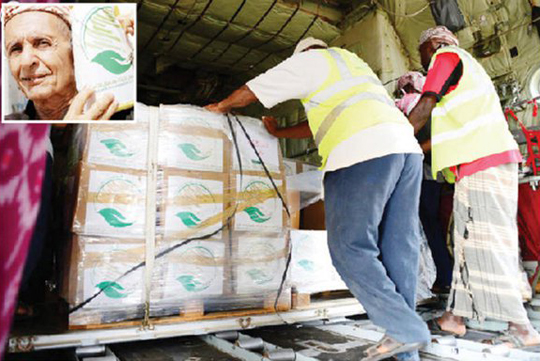
Riyadh, Oct 23: The King Salman Center for Relief and Humanitarian Aid (KSRelief) on Friday distributed 30,000 food baskets to needy families in all governorates of Hodeidah in Yemen.
Kingdom

An estimated 180,000 people are expected to benefit from this relief, bringing the total number of beneficiaries from such aid programs until October to 400,000 as a result of joint efforts from local and international partners.

The head of KSRelief and adviser at the royal court, Abdulllah Al-Rabeeah, said in a statement that the center is implementing many projects in coordination with the United Nations and the World Food Program for food emergency aid in 16 Yemeni governorates including in Al-Mahwiet, Omran, Albaidaa, Jouf, Aal Daleh, the capital’s municipality, Marib, Abb, Taiz, Hija, Rima, Ibn, Sanaa, Thamaar, and Lahj. The project is to distribute 134,000 food baskets by the end of October benefiting 938,000 people.

Al-Rabeeah added that the center is continuing with the distribution of food baskets and tents for those that are displaced in Jouf, Mareb and Hadrmout. Items for distribution include 21,700 food baskets, 1,064 tents and 17,710 blankets. The beneficiaries to date total 130,200.

KSRelief gives direct and indirect aid to those suffering from the present crises. Aid is either for relief and/or humanitarian purposes, and in such areas as education.

The teachers training program enables Yemenis to operate educational programs include e-teaching and long-distance teaching as 500 teachers are being trained on these educational technologies being implemented for the first time to meet teacher shortages.

Education and lessons are being recorded and will be aired on television. Most educational curricula have been made digital at all school levels with e-platforms to be aired to students with additional psychological support messages by Yemeni experts.

Al-Rabeeah also said the center is coordinating this program with the Yemeni orphan’s establishment as a local partner, and for indirect support, it is cooperating with 2,000 programs with the UNFPA in protecting women and children.

In addition, the center is working with different UN organizations to help farmers in growing crops and using fertilizer, agricultural implements, pesticides, vaccines and medicines in farming and animal husbandry.

He said it is supporting civil society organizations through the UNDP through training those unemployed, supporting small projects, and supervising psychological support through civil society organizations, where 313,000 have so far benefited.

Also hostels, rehabilitation and training centers have been set up in different Yemeni governorates with help in paying rents, helping those in need for livelihood and small projects at $31 million.

He added that the medical, environmental and water projects currently carried out in Yemen are continuing. So far, these involved treating 3,601 patients for injuries, which means that there are 150 injured people treated and cared for each month.

Al-Rabeeah said the projects of treating Yemenis in Sudan and Jordan are also continuing, with relatives accompanying patients. He added these are in addition to those injured who are treated inside Yemen in private hospitals, which stand at 1,800, and that coordination is continuing with their partners.

He stressed the fact that the medical, environmental and water projects are continuing according to need, and with local and international partners in line with world standards.

He added that the center still wants to operate the Saudi Hospital in Jija that will serve 270,000 patients, and to operate the Al-Salam Hospital in Saada to serve more than 356,332 patients with helping the Al-Jamhouri Hospital, Al-Thawara Hospital, Kuwaiti Hospital and the University Hospital, all in Sanaa. This is in addition to helping the central clinic in Sanaa, the Military Hospital and providing power and oxygen.

Al-Rabeeah said KSRelief is implementing food and medical aid program interventions for boys and girls below the age of five, pregnant women and those breastfeeding through UNICEF with the number of beneficiaries till now standing at 270,0000, in all of Yemen. The project for emergency aid (public, health, pharmaceuticals, medical apparatuses and oxygen) is being conducted with WHO with 750,0000 beneficiaries so far.

He said the Marib Public Hospital is being supported with beneficiaries standing at 74,480, as is the Al-Jamhouri Hospital in Aden, that serves 57,666. Two projects are being implemented for these hospitals to provide the necessary medical cadres and this will begin implementation on Nov. 5, in coordination with the stated partners in Aden, Hadramout, Marib, Saada and Taiz.

A project to establish a prosthetic center in Marib to serve all Yemenis is also being implemented.

As to supporting environmental sanitation, Al-Rabeeah said the center is implementing a project to support water services, and sterilization and sanitation from Medical Corps International to serve around 7,869,356 beneficiaries in Sanaa, Aden, Taiz, Lahj and Marib. He said the project to provide wheelchairs to 371 health facilities has been completed. This was in coordination with the Yemeni Ministry of Health, with the support of 97 public and private health facilities, clinics, and labs through WHO, but financed by the center.

The head of the center said this comes about through the orders of Custodian of the Two Holy Mosques King Salman to help the Yemeni people.

Comments

Add new comment

  • Coastaldigest.com reserves the right to delete or block any comments.
  • Coastaldigset.com is not responsible for its readers’ comments.
  • Comments that are abusive, incendiary or irrelevant are strictly prohibited.
  • Please use a genuine email ID and provide your name to avoid reject.
News Network
March 6,2020

Riyadh, Mar 6: Saudi Arabia on Thursday emptied Islam's holiest site for sterilisation over fears of the new coronavirus, an unprecedented shutdown state media said will last while the year-round Umrah pilgrimage is suspended.

The kingdom halted the pilgrimage for its own citizens and residents on Wednesday, on top of restrictions announced last week on foreign pilgrims to stop the disease from spreading.

State television relayed images of an empty white-tiled area surrounding the Kaaba -- a large black cube structure inside Mecca's Grand Mosque -- which is usually packed with tens of thousands of pilgrims.

As a "precautionary measure", the area will remain closed as long as the umrah suspension lasts but prayers will be allowed inside the mosque, state-run Saudi Press Agency cited a mosque official as saying.

Additionally, the Grand Mosque and the Prophet's Mosque in the city of Medina will be closed an hour after the evening "Isha" prayer and will reopen an hour before the dawn "Fajr" prayer to allow cleaning and sterilisation, the official added.

A group of cleaners was seen scrubbing and mopping the tiles around the Kaaba, a structure draped in gold-embroidered gold cloth towards which Muslims around the world pray.

A Saudi official told news agency the decision to close the area was "unprecedented".

On Wednesday, Saudi Arabia suspended the umrah for its own citizens and residents over fears of the coronavirus spreading to Islam's holiest cities.

The move came after authorities last week suspended visas for the umrah and barred citizens from the six-nation Gulf Cooperation Council from entering Mecca and Medina.

Saudi Arabia on Thursday declared three new coronavirus cases, bringing the total number of reported infections to five.

The umrah, which refers to the Islamic pilgrimage to Mecca that can be undertaken at any time of year, attracts millions of Muslims from across the globe annually.

The decision to suspend the umrah mirrors a precautionary approach across the Gulf to cancel mass gatherings from concerts to sporting events.

It comes ahead of the holy fasting month of Ramadan starting in late April, which is a favoured period for pilgrimage.

It is unclear how the coronavirus will affect the hajj, due to start in late July.

Some 2.5 million faithful travelled to Saudi Arabia from across the world in 2019 to take part in the hajj, which is one of the five pillars of Islam as Muslim obligations are known.

The event is a massive logistical challenge for Saudi authorities, with colossal crowds cramming into relatively small holy sites, making attendees vulnerable to contagion.

Already reeling from slumping oil prices, the kingdom risks losing billions of dollars annually from religious tourism as it tightens access to the sites.

Comments

Add new comment

  • Coastaldigest.com reserves the right to delete or block any comments.
  • Coastaldigset.com is not responsible for its readers’ comments.
  • Comments that are abusive, incendiary or irrelevant are strictly prohibited.
  • Please use a genuine email ID and provide your name to avoid reject.
News Network
May 21,2020

Dubai, May 21: Around 10,000 Iranian health workers have been infected with the new coronavirus, the semi-official ILNA news agency quoted a deputy health minister as saying on Thursday.

Health services are stretched thin in Iran, the Middle East country hardest hit by the respiratory pandemic, with 7,249 deaths and a total of 129,341 infections. The Health Ministry said in April that over 100 health workers had died of COVID-19.

No more details on infections among health workers were immediately available.

Earlier on Thursday, Health Minister Saeed Namaki appealed to Iranians to avoid travelling during the Eid al-Fitr religious holiday later this month to avoid the risk of a new surge of coronavirus infections, state TV reported.

Iranians often travel to different cities around the country to mark the end of the Muslim holy fasting month of Ramadan, something Namaki said could lead to a disregard of social distancing rules and a fresh outbreak of COVID-19.

"I am urging you not to travel during the Eid. Definitely, such trips mean new cases of infection...People should not travel to and from those high-risk red areas," Namaki was quoted by state television as saying.

"Some 90% of the population in many areas has not yet contracted the disease. In the case of a new outbreak, it will be very difficult for me and my colleagues to control it."

A report by parliament's research centre suggested that the actual tally of infections and deaths in Iran might be almost twice that announced by the health ministry.

However, worried that measures to limit public activities could wreck an economy which has already been battered by U.S. sanctions, the government has been easing most restrictions on normal life in late April.

Infected cases have been on a rising trajectory for the past two weeks. However, President Hassan Rouhani said on Wednesday that Iran was close to curbing the outbreak.

Comments

Add new comment

  • Coastaldigest.com reserves the right to delete or block any comments.
  • Coastaldigset.com is not responsible for its readers’ comments.
  • Comments that are abusive, incendiary or irrelevant are strictly prohibited.
  • Please use a genuine email ID and provide your name to avoid reject.
KT
May 18,2020

May 18: As the UAE authorities have asked all residents to avoid gatherings, it is clear that - for the first time - it's going to be a #StayHome Eid. But experts say that although it will be different, the celebration will be just as meaningful.

It is important to remember that the Eid prayer can be performed at home either individually or with family members under the sane roof, said Dr Mohammed Eyada Ayoub Alkobaisi, a Grand Mufti with the Islamic Affairs and Charitable Activities Department in Dubai.

Dr Alkobaisi said this prayer is a highly recommended Sunnah or practice urged by the Prophet Muhammad (Peace be upon him).

"Eid Prayer must be performed openly, unless we are prevented for an acceptable reason, such as fear for self, wellbeing, property, etc." Under the current circumstances, prayers can be offered from home, he said.

But what the faithful will likely miss is listening to the khutbah or the sermon of Eid with a crowd. The sight of people pouring out into the streets and coming together for prayer and worship would not be unfolding this time.

Dr Sheikh Mohamed Ashmawy, an Islamic researcher, said that in this time of Covid, doing away with several Eid traditions would be necessary for everyone's safety.

"The ban is is line with the ongoing preventive measures to curb the spread of Covid-19," he said.

However, it doesn't mean people can't celebrate and exchange heartfelt greetings, he added.

"We can greet each other remotely on the phone or via social media networks."

Islamic researcher Sheikh Mohamed Wasfi said audio-visual smart apps have made communication much easier, even bringing people closer than before.

"Of course, families and friends wish to hug, shake hands and see each other personally, but this will be a big risk these days," he said.

Sheikh Asadullah Del Mohamed, an imam, reminded that banquets, parties and visits are discouraged to avoid crowds and gathering.

Recently, 30 people from two families tested positive for the virus after breaking social distancing rules and holding a gathering.

Faithful's sentiments

Ibrahim Abdelkader, an Egyptian auditor, said that while it would be sad to spend Eid Al Fitr at home, he understood that it is for everyone's safety.

"Better to stay home than be sorry," said Ahmad Jamil, a Syrian resident.

Rashid Saeed, an Emirati national, said people are advised to just check on each other by phone or video and voice call apps.

"While Eid prayers is banned in congregation, it's not acceptable at all for some people to carelessly gather and exchange visits," he said.

Abdullah Al Saleh, an Emirati national, said he and all his relatives used to gather for breakfast after the Eid prayer - but this time, they are ready to do it in their own homes.

Mohamed Ibrahim, another Emirati, said he would surely miss seeing his kids happily prancing around with their new clothes and enjoying the outdoors like every year.

"But, I agree as it is for their health, safety and wellbeing," he said.

THINGS TO REMEMBER IN CELEBRATING EID THIS YEAR

>Perform the Eid prayer at home, individually or with family members living with you

>Exchange greetings with loved ones and friends via phone calls or online

>No hugs

>No handshakes

>No gatherings

>No visits to other homes

Comments

Add new comment

  • Coastaldigest.com reserves the right to delete or block any comments.
  • Coastaldigset.com is not responsible for its readers’ comments.
  • Comments that are abusive, incendiary or irrelevant are strictly prohibited.
  • Please use a genuine email ID and provide your name to avoid reject.