Saudi foreign minister warns of mass atrocities if Shiite militias enter Mosul

October 18, 2016

Baghdad, Oct 18: Iraqi forces advanced Monday after launching an offensive aimed at retaking Mosul and dealing a death blow to the Daesh group’s “caliphate” in the city where it was declared two years ago.

mosul

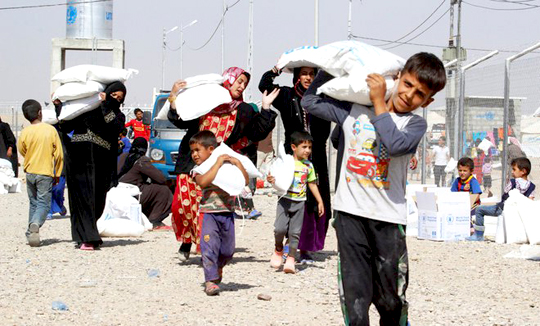
The start of the long-awaited assault raised deep concerns for hundreds of thousands of civilians trapped in Iraq’s second-largest city, with aid groups warning of a massive humanitarian crisis.

Some 30,000 federal forces are leading the offensive, backed by air and ground support from a 60-nation US-led coalition, in what is expected to be a long and difficult assault on Daesh’s last major Iraqi stronghold.

Iraqi forces could be seen readying weapons and ammunitions as columns of armored vehicles headed toward Mosul from the town of Al-Shoura, some 45 km south of the city.

The Pentagon described the operation as a “decisive moment” in the fight against Daesh but the US-led coalition’s top commander warned it could last weeks or more. It said early indications were that Iraqi forces were meeting objectives and were ahead of schedule.

Iraqi Prime Minister Haider Al-Abadi announced the beginning of the assault in a televised address in the early hours of Monday. “Today I declare the start of these victorious operations to free you from the violence and terrorism of Daesh,” Abadi said.

Meanwhile, Saudi Arabia said that Riyadh had urged the Iraqi government not to let Shiite militias enter Mosul, fearing “mass atrocities.”

Foreign Minister Adel Al-Jubeir warned against a repeat of the events in Fallujah, which Daesh was chased out of in June. “We oppose any kind of involvement by the Shiite militias,” Al-Jubeir told a press conference in London.

Comments

Naren kotian
 - 
Tuesday, 18 Oct 2016

Butcher wahabis ...we are with u shites ....later Kurdistan will become independent and becomes ally for our Israel ....Islamic state must be kicked out from everywhere ....Saudis must feel heat ....

Add new comment

  • Coastaldigest.com reserves the right to delete or block any comments.
  • Coastaldigset.com is not responsible for its readers’ comments.
  • Comments that are abusive, incendiary or irrelevant are strictly prohibited.
  • Please use a genuine email ID and provide your name to avoid reject.
News Network
January 16,2020

Dubai, Jan 16: The UAE Ministry of Climate Change and Environment on Wednesday announced that it has banned the import of birds, some eggs and meat products from Hungary and Slovakia.

The ministry said the decision was taken following a notification from the World Organization for Animal Health (OIE) on the outbreak of a highly pathogenic strain of bird flu, H5N2, in the two countries.

Accordingly, the ministry has banned "the import of all species of domestic and wild live birds, ornamental birds, chicks, hatching eggs, meats and meat products and non-heat-treated wastes from Hungary and Slovakia".

It has also regulated the import of poultry meat and non-heat-treated products, requiring a health certificate for the export of meat and meat products from the two countries to release consignments into the UAE.

A health certificate will be needed for the import of eggs, the ministry added.

However, thermally-treated poultry products (meat and eggs) have been cleared for import from all parts of Hungary and Slovakia.

Kaltham Ali Kayaf, Acting Director, Animal Development & Health Department at the ministry, said: "These measures reiterate the ministry's keenness in achieving its strategic objectives including enhancing bio-security levels and eliminating pathogens before they enter the country. In doing so, the ministry prevents the bird flu virus and related risks and impacts on the country's poultry health and safety, in addition to protecting public health and well-being."

Comments

Add new comment

  • Coastaldigest.com reserves the right to delete or block any comments.
  • Coastaldigset.com is not responsible for its readers’ comments.
  • Comments that are abusive, incendiary or irrelevant are strictly prohibited.
  • Please use a genuine email ID and provide your name to avoid reject.
News Network
April 24,2020

Dubai, Apr 24: The UAE reported 525 new COVID-19 cases on Friday. The Ministry of Health and Prevention said the total number of confirmed cases in the UAE is now 9,281.

MOHAP reported 8 deaths taking the total number of deaths in the country to 64. 123 recoveries have also been announced.

According to the Ministry of Health and Prevention, the latest cases were detected through its intensified investigation and examination procedures.

The ministry conducted over 32,000 additional COVID-19 tests among citizens and residents.

The ministry offered its sincere condolences to the families of the deceased. It also wished a speedy recovery to all patients and called upon the general public to strictly adhere to preventative measures out of concern for the health and safety of all.

Comments

Add new comment

  • Coastaldigest.com reserves the right to delete or block any comments.
  • Coastaldigset.com is not responsible for its readers’ comments.
  • Comments that are abusive, incendiary or irrelevant are strictly prohibited.
  • Please use a genuine email ID and provide your name to avoid reject.
Agencies
August 2,2020

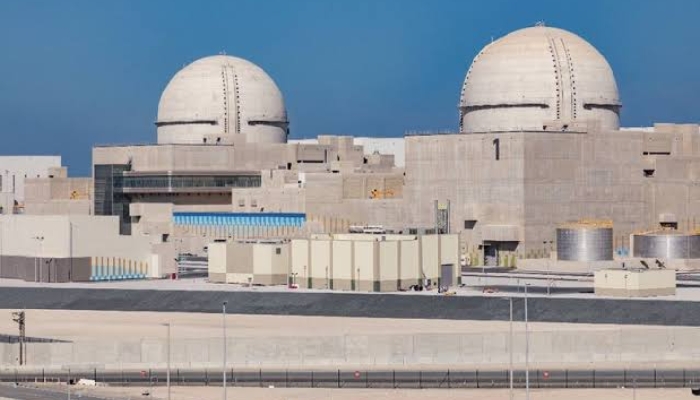
Dubai, Aug 2: The United Arab Emirates (UAE) announced on Saturday that it has started operations in the first of four reactors at the Barakah nuclear power station - the first nuclear power plant in the Arab world.

Emirates Nuclear Energy Corporation (ENEC), which is building and operating the plant with Korea Electric Power Corporation (KEPCO) said in a press release that its subsidiary Nawah Energy Company "has successfully started up Unit 1 of the Barakah Nuclear Energy Plant, located in the Al Dhafrah Region of Abu Dhabi".

That signals that Unit 1, which had fuel rods loaded in March, has achieved "criticality" - a sustained fission chain reaction.

"The start-up of Unit 1 marks the first time that the reactor safely produces heat, which is used to create steam, turning a turbine to generate electricity," said ENEC.

Barakah, which was originally scheduled to open in 2017, has been dogged by delays and is billions of dollars over budget. It has also raised myriad concerns among nuclear energy veterans who are concerned about the potential risks Barakah could visit upon the Arabian Peninsula, from an environmental catastrophe to a nuclear arms race.

Paul Dorfman, an honorary senior research fellow at the Energy Institute, University College London and founder and chair of the Nuclear Consulting Group, has criticised the Barakah reactors' "cheap and cheerful" design that he says cuts corners on safety.

Dorfman authored a report (PDF) last year detailing key safety features Barakah's reactors lack, such as a "core catcher" to literally stop the core of a reactor from breaching the containment building in the event of a meltdown. The reactors are also missing so-called Generation III Defence-In-Depth reinforcements to the containment building to shield against a radiological release resulting from a missile or fighter jet attack.

Both of these engineering features are standard on new reactors built in Europe, says Dorfman.

There have been at least 13 aerial attacks on nuclear facilities in the Middle East - more than any other region on earth.

The vulnerability of critical infrastructure in the Arabian Peninsula was further laid bare last year after Saudi Arabia's oil facilities at Abqaiq and Khurais were attacked by 18 drones and seven cruise missiles - an assault that temporarily knocked out more than half of the kingdom's oil production.

On Saturday, Dorfman reiterated his concern that there is no regional protocol in place to determine liability should an accident or incident at Barakah result in radioactive contamination spreading from the UAE to its neighbours. 

"Given Barakah has started up, because of all the well-rehearsed nuclear safety and security problems, it may be critically important that the Gulf states collectively evolve a Nuclear Accident Liability Convention, so that if anything does go wrong, victim states may have some sort of redress," Dorfman told Al Jazeera. 

The UAE has substantial oil and gas reserves, but it has made huge investments in developing alternative energy sources, including nuclear and solar.

Experts though have questioned why the UAE - which is bathed in sunlight and wind - has pushed ahead with nuclear energy - a far more expensive and riskier option than renewable energy sources.

When the UAE first announced Barakah in 2009, nuclear power was cheaper than solar and wind. But by 2012 - when the Emirates started breaking ground to build the reactors - solar and wind costs had plummeted dramatically.

Between 2009 and 2019, utility-scale average solar photovoltaic costs fell 89 percent and wind fell 43 percent, while nuclear jumped 26 percent, according to an analysis by the financial advisory and asset manager Lazard.

There are also concerns about the potential for Barakah to foment nuclear proliferation in the Middle East - a region rife with geopolitical fault lines and well-documented history of nuclear secrecy.

The UAE has sought to distance itself from the region's bad behaviour by agreeing not to enrich its own uranium or reprocess spent fuel. It has also signed up to the United Nation's nuclear watchdog's Additional Protocol, significantly enhancing inspection capabilities, and secured a 123 Agreement with the United States that allows bilateral civilian nuclear cooperation.


Comments

Add new comment

  • Coastaldigest.com reserves the right to delete or block any comments.
  • Coastaldigset.com is not responsible for its readers’ comments.
  • Comments that are abusive, incendiary or irrelevant are strictly prohibited.
  • Please use a genuine email ID and provide your name to avoid reject.