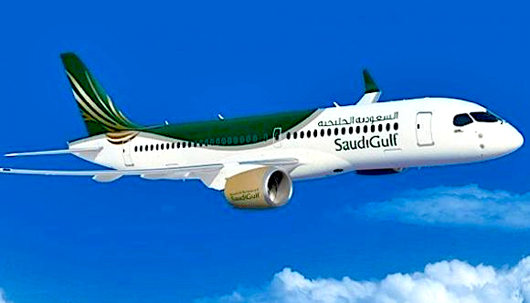
Saudi Gulf ready for Nov. 1 takeoff

May 26, 2015

Jeddah, May 26: Saudi Gulf Airlines said Monday that it would start operating flights on Nov. 1 from Dammam to Jeddah, Riyadh and one international destination, with more destinations added next year as its fleet expands.

Saudi Gulf

The statement follows a meeting between Sulaiman Al-Hamadan, president of the General Authority of Civil Aviation, and Tariq bin Abdel Hadi Al-Qahtani, chairman of the airline’s board of directors. “Saudi Gulf plans to fly from Dammam to three destinations, initially with a fleet of four Airbus A320s,” said Samer Majali, the group’s president and senior adviser.

“We are working with GACA in preparation for starting operations to obtain the technical license,” Majali said. The airline’s domestic flights will offer first class and economy fares, while international flights will provide business class and economy class services. In addition to the A320 aircraft, the airline signed a $2 billion deal with Canada’s Bombardier last year to purchase 16 CSeries jets with an option for a further 10.

Delivery of the CS300 jets, which can carry 130 to 160 passengers, is expected to begin late this year or early 2016. Majali said additional aircraft would join the fleet after the delivery of the A320s and CSeries jets.

“We are happy to welcome Saudi Gulf as a new operator in the Kingdom,” said Al-Hamdan, adding that it would strengthen competition between airline companies to provide better services to passengers.

“We believe that the increase in the number of airlines will improve air transport services between Saudi cities and regions and boost the Kingdom’s social and economic development,” the GACA chief said.

During the meeting, Saudi Gulf presented its operation plans. “They have a primary license and the final license will be given when they complete final preparations for operations,” said GACA spokesman Wael Al-Sarhan.

Only national carrier Saudi Arabian Airlines and budget operator National Air Services currently serve a domestic market of about 27 million people. Foreign carriers can only fly in and out of Saudi Arabia, not within the country, but that will change when Qatar Airways obtains regulatory approval to launch its subsidiary Al Maha Airways for the Saudi market.

Comments

Add new comment

  • Coastaldigest.com reserves the right to delete or block any comments.
  • Coastaldigset.com is not responsible for its readers’ comments.
  • Comments that are abusive, incendiary or irrelevant are strictly prohibited.
  • Please use a genuine email ID and provide your name to avoid reject.
News Network
April 5,2020

Beirut, Apr 5: The novel coronavirus has put global trade on hold, placed half of the world population in confinement and has the potential to topple governments and reshape diplomatic relations.

The United Nations has appealed for ceasefires in all the major conflicts rocking the planet, with its chief Antonio Guterres on Friday warning "the worst is yet to come". But it remains unclear what the pandemic's impact will be on the multiple wars roiling the Middle East.

Here is an overview of the impact so far on the conflicts in Syria, Yemen, Libya and Iraq:

The COVID-19 outbreak turned into a pandemic just as a ceasefire reached by the two main foreign power brokers in Syria's nine-year-old war -- Russia and Turkey -- was taking effect.

The three million people living in the ceasefire zone, in the country's northwestern region of Idlib, had little hope the deal would hold.

Yet fears the coronavirus could spread like wildfire across the devastated country appear to have given the truce an extended lease of life.

According to the Syrian Observatory for Human Rights, the month of March saw the lowest civilian death toll since the conflict started in 2011, with 103 deaths.

The ability of the multiple administrations in Syria -- the Damascus government, the autonomous Kurdish administration in the northeast and the jihadist-led alliance that runs Idlib -- to manage the coronavirus threat is key to their credibility.

"This epidemic is a way for Damascus to show that the Syrian state is efficient and all territories should be returned under its governance," analyst Fabrice Balanche said.

However the pandemic and the global mobilisation it requires could precipitate the departure of US-led troops from Syria and neighbouring Iraq.

This in turn could create a vacuum in which the Islamic State jihadist group, still reeling from the demise of its "caliphate" a year ago, could seek to step up its attacks.

The Yemeni government and the Huthi rebels initially responded positively to the UN appeal for a ceasefire, as did neighbouring Saudi Arabia, which leads a military coalition in support of the government.

That rare glimmer of hope in the five-year-old conflict was short-lived however and last week Saudi air defences intercepted ballistic missiles over Riyadh and a border city fired by the Iran-backed rebels.

The Saudi-led coalition retaliated by striking Huthi targets in the rebel-held capital Sanaa on Monday.

Talks have repeatedly faltered but the UN envoy Martin Griffiths is holding daily consultations in a bid to clinch a nationwide ceasefire.

More flare-ups in Yemen could compound a humanitarian crisis often described as the worst in the world and invite a coronavirus outbreak of catastrophic proportions.

In a country where the health infrastructure has collapsed, where water is a rare commodity and where 24 million people require humanitarian assistance, the population fears being wiped out if a ceasefire doesn't allow for adequate aid.

"People will end up dying on the streets, bodies will be rotting in the open," said Mohammed Omar, a taxi driver in the Red Sea port city of Hodeida.

Much like Yemen, the main protagonists in the Libyan conflict initially welcomed the UN ceasefire call but swiftly resumed hostilities.

Fierce fighting has rocked the south of the capital Tripoli in recent days, suggesting the risk of a major coronavirus outbreak is not enough to make guns fall silent.

Turkey has recently played a key role in the conflict, throwing its weight behind the UN-recognised Government of National Accord.

Fabrice Balanche predicted that accelerated Western disengagement from Middle East conflicts could limit Turkish support to the GNA.

That could eventually favour forces loyal to eastern-based strongman Khalifa Haftar, who launched an assault on Tripoli one year ago and has the backing of Russia, Egypt and the United Arab Emirates.

Western countries have been hit hardest by the pandemic, which could prompt them to divert both military resources and peace-brokering capacity from foreign conflicts.

A report by the International Crisis Group said European officials had reported that efforts to secure a ceasefire in Libya were no longer receiving high-level attention due to the pandemic.

Iraq is no longer gripped by fully-fledged conflict but it remains vulnerable to an IS resurgence in some regions and its two main foreign backers are at each other's throats.

Iran and the United States are two of the countries most affected by the coronavirus but there has been no sign of any let-up in their battle for influence that has largely played out on Iraqi soil.

With most non-US troops in the coalition now gone and some bases evacuated, American personnel are now regrouped in a handful of locations in Iraq.

Washington has deployed Patriot air defence missiles, prompting fears of a fresh escalation with Tehran, whose proxies it blames for a spate of rocket attacks on bases housing US troops.


Comments

Add new comment

  • Coastaldigest.com reserves the right to delete or block any comments.
  • Coastaldigset.com is not responsible for its readers’ comments.
  • Comments that are abusive, incendiary or irrelevant are strictly prohibited.
  • Please use a genuine email ID and provide your name to avoid reject.
January 15,2020

Asia, Jan 15: Iranian Foreign Minister Javad Zarif on Wednesday said that killing of Iranian general Qassem Soleimani showed the ignorance and arrogance of the United States and asserted that Washington looks at things from their perspective and not keeping the interests of the region in mind."The US looks at things from their perspective, not from the perspective of this region. The killing of Qassem Soleimani shows ignorance and arrogance. 430 Indian cities saw protests against killing of Soleimani," Zarif said at an event.

Hitting out at US President Donald Trump and Secretary of State Michael Pompeo, Zarif said that they were the only ones, along with the Islamic State (ISIS) who celebrated the death of Soleimani.

"Who is celebrating Soleimani's killing? President Trump, Pompeo and Daesh (Arabic name of ISIS). You wonder about strange bedfellows?" he said.

Tensions between the US and Iran soared dramatically earlier this month after Washington launched airstrikes at Baghdad International Airport, which killed Soleimani. Tehran retaliated by firing a volley of ballistic missiles at two military bases of US-led coalition forces in Iraq, leading to a strife in the region.

However, Zarif regretted the shooting down of the Ukrainian airline and said it happened because of "tension".

"Nine million people were out in the streets of Iran commemorating Soleimani. You cannot bring out so many people to protest. The shooting down of a plane was a mistake. 180 families are mourning the loss of their dear ones. It happened because of tension," he said.

Asked whether there a chance of a diplomatic solution to the ongoing crisis, Zarif ruled out negotiating with the US.

"Iran is interested in diplomacy. We are not interested in negotiating with the US. US did not keep its commitments under nuclear deal. We had a US deal and the US broke it. If we have a Trump deal, how long will it last?" he said.

Comments

Add new comment

  • Coastaldigest.com reserves the right to delete or block any comments.
  • Coastaldigset.com is not responsible for its readers’ comments.
  • Comments that are abusive, incendiary or irrelevant are strictly prohibited.
  • Please use a genuine email ID and provide your name to avoid reject.
Agencies
May 14,2020

Dubai, May 14: As many as 242 beggars of different nationalities have been nabbed by the Dubai Police since the beginning of the holy month of Ramadan.

Among those arrested, 143 were men, 21 were women and 78 were hawkers, said the police. "An anti-begging campaign was launched, especially to find beggar hotspots, to combat the negative phenomenon," said Colonel Ali Salem Al Shamsi, director of the anti-infiltrators department at the Dubai Police.

"Strict warnings have been issued to beggars to refrain from exploiting the sentiments of people during Ramadan," he added.

Col Al Shamsi also called on the public to stop helping them with money. "The public must direct those in dire straits through proper channels in order to get support from charitable institutions."

Col Al Shamsi also urged residents to report begging activities by calling 901 or through the Dubai Police app's 'Police Eye' feature.

Comments

Add new comment

  • Coastaldigest.com reserves the right to delete or block any comments.
  • Coastaldigset.com is not responsible for its readers’ comments.
  • Comments that are abusive, incendiary or irrelevant are strictly prohibited.
  • Please use a genuine email ID and provide your name to avoid reject.